

From Trade Bans to Targeted Imports: China Reopens to Recycled Plastics
For processors who lived through China’s National Sword shock, 2026 marks a striking turn: Beijing is preparing to reopen the world’s biggest recovered-materials market, but on circular economy terms.
China’s Circular Economy Development 15th Five-Year Plan, published in July 2026, commits to importing high-quality recycled plastics feedstock to supplement domestic supply, while reshaping the entry mechanism, simplifying procedures and widening eligible categories. The accompanying action plan sets a benchmark of more than 19.5 million tonnes of recycled plastics per year by 2030, aiming to build an "internationally advanced" recycling sector by 2035.
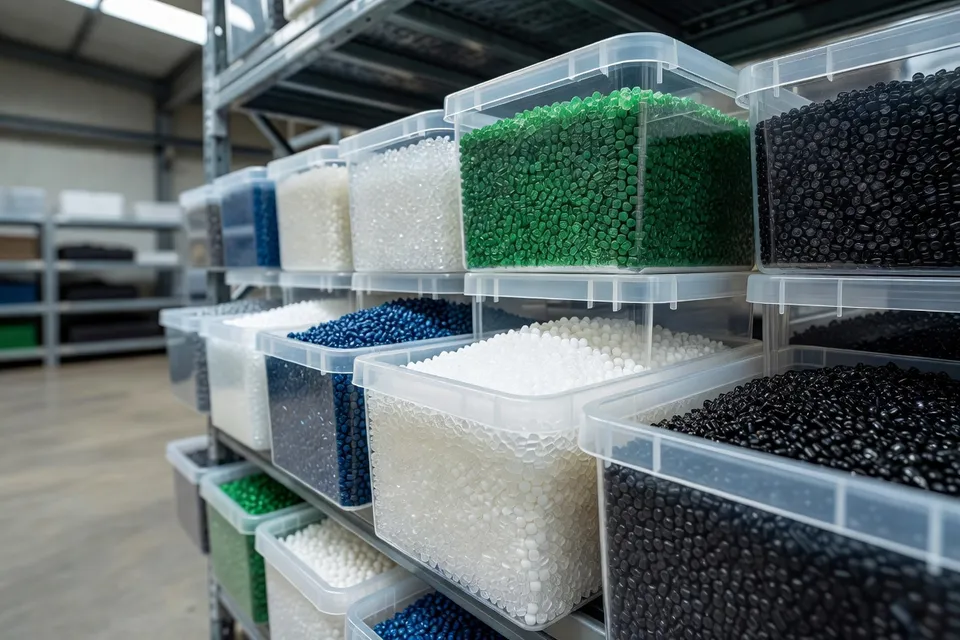
This happens as the European Union moves the opposite way: from November 21, 2026, the EU will prohibit exports of potentially recyclable plastic to non-OECD countries, a change expected to keep 500,000–800,000 tonnes of material inside the bloc annually. For European reclaimers, that means less offshore relief and more pressure to absorb domestic waste. For Asian recyclers, especially in China, it means access to cleaner, sorted streams—if they can meet the new standards.
Domestically, China has spent the last year redrawing the line between "waste" and feedstock. In August 2025, regulators issued nine national standards for recycled plastics, and in August 2026 an Ecological Environment Code took effect that, for the first time, allows mandatory use of recycled content in key product categories. The same code hardens restrictions on disposable plastic products, tightening bags and other items that were once the volume drivers of low-value exports.
For exporters, the signal is practical: low-grade, contaminated bales are out; certified, traceable recycled pellets and flakes are in. For brand owners with operations in China, recycled-content mandates are moving from CSR slide decks into compliance checklists.
Europe’s Circular Plastics Slowdown: Capacity vs. Reality
While China tunes its imports, Europe is discovering how hard it is to grow circular plastics at scale. Plastics Europe’s 2026 report, “The Circular Economy for Plastics – A European Analysis 2026,” shows that by 2024, circular production (mechanical and chemical recycling plus bio-based plastics) reached 8.7 million tonnes, or 15.8% of total European plastics output. That looks like progress—until you read the growth rates.
Annual growth in circular production collapsed from 13.6% in 2022 to just 1.2% in 2024. Circular plastics demand growth fell from 16.2% in 2022 to 4% in 2024. New products passed the symbolic threshold of more than 15% circular content, but more than 70% of collected plastic waste still heads to incineration or landfill, even as 9.7 million tonnes—about 29.6%—are recycled.
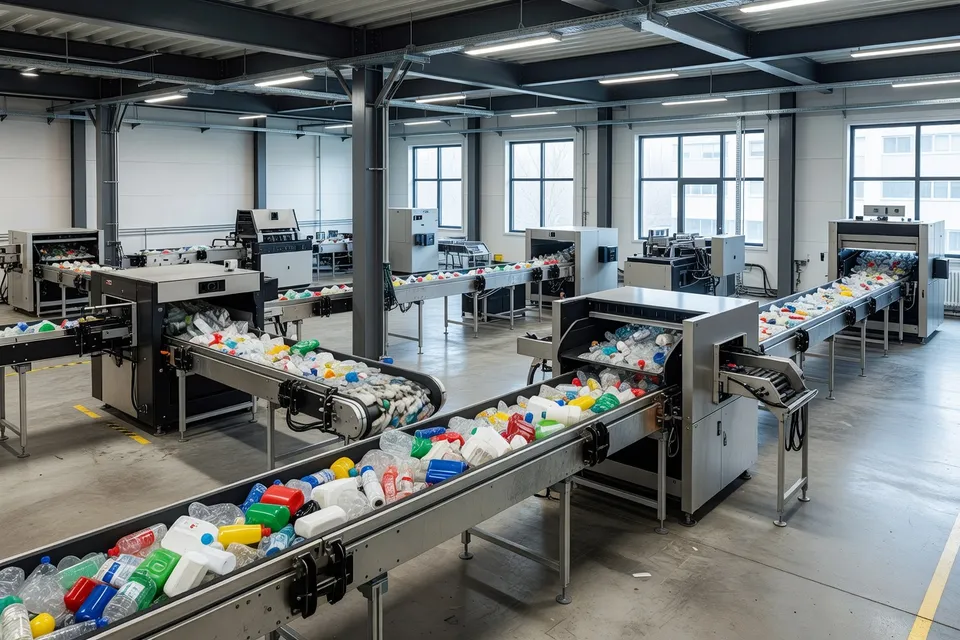
Trade data in the same report exposes how dependent Europe’s circular economy is on cross-border flows. In 2024:
- 19% of converter demand for circular plastics was covered by imports.
- 12.4% of collected plastic waste was recycled outside Europe.
- Exports of sorted plastic waste rose 36.5% since 2022.
For plant managers, that translates into uneven utilization. Some domestic recyclers complain of underused capacity while high-quality recyclate still arrives from overseas. At the same time, sorted European waste leaves for processors in other regions, often at lower cost.
Policy responses are beginning to catch up. The European Commission’s December 2025 package to boost circularity includes EU-wide end-of-waste criteria for plastics, new customs codes separating virgin and recycled plastics, and tighter safeguards to ensure imported recyclate meets European emission and collection standards. Combined with upcoming rules under the Packaging and Packaging Waste Regulation, these measures are meant to stabilize demand, but they also raise the bar for traceability and documentation.
Chemical Recycling: Between Proven Plants and Uneven Business Cases
Against this policy backdrop, chemical recycling is being sold as the missing link between hard-to-recycle streams and recycled-content mandates. On the ground, the picture is mixed.
Swiss-based enespa reports that its modular plastic-to-oil plants have moved beyond prototypes: by 2025, the company had completed the transition from prototype to serial production of NeoOil P5 pyrolysis units at its Tangstedt site, and had first plants operating in Brazil and Australia, with projects advancing in Lahti (Finland) and Tangier (Morocco). Their process can handle mixed and contaminated waste, with internal documentation claiming there are effectively no limits to how often plastics can be chemically recycled through their route.
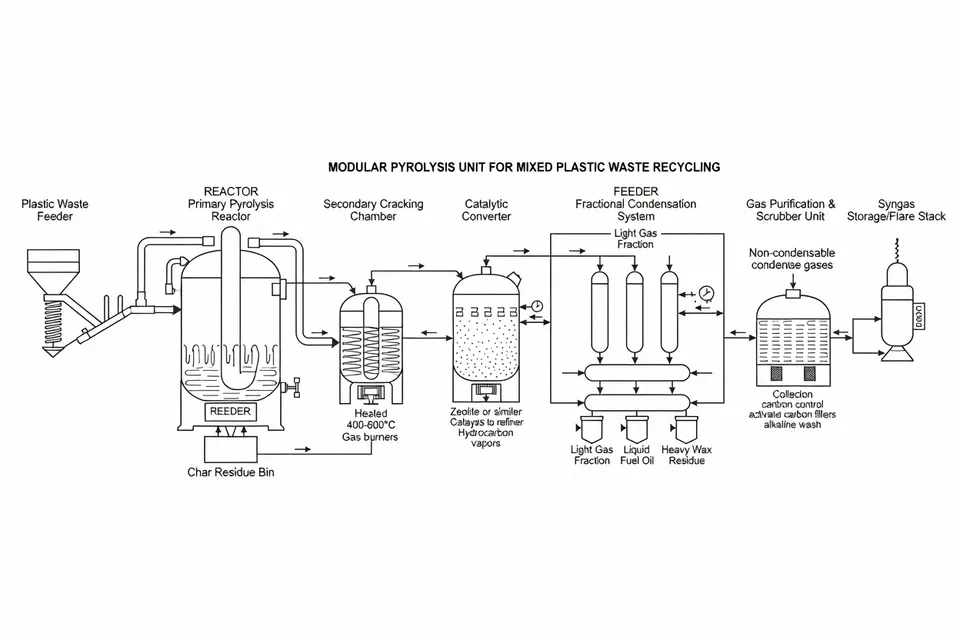
Yet enespa’s own commentary shows why many advanced recycling projects stall. Chemical recycling plants face high CAPEX, volatile energy and operating costs, and uncertain offtake for pyrolysis oil. Regulatory expectations—especially recycled-content credits and recognition under European waste law—are evolving faster than offtake contracts, leaving a gap between policy promises and bankable cash flows.
In response, enespa has reshaped its model as “Recycling as a Service”: instead of selling equipment alone, it now offers complete plant solutions, support through permitting and start-up, training for operations teams, in-house lab support, and co-development of operating models and feedstock sourcing. For processors, that looks less like a one-time capex purchase and more like a long-term service and supply partnership.
Regulators, particularly in the United States, are still deciding how to classify these operations. A January 2026 regulatory outlook notes that if a state concludes advanced recycling turns discarded plastics into feedstock without creating major disposal concerns, it may treat such facilities as manufacturing rather than waste management. That classification directly affects permitting pathways, air rules, and sometimes tax treatment. California has taken the opposite approach, keeping pyrolysis under solid waste law and declining to recognize it as recycling, while states like Oklahoma have broadened “advanced recycling” to include tire pyrolysis.
For any company looking to install chemical recycling, the operational lesson is clear: build a project on conservative energy and offtake assumptions, secure long-term purchase agreements, and check how your host jurisdiction defines “advanced recycling” before you design the stack.
Tire and Polymer Chemistries: Lab-Scale Breakthroughs with Plant Potential
Not all circular economy advances are policy or plant-scale. Some are quietly resetting the chemistry.
In June 2025, a KAIST team reported a dual-catalyst continuous reaction system that selectively converts waste tires into high-purity cyclic alkenes, including cyclopentene for rubber and cyclohexene for nylon fibers. The process achieved selectivity up to 92% and 82% yield, turning one of the hardest rubber waste streams into direct monomer feedstock rather than fuel.
"This process shows high selectivity of up to 92% and a yield of 82%." - Professor Soonhyuk Hong, Department of Chemistry at KAIST said
On the plastics side, enzyme-based routes are moving from lab curiosity toward cost parity. A June 2025 analysis found that a redesigned enzyme recycling process for PET, which slashes acid/base additions by more than 99%, can cut running costs by 74% and energy use by 65%, delivering modeled enzyme-recycled PET at $1.51/kg versus $1.87/kg for U.S. domestic virgin PET. If those numbers hold at full scale, they give packaging converters a credible path to meet recycled-content mandates without sacrificing mechanical performance.
These chemistries will not replace mechanical recycling. Instead, they are likely to slot into specific streams—tires, PET trays and bottles, multilayer films—where conventional regrind either fails on purity or cannot compete on value. For operations teams, the implication is to start segmenting waste streams by chemistry and potential route, not just by resin code.
Design Rules: Cutting Problematic Formats Out of the System
While technology pushes up-value pathways, voluntary initiatives are quietly removing entire formats from play. The U.S. Plastics Pact’s 2022 Problematic and Unnecessary Materials list targets 11 packaging items that are "not currently reusable, recyclable, or compostable at scale" in the U.S. and are unlikely to be by 2025.
Items flagged for phaseout include:
- Cutlery, stirrers and straws (when not reusable, recyclable, or compostable)
- Intentionally added PFAS
- Non-detectable pigments such as carbon black
- Opaque or pigmented PET bottles (other than transparent blue or green)
- Oxo-degradable and oxo-biodegradable additives
- PETG in rigid packaging
- Polystyrene (including EPS)
- PVC, including PVDC
- Problematic label constructions that render packaging non-recyclable.
Participants in the pact are expected to eliminate these items from their portfolios, with initial phaseout goals set for end of 2025 and newer targets extended to 2030 as the list expands to multimaterial films, foamed PET and certain produce stickers. In 2026, Waste Dive reported that the U.S. Plastics Pact removed transport EPS from the problematic list after new recycling-rate data, marking the first time a polymer stream has been de-listed.
For converters and brand owners, these lists function as de facto design rules. Even without regulation, retailers and CPG customers increasingly ask whether packaging includes any of the flagged materials. That shifts demand toward mono-material films, detectable pigments, and label constructions aligned with APR design guidance.
What Processors Can Copy Now
Across these developments, three practical themes emerge for processors, recyclers and brand owners:
-
Treat trade and policy as part of plant design. China’s reopening to selected recycled plastics and the EU’s export restrictions change available feedstock and offtake options. Long-term contracts should now factor both policy timelines and border classifications.
-
Segment waste streams by route, not just resin. Mechanical recycling remains the workhorse, but enzyme processes for PET, advanced chemistries for tires, and chemical recycling for mixed streams are carving out niches. Mapping where each stream can capture the most value is an operations task, not just a sustainability one.
-
Design out what systems cannot handle. The U.S. Plastics Pact’s problematic materials list gives a concrete, operational definition of "non-circular" packaging in 2022–2026. Using that list as a checklist during packaging design reviews reduces future sorting headaches and regulatory risk.
Circularity in plastics and rubber is no longer a single technology bet. It is a set of connected decisions—trade, plant economics, design standards, and chemistry—that can either add up to a workable business case or stall at the permit office. The companies and plants moving fastest are the ones treating those decisions as one integrated project, not four separate conversations.
Editorial Insights
- How should plastics and rubber processors rethink feedstock strategy as trade rules and circular economy policies tighten across major regions?
- Processors need to shift from opportunistic sourcing toward structured, policy-aware feedstock strategies. That means mapping how import and export restrictions, recycled-content mandates, and end-of-waste criteria affect both incoming streams and downstream customers, and baking those assumptions into contracts and plant design. Operations that treat policy shifts as predictable boundary conditions rather than surprises will be better positioned to secure stable, high-quality inputs and reliable offtake.
- What does the slowdown in circular plastics growth imply for business planning over the next decade?
- The tapering growth in circular plastics signals that the low-hanging fruit has largely been picked and that future gains will be harder won. Companies should assume more modest demand growth, tighter competition for high-quality recyclate, and slower ramp-up of new capacity than policy headlines suggest. In practical terms, that argues for conservative volume forecasts, diversified recycling routes, and closer integration between product design and recovery infrastructure to unlock the next tranche of circularity.
- How can chemical and enzyme-based recycling be realistically integrated into existing mechanical recycling operations?
- Advanced chemistries work best as targeted modules, not replacements for mechanical recycling. Operators should segment streams by chemistry and value potential—sending clean, homogeneous fractions to mechanical lines while steering contaminated, multilayer, or rubber-rich streams to chemical or enzyme routes where they can yield higher-value outputs. Integration hinges on shared pre-sorting, compatible quality control, and long-term offtake contracts for oils or monomers so that new processes enhance overall plant economics instead of cannibalizing core capacities.
- Why are design rules and "problematic materials" lists becoming as important as formal regulation for packaging stakeholders?
- Voluntary design lists effectively define what the system can and cannot handle, long before legal bans arrive. Buyers increasingly treat these lists as procurement filters, which means materials labeled problematic lose market access even in the absence of statutory restrictions. For packaging teams, aligning specifications with these informal standards reduces future retrofit costs, eases recyclability claims, and lowers reputational and compliance risks as formal regulation gradually converges with best-practice design guidance.
- What regulatory uncertainties most directly affect investment decisions in advanced recycling projects?
- The core uncertainties are how jurisdictions classify advanced recycling—manufacturing versus waste management—and whether outputs qualify as recycled content under official accounting rules. Those decisions determine permitting timelines, emissions obligations, access to incentives, and the bankability of offtake agreements. Investors are increasingly demanding projects built on conservative energy and price assumptions, backed by clear regulatory definitions and long-term purchase contracts that survive policy reinterpretations.
- How does segmenting waste streams by chemistry and route change day-to-day plant operations in the plastics and rubber sector?
- Moving from resin-only sorting to chemistry-based segmentation pushes plants toward more granular data, tighter quality control, and closer collaboration with upstream suppliers. Operators must understand which streams justify mechanical, chemical, or enzyme treatment and adjust line configurations, storage, and logistics accordingly. This approach can raise complexity in the short term but ultimately improves yield, reduces contamination, and allows plants to match each tonne of material to its highest-value recovery pathway.
References
- 1.The Diplomat. (2026, August 21). After 9 years, China is reopening its borders to recycled plastic. The Diplomat.
- 2.Plastics Europe. (2026, May 18). Circular economy for plastics 2026. Plastics Europe.
- 3.Phys.org. (2025, June 26). New and highly efficient recycling technology to turn used tires into raw materials for rubber and nylon. Phys.org.
- 4.enespa. (2026, August 13). Chemical recycling: between technological breakthrough and economic reality. enespa.
- 5.K&L Gates. (2026, January 14). 2026 regulatory outlook: advanced recycling. K&L Gates.
- 6.Waste Dive. (2022, January 25). US Plastics Pact releases anticipated 'problematic' materials list. Waste Dive.