

From Lab Algorithms to Shop-Floor Throughput
Walk the aisles of any major plastics or tire manufacturing event in 2026 and one theme dominates the conversations around the machines: AI is no longer a slide deck promise, it is embedded in production logic. Injection molders, tire makers, and materials developers are all converging on the same goal – use data-driven autonomy to stabilize quality, shorten development cycles, and push more saleable product through the same assets.
What is striking this year is how quickly ideas that began in research – materials informatics, explainable AI models, generative design – are being packaged into tools that plant engineers can actually deploy. The discussion has shifted from "if" AI belongs in production to very specific questions about where it makes the fastest payback: cavity pressure control, machine vision inspection, rubber compound design, or digital twins in tire pre‑production.
Injection Molding: AI Takes Over the First Response to Defects
In injection molding, 2026 is the year real‑time AI control stops being a future concept and starts showing up in everyday project specifications. Evok Polymers describes a practical architecture that many North American molders are now either piloting or planning: press and mold are instrumented with cavity pressure sensors, temperature probes, and injection speed monitors, while a machine‑learning layer defines a "reliable zone" – the parameter window where parts consistently meet spec.
Instead of waiting for operators to discover short shots or sink marks at the end of a shift, the AI compares every cycle’s sensor signature to that reliable zone and flags drifts immediately, identifying which levers – shot volume, pack pressure, hold time, cooling duration – are responsible, and recommending corrections. The human role doesn’t disappear; Evok explicitly frames AI as a way to accelerate data collection and anomaly detection across thousands of cycles while experienced engineers still validate root causes and refine windows.
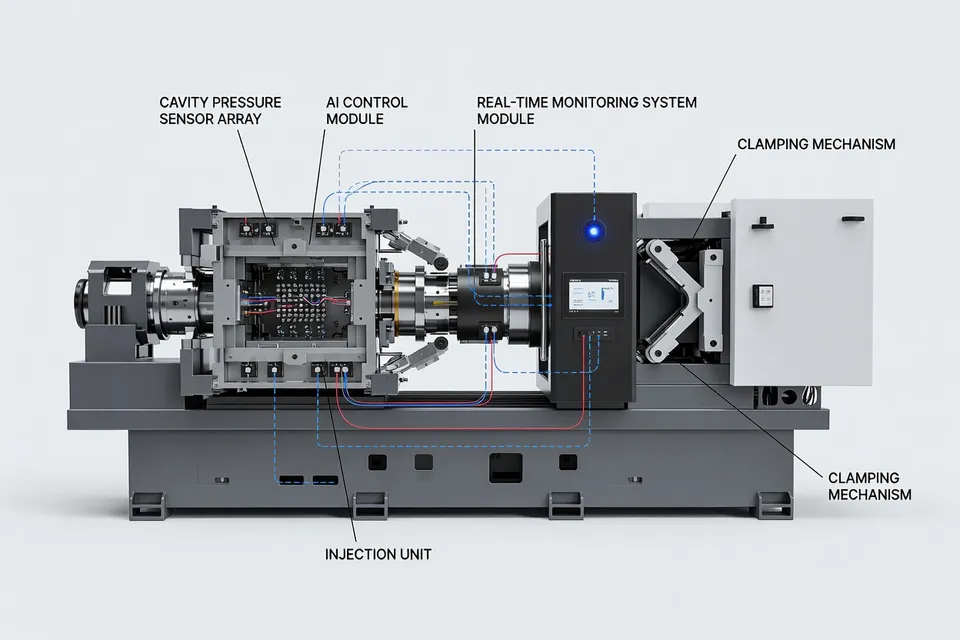
Parallel work in the wider molding community points in the same direction. A recent review of AI for micro‑molded parts reports that across studies from 2010–2025, learning‑based models consistently reduce trial‑and‑error experiments, improve dimensional stability, and support intelligent monitoring when combined with in‑mold sensing and closed‑loop control. Academic demonstrators using model predictive control and OPC UA communications have already shown how fully automated cells can adjust parameters in real time to keep weight and dimensional features on target while minimizing scrap.
For processors, the operational implication is clear: AI is becoming the first responder to process drift. Quality engineers are still needed, but their attention is moving from fire‑fighting individual defects to designing the sensing strategy, validating models, and deciding where closed‑loop autonomy is acceptable.
Machine Vision and Predictive Quality: Inspection Becomes Continuous
Quality control is another area where 2026 feels different on the plant floor. Evok’s trend analysis notes that AI vision systems are increasingly specified not just to spot obvious blemishes, but to catch micro‑level surface defects, dimensional drift, and subtle color inconsistencies that human inspectors typically miss or detect too late. Rather than sampling a few parts every hour, high‑resolution cameras and deep‑learning models are now examining every component.
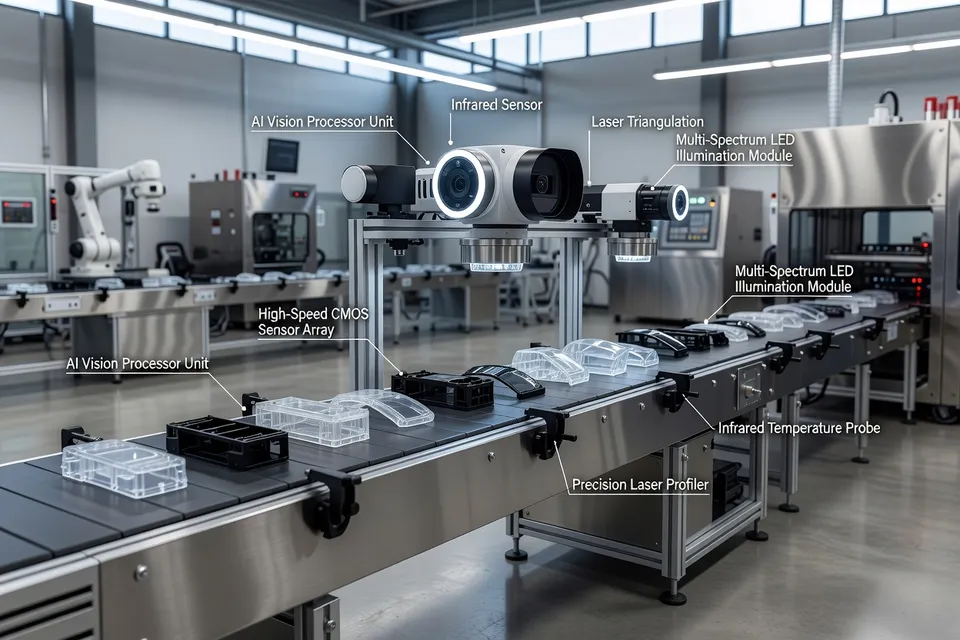
Other industrial case studies underline how this shift compresses the response time to defects from tens of minutes to just a few, and pushes scrap rates down by an order of magnitude while keeping false rejection in check. In the tire sector, 2025 coverage of machine vision shows similar dynamics: AI‑equipped inspection machines take feeds from dozens of cameras, evaluating each tire’s internal and external structure for anomalies in seconds, and increasingly doubling as predictive‑maintenance sensors on the same line.
For converters and brand owners, this level of continuous inspection changes the economics of quality. Instead of budgeting for a certain percentage of scrap as inevitable, they can rethink upstream process windows and downstream customer commitments, knowing that defects are likely to be caught and corrected within the same production cycle.
Tire Manufacturing: Autonomy Extends from Mixing to Design Decisions
Rubber and tire producers are pushing AI much deeper into their development and manufacturing stacks. Yokohama Rubber has spent the last several years building out its HAICoLab framework – a proprietary human‑AI collaboration concept that couples multi‑scale simulation with materials informatics. Under HAICoLab, the company first developed AI systems to predict physical properties of rubber compounds and key tire characteristics from historic measurements and simulation data.
It then moved into AI‑generated rubber compounds: the system has learned tens of thousands of formulations and can propose candidate recipes that combine more than 100 compounding agents to meet target property values, effectively inverting the usual trial‑and‑error workflow. A tire design support system based on explainable AI techniques such as SHAP further allows less‑experienced engineers to see which design factors contribute most to a given performance target, and how adjusting each factor shifts the predicted characteristics.
In 2026, Yokohama has gone a step further by operationalizing a generative AI system that uses retrieval‑augmented generation to search internal technical documents and return context‑specific answers for development staff. Engineers can ask the system targeted questions; the AI agent plans searches, retrieves relevant regulatory texts, reports, and case studies, and iteratively evaluates the results to refine its responses. Links back to source documents are displayed so users can verify and interpret the information.
"The system…contributes to further accelerating and enhancing tire development by providing rapid and accurate access to technical information necessary for decision‑making." - Yokohama Rubber Co. statement in European Rubber Journal
For tire R&D teams, this combination of predictive models, generative compound design, explainable AI, and knowledge search shifts the bottleneck: instead of time being consumed by data gathering and basic parameter sweeps, effort can move to framing better hypotheses and exploring unconventional design spaces.
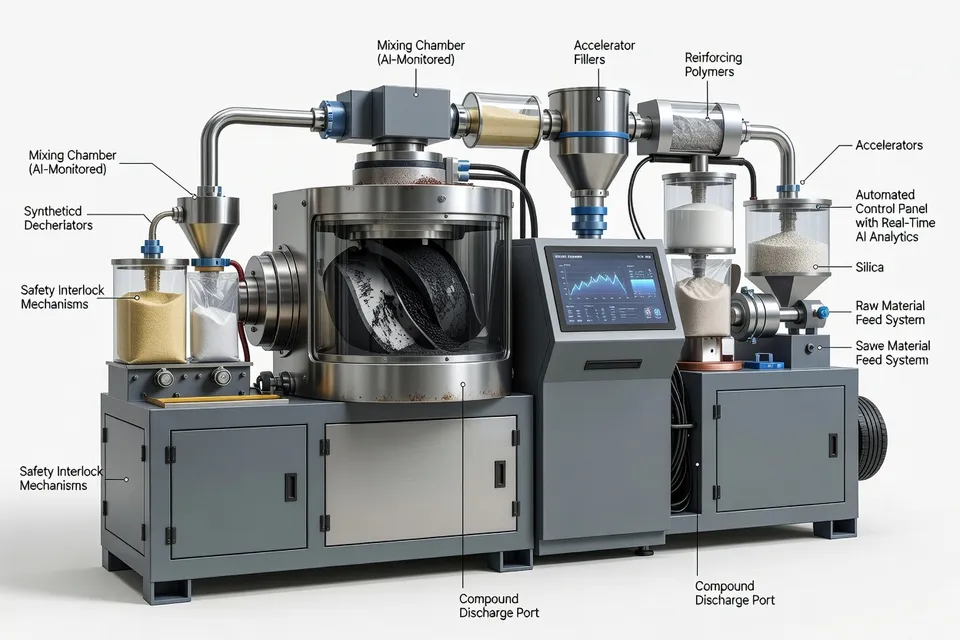
On the manufacturing side, other suppliers are quietly embedding AI into tire building machinery. VMI’s equipment roadmap, for example, uses machine vision and self‑learning algorithms to optimize splicing and automate foreign‑object detection, skipping contaminated material and coordinating "smart run empty" behavior to reduce waste during cassette changes. Rockwell Automation’s digitalization leads describe how AI‑driven systems across mixing, extrusion, assembly, and inspection maintain consistent output over long runs and shorten restart times when recipes change.
Polymer Science: Journals Signal a New Baseline for AI Integration
The materials community is reinforcing this industrial momentum from the publication side. In 2026, ACS launched a special issue in Polymer Science & Technology explicitly focused on "AI for Polymer Science and Technology," with topics ranging from AI‑driven polymer discovery to AI‑informed processing and structure‑property analysis. The call frames AI not as a niche technique but as a transformative tool for sustainable and functional polymers, high‑throughput virtual screening, and advanced characterization.
Parallel editorial initiatives in Macromolecules emphasize automation in polymer research, data‑wrangling tools, and AI that addresses polymer‑specific problems such as complex architectures or unexplored application windows. For processors and suppliers, this matters because it signals that future resin and additive systems entering the market will increasingly be designed, screened, and modeled using AI from the outset.
What Processors Should Pay Attention to in 2026
Across these examples, a few practical themes stand out for plastics and rubber manufacturers evaluating AI automation this year:
- Start where sensors already exist. Plants with established measurement infrastructure – cavity pressure in molding, mixing and extrusion parameters in tire production, inline inspection cameras – are finding it easier to layer machine‑learning models on top and prove economic benefit quickly.
- Treat AI as a collaborator, not an autopilot. The most mature implementations, from Evok’s molding projects to Yokohama’s HAICoLab systems, deliberately keep human engineers in the loop to interpret features, challenge model assumptions, and guide hypothesis generation.
- Use pilots to quantify value before scaling. Tire sector case studies show typical projects take a few weeks to validate an AI use case on one operation, calculate incremental output or scrap reduction, and then decide whether to roll out.
- Plan for data and skills, not just software. Research reviews repeatedly stress that robust datasets, standardized benchmarks, and interpretable models validated in factory conditions remain prerequisites for broader adoption. That has staffing consequences: the skills mix on the production side is drifting toward process engineers who can read both SPC charts and model explanations.
For a sector accustomed to conservative change on the factory floor, the speed of AI adoption in 2026 feels unusually brisk. Yet the pattern is consistent: wherever sensors, historical data, and strong process discipline already exist, AI automation is quietly converting those assets into higher throughput, more stable quality, and faster development – not by replacing people, but by changing what they spend their time on.
Editorial Insights
- Why is AI becoming more valuable in production environments rather than staying confined to research and pilot projects?
- AI adds the most value where there is already a steady stream of process data, because it can detect drift, predict defects, and recommend corrections before scrap accumulates. That makes it especially useful in mature operations that already depend on disciplined measurement and repeatable workflows.
- How does AI change the economics of quality control for high-volume polymer processing?
- The main shift is from sample-based inspection to continuous monitoring, which compresses response times and reduces the cost of late-stage defects. Over time, that can lower scrap, improve yield, and allow tighter customer specifications because quality is managed during production rather than after it.
- What new skills and data practices do plants need to make AI automation work reliably?
- Successful deployment depends less on software alone and more on clean sensor data, standardized process records, and people who understand both production behavior and model outputs. The most effective teams will be able to validate recommendations, challenge false signals, and translate model insights into process changes.
- Why is explainability important when AI starts influencing formulation and process decisions?
- Explainability matters because plants need to know not just what the model predicts, but why it reached that result and which variables are driving it. Without that transparency, it is difficult to trust the system, transfer it across lines, or defend decisions when performance changes.
- What broader impact could AI have on polymer innovation over the next few years?
- AI is likely to shorten the path from idea to viable material by narrowing the search space for formulations, surfacing patterns in historical data, and accelerating technical knowledge retrieval. That does not eliminate laboratory work, but it can shift effort toward higher-value experimentation and faster screening of new performance and sustainability targets.
References
- 1.ACS Axial. (2026, August 3). Call for papers: AI for polymer science and technology. ACS Axial.
- 2.Evok Polymers. (2026, August 18). How AI and automation are changing production in 2026. Evok Polymers.
- 3.Tire Technology International. (2026, August 28). News. Tire Technology International.
- 4.European Rubber Journal. (2026, August 28). Yokohama Rubber advances generative AI system for tire R&D. European Rubber Journal.
- 5.Plastics Technology. (2026, August 26). Plastics Technology: Best practices for plastic processors. Plastics Technology.