

Smart manufacturing moves from pilots to plant reality
Walk any serious plastics or rubber facility in 2026 and the shift is visible: AI is no longer trapped in pilot projects or isolated dashboards. It is starting to sit directly on top of production, resin handling and compounding, changing how processors make decisions hour by hour.
In the plastics sector, experts point to a simple inflection point. Smart manufacturing used to focus on wiring machines together and logging data; now plants are leaning on AI systems that interpret that data and increasingly support autonomous decisions on process conditions, maintenance and even material purchasing. One consultant quoted in Plastics Machinery Manufacturing describes smart factory technology as "finally becoming a reality" because AI tools have matured, and the cost and access barriers have dropped enough for mid-sized processors to participate.
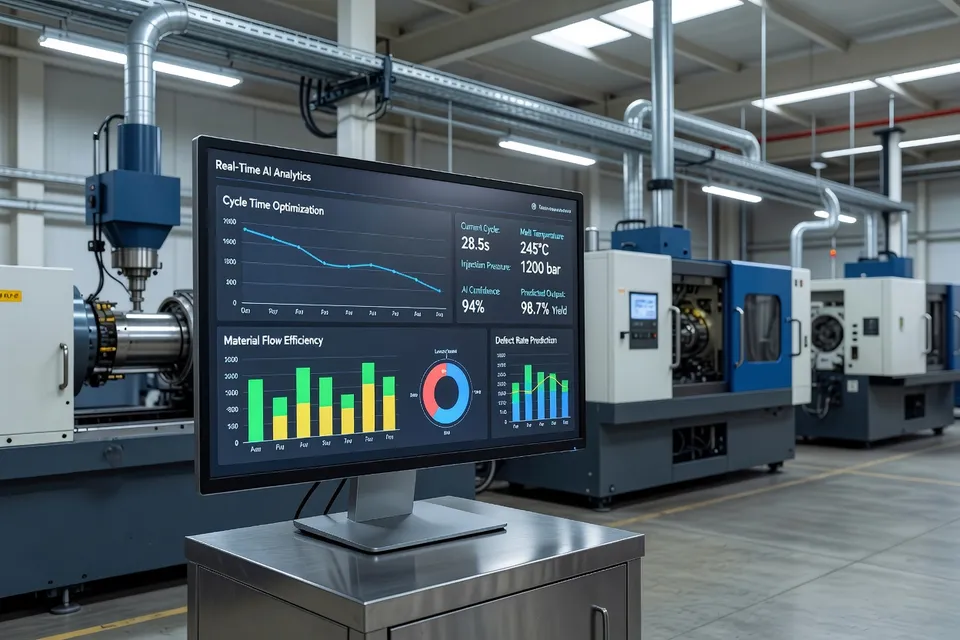
For rubber producers, a parallel transformation is happening on the formulation side. Mixing rooms that once relied purely on operator feel are being backed by analytics on rotor behavior, fill levels and ram pressure, with process analyzers catching shifts in dispersion or viscosity before they show up as scrap in curing or extrusion.
Clip-on intelligence: machine monitoring in injection molding
If there is a front line where AI-enabled monitoring is changing plastics, it is in injection molding. A recent 2026 benchmark study of molding machines in plastics and packaging lines found a 71% median runtime across the sample, with the top quartile of plants hitting 97% runtime on their critical assets. That 26‑point gap represents recoverable capacity without buying new presses—it is locked inside changeovers, short stops and maintenance delays.
The benchmark author underscores three operational levers:
- Standardizing changeovers, where the data show a more than 250% spread in changeover times across crews.
- Attacking short stops, especially mechanical events like ejector jams and feed throat issues that repeatedly disturb the thermal process.
- Contextualizing targets, using 71% as a health baseline but aiming at 97% for machines that set plant throughput.
Monitoring platforms in this space have shifted from complex PLC integrations to non‑intrusive sensors that read the electrical "heartbeat" of a machine. One FactoryOps provider, benchmarked at $1,500 per machine per year for typical installations, clips current transformers around power leads to infer cycle times, downtime events and energy use without touching controller logic. From an operations standpoint, that matters because mixed fleets of legacy hydraulics and new all‑electric presses can be watched from a single dashboard within days, not months.
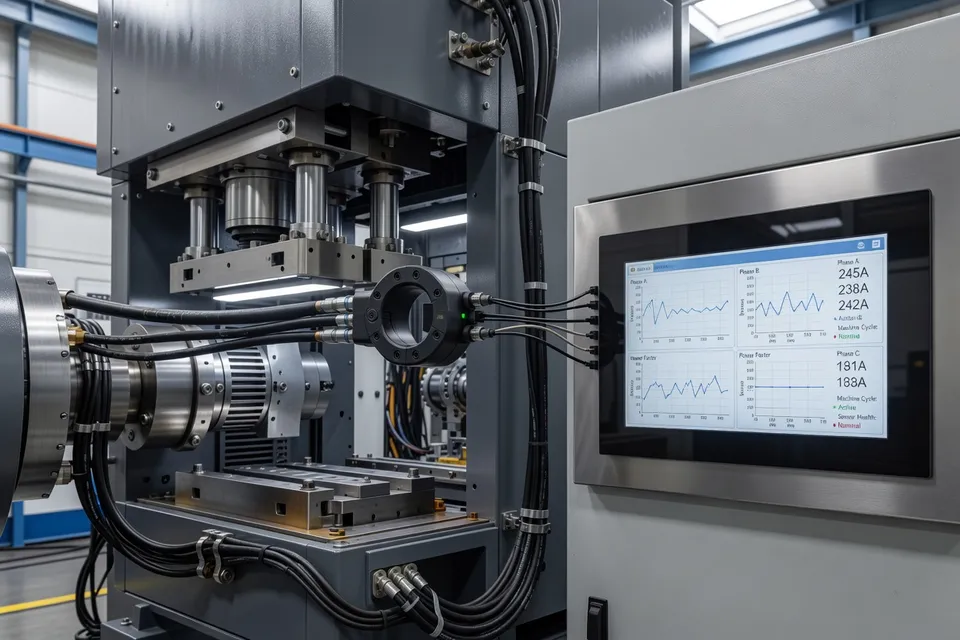
For molders, the impact is practical rather than theoretical. Real‑time views of runtime and micro‑stops make it possible to:
- Move skilled setters to the lines with chronic changeover overruns.
- Differentiate true maintenance work from "waiting" time around presses.
- Tie resin formulations and drying performance to live scrap and cycle metrics instead of weekly spreadsheets.
Resin drying: the energy elephant AI finally sees
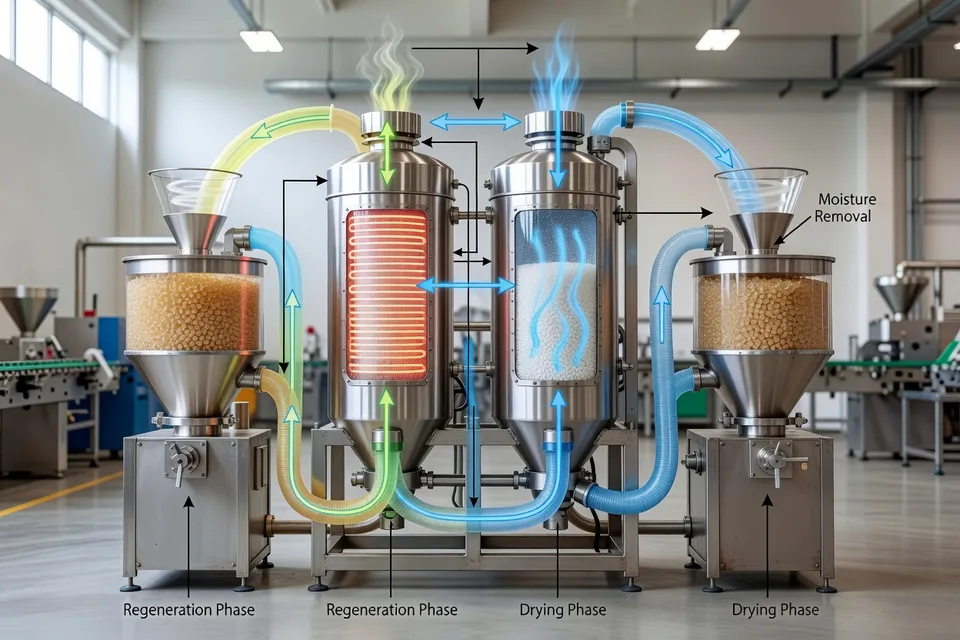
While machine monitoring grabs attention, a quieter opportunity is hiding in utilities—specifically resin drying. A March 2026 analysis in Plastics Engineering calls drying "the energy elephant hiding in plain sight," noting that desiccant dryers impose high, sustained electrical demand through heater duty, blower work and regeneration cycles that rarely receive disciplined oversight.
The article makes two points that resonate on the shop floor:
- Dryer energy demand is not limited to heating process air; desiccant regeneration can swell significantly when air ingress, leaks or unstable control increase purge requirements.
- Airflow is a second major load. Poorly controlled volumetric flow raises both blower work and thermal duty, often without improving moisture removal.
From a smart manufacturing perspective, this is fertile ground for AI. If the same sensors tracking press utilization also capture power draw on dryers, plants can start correlating dew point stability, airflow and residence time with kWh consumption and scrap rates. The 2026 article argues that maintaining stable dew point, trimming airflow and tightening systems to reduce air ingress allows moisture specs to be met at lower temperatures or flows, simultaneously reducing energy and quality risk.
That framing turns dryer optimization into a data project: prioritize dew point control, regeneration stability, airflow right‑sizing, system tightness and residence‑time protection, then let monitoring platforms surface where energy and scrap diverge. For processors hit by resin price volatility and rising electricity tariffs, this is one of the few levers that cuts both utility spend and defect rates.
Rubber mixing: seven levers and a new level of discipline
Rubber compounding teams have their own version of hidden variation. Alpha Technologies highlights seven factors that can quietly reshape a mix: rotor type, rotor speed, rotor path, mixing scheme, ram pressure, fill factor and equipment wear or damage.

The article breaks down how these variables play out in practice:
- Two‑wing rotors offer slower temperature rise and lower energy demand, suiting general‑purpose and final mixes, while higher‑wing configurations change shear and dispersion behavior.
- Running rotors at friction speed, where one turns faster than the other, alters the mixing dynamics compared with even speed operation.
- Tangential rotor paths are preferred for masterbatches and re‑mills, but their behavior depends heavily on fill and speed.
- Mixing schemes—from "right side up" sequences to Y‑mixing and slush mixing—change when and how additives encounter the polymer, with early oil addition, for example, hindering filler dispersion.
- Ram pressure and fill factor directly influence cycle time and dispersion; too high a fill can create dead zones, while too low a fill undermines ram effectiveness.
What is changing is that these factors are increasingly quantified via rubber process analyzers tracking viscosity, cure curves and dynamic moduli across batches. Instead of discovering problems at the press or in the field, compounding teams use statistical process control on Mooney viscosity, t90 and Payne effect to catch drift tied to incoming material lots, mixer wear or ambient conditions.
For tire makers and technical rubber producers, this dovetails neatly with AI‑supported R&D. Yokohama Rubber, for example, has put a proprietary generative AI system into full‑scale operation in August 2026, using retrieval‑augmented generation to search internal technical documents and answer developer questions on compounds, regulations and past case studies. That system sits atop earlier AI tools that already predict physical properties of rubber compounds, tire characteristics and mold design behavior, creating a loop where lab data, past formulations and process failures can be queried in seconds.
Simulation and decision support: from mold trials to HAICoLab
On the plastics side, computer‑aided engineering (CAE) has quietly become one of the most mature smart tools in the plant. Moldex3D’s automotive solutions show how simulation moves beyond part geometry to address fiber orientation, weld lines, warpage and viscoelastic stress relaxation over a part’s life. One case cited by the developer involves partnering with a major automaker to eliminate warpage in a door trim; an automatic boundary layer mesh of more than 5 million elements was generated in under four hours, giving designers a high‑fidelity platform to test changes well before steel was cut.
The same ecosystem extends into process optimization. Design‑of‑Experiments (DOE) modules allow engineers to treat injection molding parameters scientifically instead of relying on trial‑and‑error. By systematically varying temperatures, pressures and gate locations in virtual runs, teams identify the combinations that maximize yield while reducing mold trials, shortening time to market and cutting development cost.
In rubber and tires, Yokohama’s HAICoLab framework plays a similar role at the knowledge level. Established in October 2020, it underpins AI systems that generate new rubber compounds, predict tire behavior and support mold design. The new generative AI layer, built on RAG, expands that environment by tapping regulatory documents, manuals and technical reports; the system not only proposes answers but also displays links to the source documents so engineers can verify the basis before acting.
For processors and brand owners, the operational implications are concrete:
- Trial loops shorten as simulation and AI narrow the window of viable settings or formulations before plant trials begin.
- Knowledge trapped in individual experts’ notebooks becomes searchable, reducing the risk of losing process know‑how when senior staff retire.
- Sustainability targets—less scrap, fewer mold trials, better energy use in drying and curing—become easier to quantify and defend when backed by data from monitoring and simulation tools.
The net effect in 2026 is that AI and smart manufacturing are no longer distant promises for rubber and plastics. They are showing up in power clamps on press cords, in SPC charts in mixing rooms, and in generative interfaces for tire engineers who want an instant cross‑section of every compound and test the company has ever run.
Processors that treat these systems as daily operating tools—rather than side projects—are the ones quietly reclaiming uptime, energy and mix stability from the margins of their plants.
Editorial Insights
- How is the shift from data logging to AI-driven decision support changing day-to-day plant management in plastics and rubber?
- The move from simply collecting data to using AI to interpret it is turning plant management into a more proactive, exception-driven discipline. Instead of supervisors reacting to scrap reports or downtime summaries, AI systems highlight the few lines, dryers or mixers that deviate from expected behavior and suggest probable causes and corrective actions. This reduces the noise in daily operations, sharpens focus on the highest-impact issues, and gradually embeds a more scientific mindset into routine production decisions.
- What are the main organizational barriers to capturing the full uptime gains promised by AI-enabled machine monitoring?
- The technical hurdle of sensing machines is now relatively modest; the harder work lies in changing behavior around the insights. Plants often struggle with inconsistent changeover practices, unclear ownership of short-stop reduction, and maintenance teams that are not yet measured on data-based metrics like mean time between specific recurring faults. Without standard work, cross-functional accountability and a willingness to adjust staffing patterns based on runtime data, the theoretical capacity gains remain locked in reports instead of showing up as shipped product.
- Why is better visibility into resin drying and utility loads emerging as a critical sustainability lever for processors?
- Resin drying and related utilities represent a continuous, high-energy backbone that often runs out of sight and out of mind, yet they heavily influence both carbon footprint and quality. By instrumenting dryers and correlating dew point, airflow and residence time with scrap, plants can move away from default high-temperature, high-flow settings toward optimized profiles that meet moisture targets with less energy. This turns sustainability into an operational discipline: measurable, auditable and directly linked to defect reduction rather than a separate, abstract initiative.
- How does quantifying mixing-room variables in rubber compounding alter risk management for downstream applications?
- When parameters such as rotor design, speed, fill factor and ram pressure are tracked against viscosity and cure behavior, variation that used to surface in presses or the field is caught at the source. This data-driven view allows teams to distinguish between raw material issues, equipment wear and recipe drift before critical parts are produced. Over time, the compounding stage becomes a controlled gate for performance, lowering warranty exposure and giving customers more confidence in the consistency of high-demand rubber applications.
- What strategic advantage does embedding AI into simulation and technical knowledge systems offer beyond faster product development?
- Integrating AI with simulation and internal technical archives gradually builds a living memory of what works, what fails and under which conditions. This not only compresses design and trial cycles, it reduces dependence on tacit know-how concentrated in a few experts and makes regulatory and performance constraints more transparent to every engineer. Strategically, it turns technical knowledge into a reusable, scalable asset, improving resilience to staff turnover and enabling more ambitious materials and design changes with controlled risk.
- As AI systems become embedded in plant decisions, what ethical and governance questions should processors address?
- Once algorithms start influencing process settings, maintenance priorities and material choices, plants need clear boundaries on how those recommendations are validated and who remains accountable. There is a risk of over-trusting opaque models, particularly when safety, regulatory compliance or long-term durability is at stake. Establishing governance that requires traceable rationales, routine performance audits and the ability for human experts to override or challenge AI outputs helps ensure that these tools augment judgement rather than quietly displace it.
References
- 1.Plastics Machinery & Manufacturing. (2026, August 26). AI, lower costs and better data access accelerate smart manufacturing adoption. Plastics Machinery & Manufacturing.
- 2.Guidewheel. (2025, December 19). 2026 machine monitoring system benchmarks for injection molding. Guidewheel.
- 3.Rubber World. Rubber World home page. Rubber World.
- 4.European Rubber Journal. (2026, August 28). Yokohama Rubber advances generative AI system for tire R&D. European Rubber Journal.
- 5.Plastics Technology. Plastics Technology: Best practices for plastic processors. Plastics Technology.
- 6.Moldex3D. (2014, February 14). CAE simulation technology drives opportunities for sustainable automotive manufacturing. Moldex3D.
- 7.Alpha Technologies. (2022, November 30). 7 important factors that affect your rubber mix. Alpha Technologies.
- 8.Plastics Engineering. (2026, March 26). Resin drying: The energy elephant hiding in plain sight. Plastics Engineering.