


Smart controls shift pelletizing from standalone machine to connected line
In 2026, the most interesting efficiency gains in extrusion lines are coming less from bigger motors and more from smarter control architectures wrapped around familiar hardware.
Bay Plastics Machinery’s S.M.A.R.T. Control for strand pelletizing systems is a good example of how pelletizers are being pulled into the Industry 4.0 conversation instead of running as isolated, operator‑driven units. The system is housed on the pelletizer but is designed to control and coordinate downstream auxiliary equipment as part of a unified line, rather than leaving cooling baths, air knives, and conveyors on separate islands of control.
At its core, S.M.A.R.T. — short for System, Monitoring, Analysis, Recipes and Training — blends process control with a rich layer of diagnostic and training tools. The controller logs starts, stops, emergency stops, faults and other events in real time, then presents them alongside graphical trend data so operators can see how alarms, speed changes, or bath adjustments correlate with scrap and throughput.
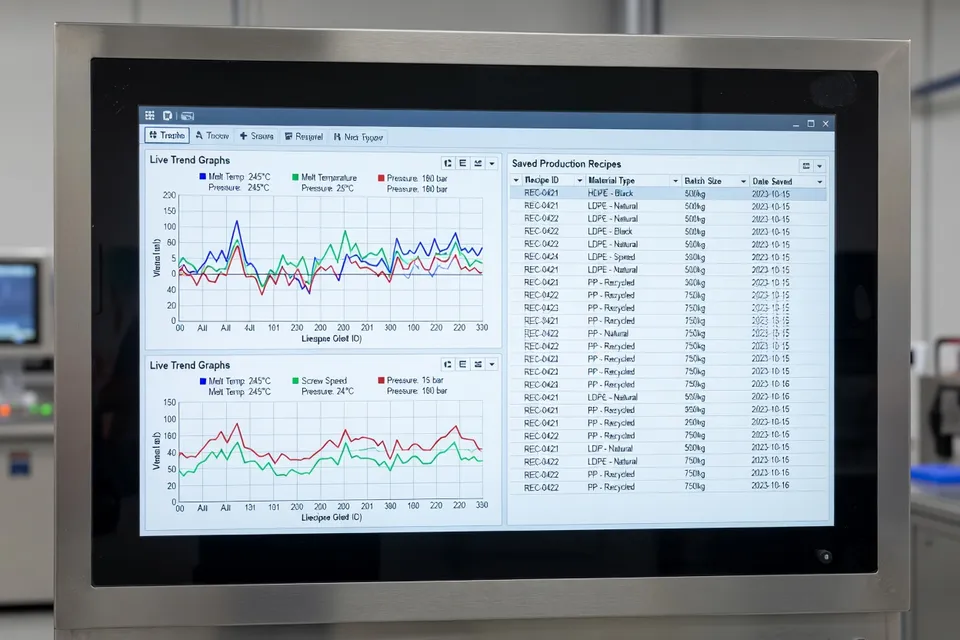
Recipe storage is where processors I spoke with see immediate labor savings. Once a strand‑pelletizing line is tuned for a particular formulation and pellet length, the operator can save that setup and recall it on the next run instead of “dialing in” with a bank of discrete knobs. That can shorten changeovers, reduce the number of off‑spec startup bags, and cut the dependence on a single “super user” who remembers each product family’s quirks.
The same interface doubles as a maintenance and training hub. S.M.A.R.T. stores digital documentation, maintenance procedures, training videos, and even a 3D model of the specific machine to help technicians identify the exact component and part number needed for service. That matters for smaller plants where maintenance teams are stretched and cannot afford long hunts through PDFs or catalogs every time a bearing or blade holder needs replacing.
For processors under pressure to run more SKUs with fewer expert operators, this kind of embedded guidance can be the difference between keeping pelletizing in‑house or outsourcing compounding work.
High-intensity batch mixing tightens compounding cycles
While pelletizing moves into the era of smart line control, compounders are attacking efficiency inside the mixer.
Polymer Resources, a plastics compounder of customized engineering thermoplastics, has rethought its post‑blending step by replacing a ribbon blender with a rotary batch mixer from Munson Machinery. The 700‑TS‑140 rotary batch mixer provides 140 cubic feet of capacity and has allowed the company to blend up to 6,000 pounds of specialty resin in just two to three minutes.
The impact is not marginal. Polymer Resources reports more than a 30% reduction in post‑blending time after installing the rotary batch mixer, alongside noticeable improvements in blend uniformity. The rotary drum’s internal flights generate a four‑way tumble‑turn‑cut‑fold action that rapidly folds material through the batch, eliminating the dead zones they fought with in the old ribbon blender.
"Right off the bat we were getting perfect blends in two minutes, and we no longer have any reported issues of contamination." - a Polymer Resources production leader said
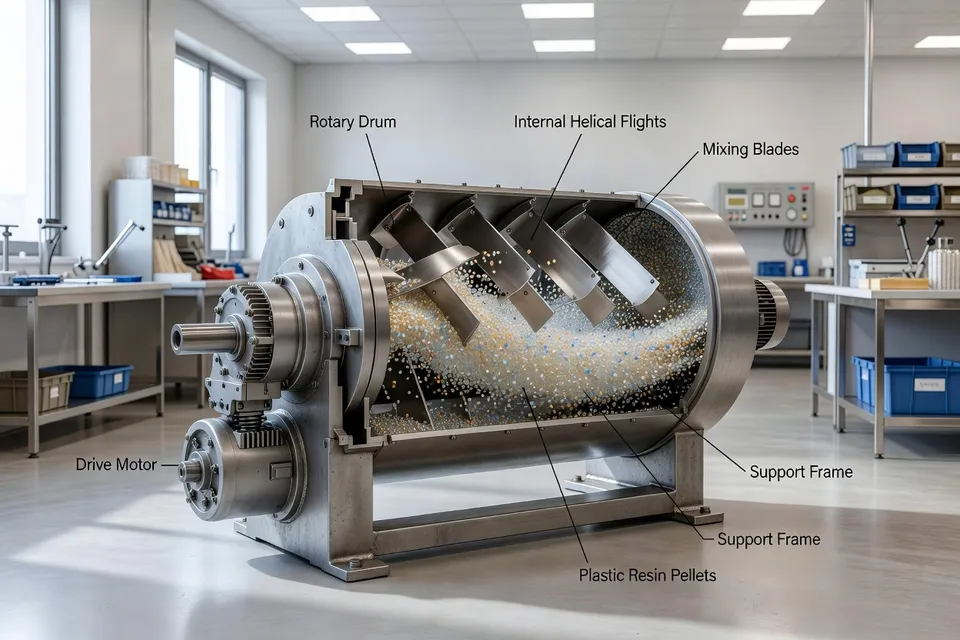
From an operations standpoint, the contamination and cleaning story is as important as the cycle time itself. With the rotary batch mixer, complete discharge and the absence of internal shafts or spokes cut down material hang‑up and trapped fines. That reduces cross‑contamination risk between color or additive packages and shortens washdowns.
For any compounder juggling short runs of specialty compounded grades, these gains translate directly into more salable pounds per shift and a lot less time spent arguing about who left streaks of the previous color in the mixer.
Real-time visibility raises blow molding OEE
On the downstream forming side, blow molding shops are discovering that software and sensors can often move the needle faster than new iron.
Guidewheel’s 2026 industry work on blow molding lines frames a gap that many processors will recognize: typical plants run OEE far below what their assets can deliver, not because the blow molders are inherently slow but because downtime and micro‑stops are poorly understood.
Guidewheel’s FactoryOps platform uses non‑intrusive, clip‑on sensors that read the electrical “heartbeat” of blow molders and auxiliary equipment, capturing uptime, cycle times and run/idle/down states without deep PLC integration. That lowers the barrier for older lines with mixed controls where a traditional SCADA rollout would be a multi‑year IT project.
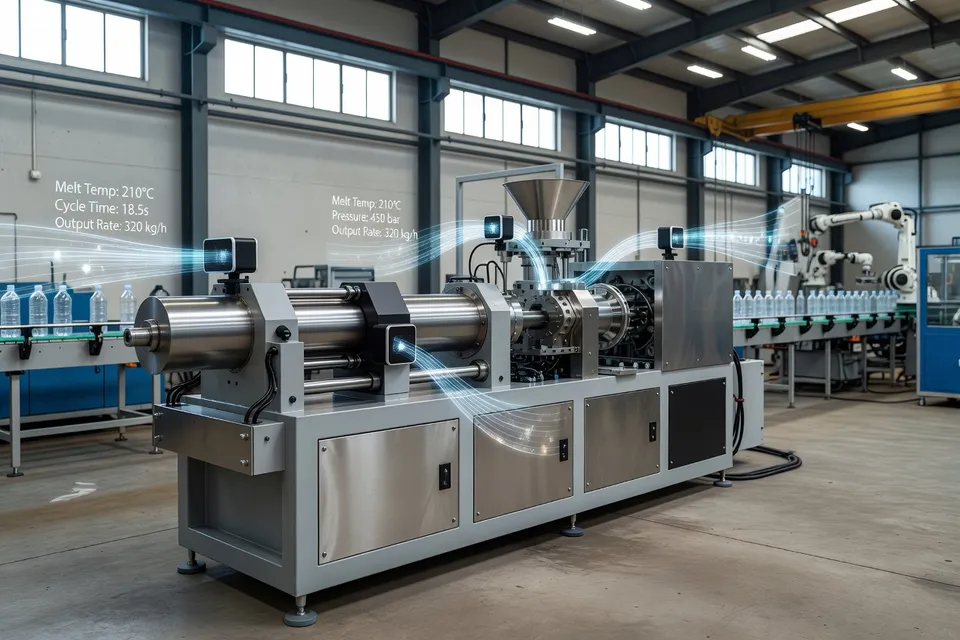
The company’s benchmark work, based on millions of machine‑minutes, points to a practical message for plant managers: the spread between mediocre and top‑quartile blow molding performance is less about buying a new press and more about seeing and acting on losses in real time. In other words, if you can see changeovers, leaks, and labeler issues as clearly as you see machine speed, you can fix the real constraints instead of blaming the press.
For converters serving fast‑moving packaging programs, this has commercial weight. With a clearer view of chronic downtime on specific molds, shifts, or downstream conveyors, they can negotiate smarter with brand owners on realistic lead times — and defend their margins with data when last‑minute spec changes hit.
Injection molders probe repeatability before replacing hardware
The final piece of the efficiency puzzle in 2026 is more subtle but just as consequential: how molders diagnose repeatability issues before spending on hardware.
A recent technical analysis on non‑return valve performance in injection molding argues that many shops replace valves prematurely because they rely on gut feel rather than data. Instead, the author recommends shot‑mass repeatability studies to determine whether dimensional drift is being caused by worn valve components or by unstable process parameters.
The proposed method is straightforward but disciplined. Set the machine to a standard velocity‑to‑pressure transfer process, fill parts to roughly 95–98% full, zero out pack‑and‑hold, stabilize, then record 10 fill‑only shots and weigh them without the cold runner. The percentage variation in part weight tells you far more about melt delivery consistency than a visual inspection of the screw tip.

The article also offers practical target bands: less than 0.5% variation for all‑electric injection units, less than 0.8% for servo‑hydraulic units, and less than 1.5% for older machines. If results fall inside those ranges, the non‑return valve is likely doing its job, and attention should shift to back pressure, decompression settings, screw speed, or melt temperature stability.
Recommended starting points include back pressure in the 500–1,000 psi range, minimal melt decompression — typically 0.1–0.3 inch — and a screw speed that completes plasticating 2–4 seconds before mold opening. The broader message to processors: treat the feedscrew and valve as precision flow‑control components, not expendable hardware you swap out whenever parts start to drift.
For shops wrestling with tight tolerance work, that shift in mindset can save both maintenance spend and unnecessary downtime.
One efficiency trend, three levers
Taken together, these developments point to a consistent pattern running through 2026 extrusion and molding operations:
- Smarter controls on pelletizers are converting tribal knowledge into recipes, logs, and guided troubleshooting, so lines can change over faster and run more predictably.
- Faster, cleaner batch mixing is giving compounders the confidence to shorten cycles while holding or improving blend quality, which supports shorter lead times and more custom formulations.
- Data‑driven monitoring and diagnostics in blow molding and injection molding are moving decisions away from intuition and toward measured loss analysis and shot‑to‑shot repeatability.
For processors looking ahead to the next trade‑show cycle rather than the next machine brochure, the question is no longer just “What clamp tonnage do we need?” but “Where in our material and melt path will smarter control, faster mixing, or better data unlock the next point of margin?”
Editorial Insights
- How should processors decide whether to invest first in smarter controls, faster mixing, or new molding analytics tools?
- A practical starting point is to map the full material and melt path and quantify where the most scrap, unplanned downtime, or labor hours are concentrated. If changeovers and recipe drift dominate losses, line‑level controls and standardized setups usually have the highest payback; if cleaning and cross‑contamination are chronic, high‑intensity, easy‑to‑clean mixing becomes more strategic; if unexplained downtime or dimensional drift are the main complaints, real‑time monitoring and repeatability studies typically deliver faster returns than new capital equipment.
- What are the main workforce implications of shifting tribal processing knowledge into recipes, logs, and guided diagnostics?
- Codifying know‑how into digital recipes and diagnostic tools reduces dependence on a few veteran operators and makes it easier to onboard new staff, but it also changes job profiles. Roles tilt toward interpreting data, managing exceptions, and maintaining digital assets rather than manually “dialing in” every run, which means plants need to invest in basic data literacy and cross‑training while still retaining a core of hands‑on process expertise to validate and refine the digital playbook.
- How do these efficiency technologies intersect with sustainability expectations in plastics processing?
- Smarter controls, cleaner mixing, and data‑driven diagnostics typically cut scrap, reduce reprocessing, and lower energy use per good part, which directly improves the environmental profile of a plant. They also make it more feasible to run short campaigns, frequent color changes, and recycled or bio‑based formulations without prohibitive waste, aligning operational efficiency with growing pressure for more flexible and lower‑impact manufacturing.
- What risks do processors face if they deploy advanced monitoring and control without a strong data and maintenance discipline behind it?
- Without clear ownership of data quality, basic maintenance, and alarm management, plants can drown in charts and notifications while underlying problems persist. The risk is that teams start ignoring dashboards, overtrust automated recommendations, or use selective data to justify preconceived decisions, so any rollout should be paired with simple standards for sensor care, clear KPIs, routine review rituals, and a culture that treats data as a tool for learning rather than policing.
- How can smaller processors justify these types of upgrades when capital and IT resources are limited?
- Smaller plants benefit from targeting low‑infrastructure changes that piggyback on existing equipment and deliver measurable gains within a year, such as add‑on controls, high‑yield mixers, and clip‑on monitoring. Building a simple business case around fewer off‑spec bags, reduced cleaning time, or avoided premature component replacement often reveals that incremental, focused projects can free enough cash and capacity to fund the next step in the modernization roadmap.
- Why is a more disciplined, measurement‑based approach to repeatability increasingly critical as tolerances tighten in plastics applications?
- As end-use requirements move toward thinner walls, more demanding fits, and higher cosmetic expectations, guessing at root causes becomes too expensive in both scrap and downtime. Structured repeatability checks and defined performance bands turn troubleshooting into a controlled experiment, allowing teams to separate mechanical wear from process instability, avoid unnecessary hardware changes, and systematically tune parameters so that capability margins are understood rather than assumed.
References
- 1.Plastics Machinery & Manufacturing. Plastics machinery manufacturing: Home. Plastics Machinery & Manufacturing.
- 2.Plastics Machinery & Manufacturing. (2026, August 25). S.M.A.R.T. Control makes Bay pelletizers easier to operate. Plastics Machinery & Manufacturing.
- 3.Processing Magazine. (2026, July 22). Polymer Resources cuts post-blending time more than 30% with rotary batch mixer. Processing Magazine.
- 4.Guidewheel. (2025, December 19). Industry report: Blow molding machine maintenance and OEE tracking in plastics packaging lines 2026. Guidewheel.
- 5.Plastics Technology. (2026, May 15). Non-return valve repeatability: Worn components or faulty process parameters. Plastics Technology.