

A gas-phase plastic puts circularity into the process window
When a team at the University of Surrey reported a novel plastic that sublimates into a gas at around 90°C and then reforms into the same solid polymer on cooling, it sounded like a lab curiosity. For plant people, the detail buried in the work matters more: the material behaves like a soft, hydrophobic polyethylene analogue in service, yet depolymerizes cleanly into gaseous monomers instead of a liquid stream.
In trials described with the new sulfur-ring-based polymer, around 90% of the solid material converted to vapor in a simple test-tube setup held at 90°C for two hours, then recondensed as a recoverable waterproof plastic on a cooler wall—without special equipment or complex separation. That direct solid–gas–solid path strips out grinding, melt filtration, and solvent work-up from a typical recycling flow.
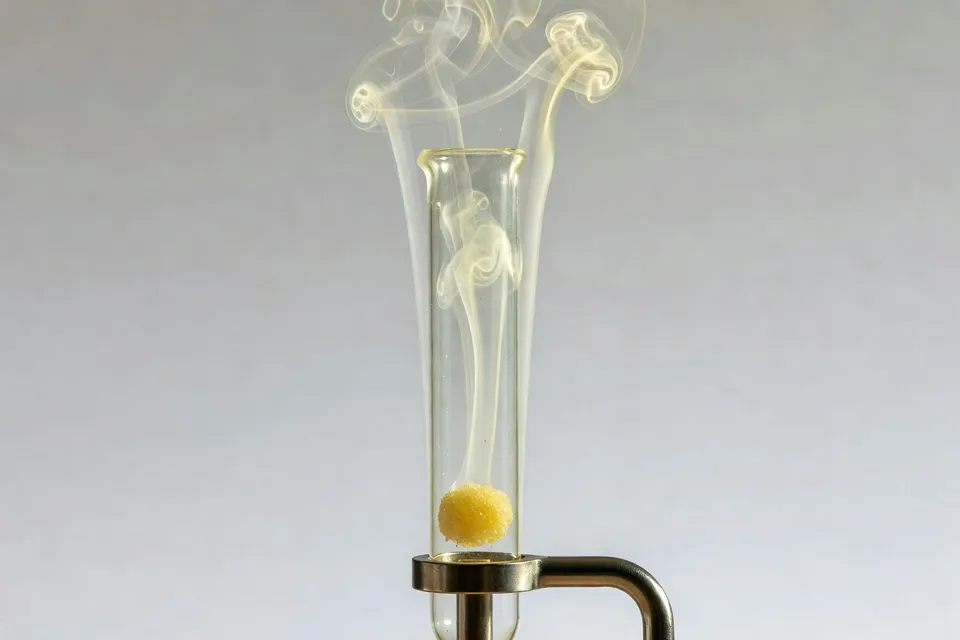
For processors, the operational hook is not that this polymer will replace film or bottle grades tomorrow; the study explicitly frames it as a proof-of-principle for "sublimable" homopolymers. The message is that certain thermoplastics could be engineered so that rework and end-of-life recovery happen through a controlled depolymerization step inside an existing thermal envelope, then re-polymerization at ambient conditions.
That opens practical questions:
- How do you design ovens, ducts, and condensers to capture monomer vapor with minimal fugitive losses?
- Where do you meter reclaimed material back into compounding without cross-contaminating conventional streams?
- Can devulcanization-style controls, such as those planned for Terra Rubber’s new kerbside reclaim rubber facility in Palakkad, Kerala, cross over into plastics that depolymerize via gas-phase monomers?
Terra Rubber’s devulcanisation project shows circular scaling
Tolins Tyres’ subsidiary Terra Rubber Private Limited has begun construction of a reclaim rubber manufacturing facility in Palakkad, Kerala, designed to convert scrap tyres and rubber waste into reclaimed rubber via a controlled devulcanisation process. The project is explicitly tied to backward integration, raw-material efficiency, and participation in India’s waste tyre Extended Producer Responsibility (EPR) ecosystem.
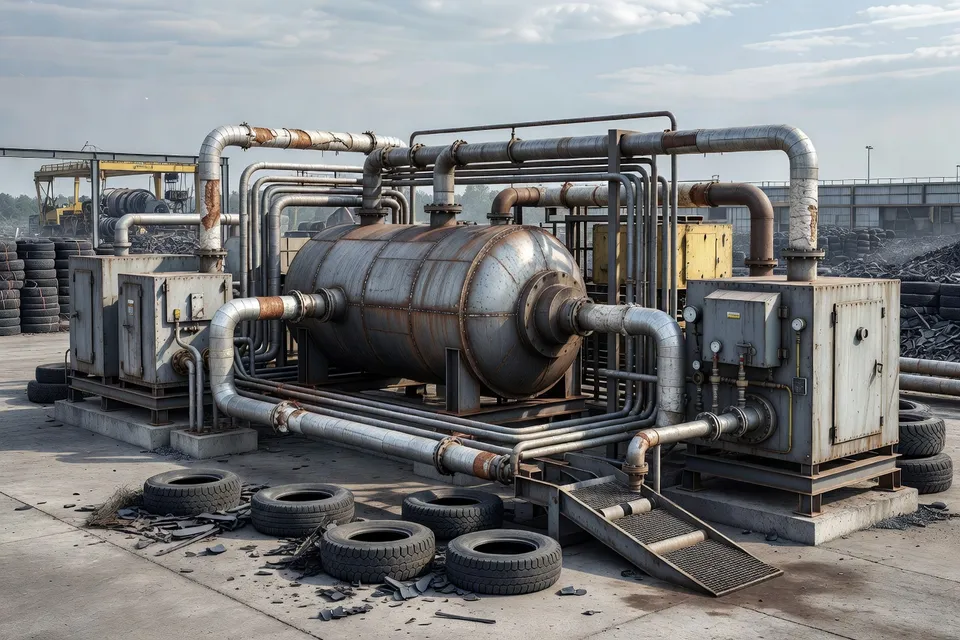
The facility’s concept is straightforward: feed in used tyres and compound scrap, run a thermal–mechanical devulcanisation step to break sulphur crosslinks, and output reclaimed rubber that can substitute a portion of virgin elastomer in new compounds, subject to performance limits. For tread manufacturers, that means a separate stream of internal production waste and external post-consumer tyres routed into a single devulcanisation plant, then back into blends for selected product families.
The operational lesson for plastics plants is clear. Terra Rubber’s move formalizes what many processors still treat as ad hoc rework: it assigns separate equipment, a defined process window, and a product spec to the recycling step instead of folding scrap back into the main mixing line. A sublimable plastic, engineered for gas-phase recovery, would require similar discipline—dedicated depolymerisation and condensation hardware, verified monomer purity, and clear rules for how much recycled feedstock can be reintroduced per formulation.
3D-printable liquid crystal elastomers bring switchable motion
On the motion side of the story, soft actuation research has stepped past simple one-direction shape change. A Nature Communications study highlighted by TechXplore details the first 3D-printable smectic liquid crystal elastomer (LCE) ink that can switch molecular alignment during extrusion. By tuning printing speed and temperature, the team led by Suk-kyun Ahn at Pusan National University programmed the same filament either to elongate or contract when heated.
"Our work provides the first demonstration of switching molecular alignment between two orthogonal directions using a single 3D-printable smectic LCE ink, simply by tuning the printing speed and temperature." - Suk-kyun Ahn, professor at Pusan National University said
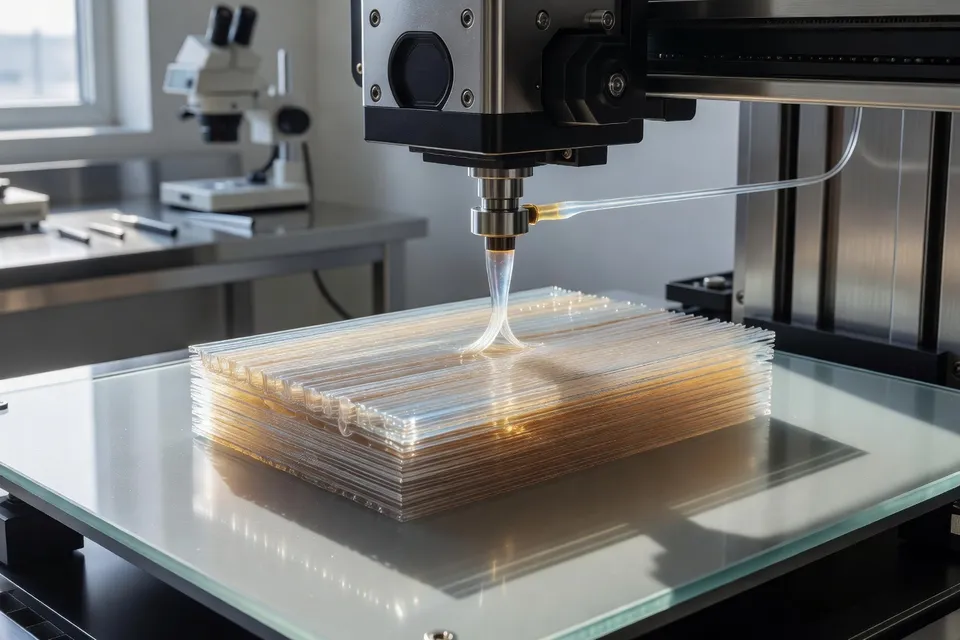
From a manufacturing standpoint, this is not just a clever lab trick. Conventional extrusion-based 3D printing of soft actuators has struggled to orient domains in multiple directions without changing the ink or adding post-processing. Here, orientation is set in-line by process parameters, so a single material can deliver opposite thermal responses in different sections of a part.
For plant engineers working on soft grippers, haptic feedback modules, or adaptive seals, that suggests:
- Design teams can encode multiple heat-driven motions in one build, using speed/temperature profiles instead of multi-material assemblies.
- Maintenance teams face fewer bonded interfaces that can delaminate; the actuation function is intrinsic to the printed elastomer.
- Qualification moves from material change control to process window validation—documenting the exact speed and temperature ranges that yield reliable alignment switching.
AI-guided elastomers push printable stretch and grip
A separate TechXplore report in August 2026 described a soft 3D-printed robotic hand built from a new elastomer whose formulation was found using machine learning. The team used a Digital Light Processing (DLP) printer and trained an AI model to identify compositions that can be printed into complex shapes while stretching to more than six times their original length without tearing.
The printed soft actuators, when inflated with air, bent like human fingers and enabled a hand that lifted a 1 kg water bottle and safely grasped fragile eggs, glass bottles, egg cartons, and a computer mouse. For processors, the key is that the material combined high stretchability with DLP printability—two properties that traditionally trade off.
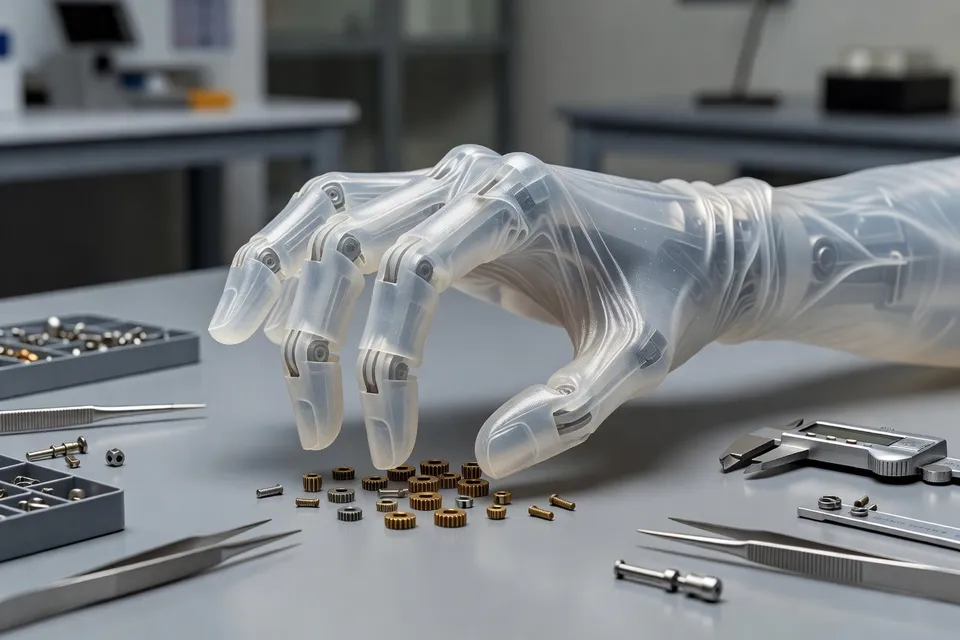
In practical terms, that means:
- OEMs can design softer, more compliant grippers and wearable devices without abandoning high-resolution vat photopolymerization.
- Compounding groups may need to think of formulation as a search problem, where AI explores hundreds of recipe variants while the plant validates a shortlist on real equipment.
- QC teams must learn to verify not only tensile strength but actuation durability under repeated pneumatic cycling, since soft robotic hands are closer to seals and bellows than to static gaskets.
Integrated soft robotics point to embedded actuation and sensing
Looking at the broader field, recent work on multimaterial 3D printing of soft actuators and integrated electronics shows how these materials and methods converge. One study combined Digital Light Processing (DLP) for the bulk soft structure with Direct Ink Writing (DIW) to deposit conductive and resistive silicone circuits, embedding discretized PCBs inside a printed soft body.
The resulting soft actuator used two rows and three columns of feet, each column controlled by independent pneumatic channels, to achieve forward, backward, and turning motions simply by varying actuation sequences. A single pump handled all three channels using valve timing. Compared with traditional molded and assembled soft robots, the integrated print reduced manual steps and alignment errors.
For industry, that approach suggests a path where:
- Soft seals, cushions, and dampers can be printed with embedded sensing and localized actuation, turning formerly passive components into active elements.
- Maintenance shifts from replacing whole mechanical structures to swapping printed modules with built-in wiring and valves designed for plug-and-play.
- Materials teams must qualify not just bulk elastomer properties, but compatibility between structural silicones and conductive/resistive inks over a shared cure profile.
What processors can copy now
Most of these developments are still at the research and pilot stage. But they offer concrete next steps that plastics and rubber processors can act on today:
- Map your own scrap and rework streams against dedicated recovery equipment. Terra Rubber’s devulcanisation plant design formalizes that scrap-routing discipline for tyres; the same thinking applies to any polymer that can be cleanly depolymerized or mechanically reclaimed.
- Treat print-process parameters as a design axis, not just a quality constraint. The smectic LCE study shows that print speed and temperature can program function—in this case, direction of thermal actuation—without changing materials.
- Pilot AI-guided formulation for at least one printable elastomer. The DLP soft hand work demonstrates that stretchability and printability can be jointly optimized by machine learning, then proven on real parts like grippers.
- Plan for embedded functionality in soft components. Integrated DLP/DIW methods with pneumatic networks and electronics indicate where seals, pads, and liners may soon carry sensing and motion, not just bulk properties.
Taken together, a sublimable plastic, devulcanised rubber flows, and programmable soft actuators point toward a shop floor where polymers are designed both for circularity and for motion—and where printers, mixers, and recovery lines are tuned as carefully as the materials they run.
Editorial Insights
- How could gas-phase depolymerization change the way plastics are designed for recovery?
- It shifts recovery from a sorting problem to a materials-design problem. If a polymer can be engineered to depolymerize cleanly into a recoverable vapor, circularity can be built into the process window rather than added through downstream separation.
- What operational capabilities will matter most if recovery moves from melt reprocessing to vapor capture?
- The critical requirements become containment, condensation, and purity control. Plants would need tight control of vapor losses, reliable capture hardware, and clear rules for feeding reclaimed material back into production without contaminating standard streams.
- Why are dedicated recovery lines becoming more important for rubber and plastics circularity?
- Dedicated lines create a defined process window, a consistent output spec, and better traceability than ad hoc scrap blending. That matters because circularity only scales when recovered feedstock is predictable enough to substitute for virgin material in selected applications.
References
- 1.Phys.org. (2026, August 18). Novel plastic turns into a gas when heated—then reforms once cooled. Phys.org.
- 2.Tech Xplore. (2026, August 10). 3D printing method creates soft actuators with switchable heat-driven motion. Tech Xplore.
- 3.ScanX Trade. (2026, August 24). Tolins Tyres subsidiary Terra Rubber starts reclaimed rubber plant construction in Palakkad. ScanX Trade.
- 4.ChuncoTech Rubber. (2026, September 4). Solution. ChuncoTech Rubber.
- 5.Restorative Dentistry & Endodontics. Restorative Dentistry & Endodontics search results for composite. Restorative Dentistry & Endodontics.
- 6.MarkLines. (2026, September 3). News - tire. MarkLines.