

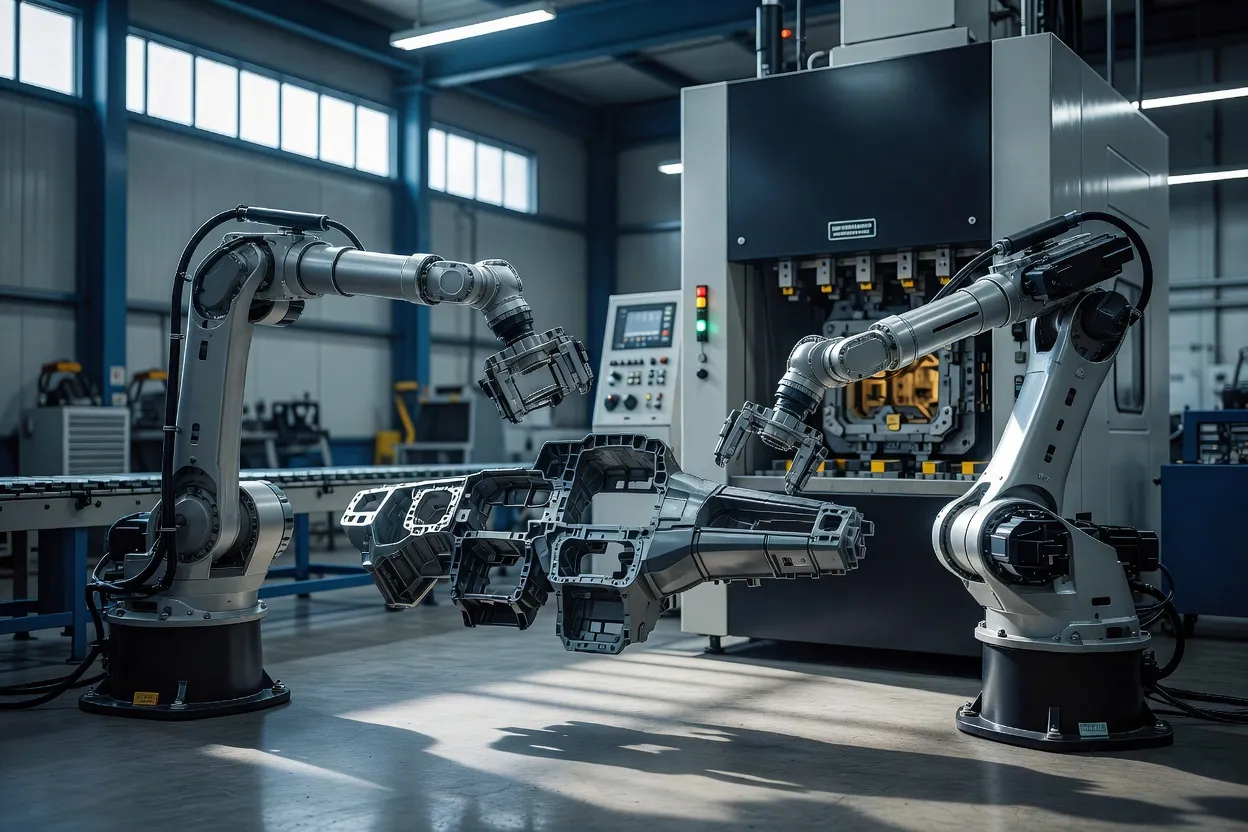
Twin robots take center stage in KraussMaffei’s automation push
KraussMaffei is sharpening its automation offer for complex injection molding with the launch of the LRXplus Twin multiple-kinematics system, extending its LRXplus linear robot platform into coordinated twin-robot operation for demanding multi-step processes.
The new configuration is aimed squarely at molders wrestling with high-cavity tools, multi-daylight molds, insert loading, and downstream assembly or sorting in tight footprints—applications where conventional single linear robots or standalone six-axis systems can become a bottleneck.
What’s new: mechanically coupled twins and shared motion control
At the heart of the development is the idea of multiple kinematics: up to four robots, each with six axes, coordinated as a single automation system via a shared control and program environment.
For the LRXplus family, KraussMaffei now offers the LRXplus Twin in Twin X and Twin Z variants, each designed for payloads in the 35 to 100 kg range, giving processors scope to handle sizeable grippers, multi-part take-out, or complex assemblies on large presses.
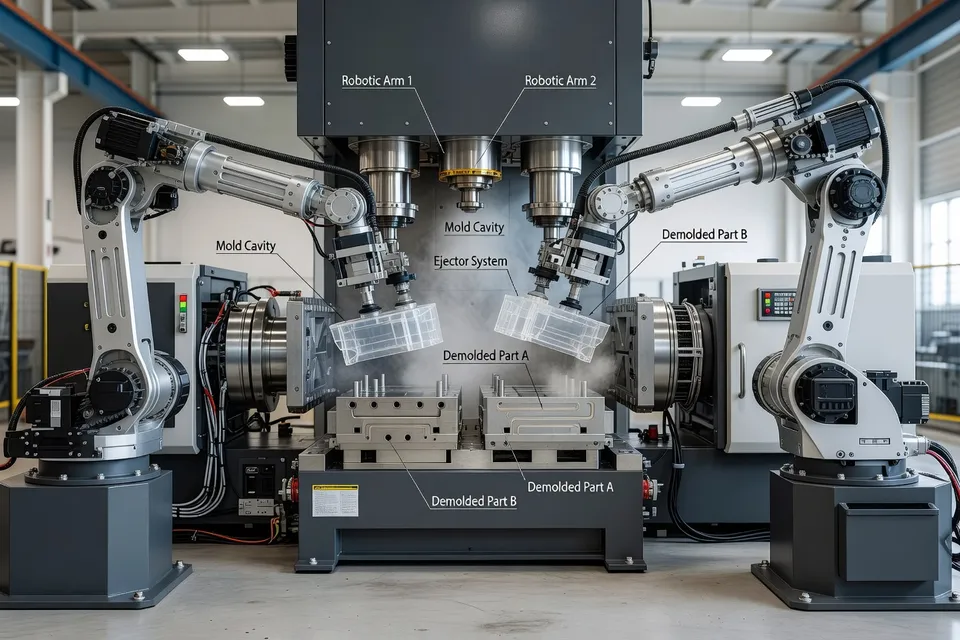
Mechanically coupled axes allow the two robots to perform:
- Precise parallel movements along shared axes for simultaneous demolding or placement in the mold.
- “Handshake” transfers where one robot passes parts on the fly to another without stopping the line.
This coupling is intended to reduce cycle time by overlapping motions rather than running removal, transfer, and placement sequentially. For multi-stage processes—such as removal, assembly, sorting, and interlinking—better synchronization between steps can translate directly into more parts per hour and more stable quality.
smartControl MC7: one brain for up to 24 axes
To make twin kinematics practical on the shop floor, KraussMaffei has upgraded its control concept. The smartControl MC7 platform can centrally program and coordinate up to four robots with six axes each, for a total of 24 axes in one system.
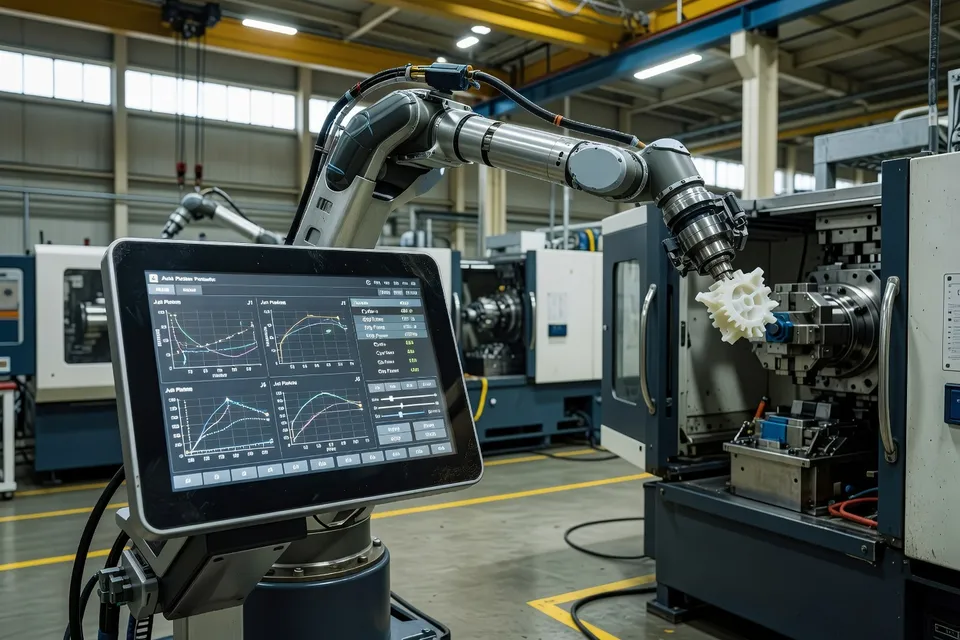
Key elements include:
- A shared coordinate system across all axes to simplify programming and mode changes.
- A joint program editor (HTML5-based in the MC7 implementation) so engineers can assign commands to individual robots with minimal effort.
- A handheld multi-touch pendant for setting up complex motion sequences directly at the cell.
In earlier MC6-based multiple-kinematics implementations, KraussMaffei already highlighted benefits such as central peripheral signal management, intelligent collision monitoring of linked axes, and flexible assignment of process steps to different robot axes. The new MC7 generation extends that logic with modern UI tooling and web technologies, responding to user expectations shaped by smartphone interfaces and Industry 4.0 projects.
For processors, the practical upside is that complex automation ceases to be a patchwork of separate robot programs and PLC logic. Instead, the injection molding cell can be treated as a single, coordinated system where mold movement, demolding, assembly, quality checks, and buffering are programmed against a shared timeline.
Designed for real-world plants: compatibility and layout options
KraussMaffei positions the LRXplus series as universal, easy-to-integrate linear robots with over 500 axis combinations, covering every clamping force level with preconfigured axis and wrist options. The LRXplus Twin follows that approach, but adds multiple-kinematics capabilities to the package.
According to the company, the LRXplus Twin can be operated as an integrated or standalone solution, and is compatible both with current KraussMaffei machines and older control generations, as well as injection molding machines from other manufacturers.
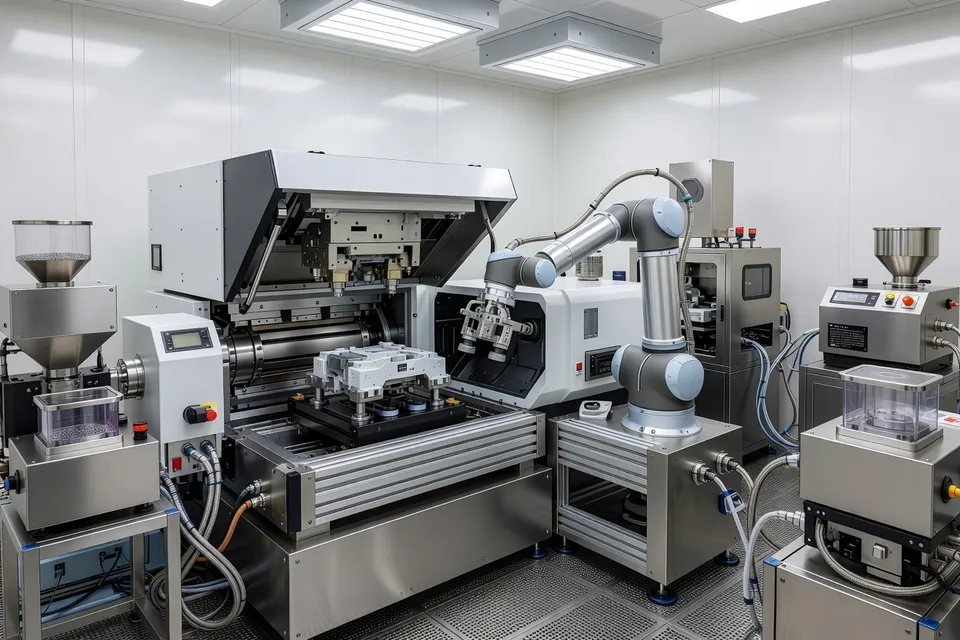
That matters for plants where the press fleet is mixed and where investment cycles are long. Rather than tying the twin robotics exclusively to new premium machines, KraussMaffei is signaling that multi-kinematics automation can be applied as retrofit or cell upgrade without forcing premature machine replacement.
The company has also introduced more compact linear-robot concepts on the same platform, such as the LRXplus SE side-entry robot for high-cavity and cleanroom applications, enabling higher machine density—for example, five production cells in the space previously used for four. Those developments sit in the same design philosophy: extraction and downstream processes should occupy less footprint while becoming more dynamic and payload-capable.
Impact on complex molding: fewer dead times, more options
For molders and brand owners, the most immediate implication of the LRXplus Twin concept is better use of machine dead time. By overlapping mold opening with robot entry—an approach KraussMaffei previously promoted under its “synchronous motion” function—demolding time reductions of up to around 35% and cycle time improvements of about 6% have been reported in large-part applications such as trash containers.
While the new twin kinematics are described more generally than that specific case, the direction is clear: cycle time is attacked through coordinated motion and early intervention, not just faster drives. As more gripper operations, insert placements, and quality checks are folded into the same cycle, the ability to choreograph multiple robots against the mold movement curve becomes strategic.
For processors, this opens several routes:
- Higher throughput on existing presses by cutting non-productive time between cycles.
- More integrated work steps per cycle, supporting functional integration and multi-component strategies such as KraussMaffei’s Multinject and multilayer concepts.
- Reduced hardware complexity where robot motion can replace elaborate gripper mechanics, simplifying maintenance and changeovers.
In sectors like automotive, medical, and packaging—where traceability, cleanliness, and repeatability are paramount—being able to centralize robot and peripheral control around the machine also supports tighter documentation and more robust validation of the production sequence.
How it fits into the wider digital and automation trend
The LRXplus Twin debut arrives as the plastics industry doubles down on automation and digitalization to cope with labor shortages, cost pressure, and recycled material variability. KraussMaffei, for instance, has recently expanded digital process control with AQCplus, which adapts holding pressure based on part weight to stabilize cycles when recyclates or filled compounds fluctuate.
Taken together, weight-based adaptive process control, compact linear robots such as LRXplus SE, and multiple-kinematics solutions like LRXplus Twin point to a future where:
- The molding machine defines the cycle, but robots and sensors collaboratively squeeze out idle time.
- Complex demolding and assembly are no longer afterthoughts, but engineered as part of the machine’s process window.
- Quality assurance and material-efficiency targets are built into the cell’s software architecture, not just downstream inspection.
For processors evaluating automation investments, the questions now shift from “one robot or two?” to how many axes can be centrally coordinated, on which presses, and with what upgrade path. KraussMaffei’s move to extend LRXplus with a Twin option—and to run up to four robots and 24 axes under smartControl MC7—positions the company as a supplier of integrated, scalable automation rather than isolated pick-and-place hardware.
The commercial stakes are high: as molded parts become more sophisticated and sustainability demands tighter material and energy performance, the plants that can orchestrate multiple robots, quality controls, and assembly steps in one synchronized sequence will be better placed to win long-term programs. The LRXplus Twin gives KraussMaffei users a clearer route into that kind of automation—without abandoning their existing presses.
Editorial Insights
- How does multi-robot kinematics change the way processors should think about cycle-time optimization in complex molding cells?
- Multi-robot kinematics shifts cycle-time optimization from individual motion speed to system-level choreography. When several axes are coordinated against the mold’s movement curve, dead times between opening, take-out, transfer, and downstream steps can be overlapped rather than queued. For processors, this means looking at the entire cell as one timeline, where every axis and peripheral is tuned to squeeze out idle seconds and stabilize quality, rather than treating demolding and assembly as separate, add-on tasks.
- What are the strategic benefits of centralizing control of robots, peripherals, and quality checks in a single molding cell architecture?
- Centralized control allows processors to program mold movement, demolding, assembly, inspection, and buffering as one coherent process rather than a patchwork of separate programs. This improves traceability and validation, simplifies change management, and reduces the risk of hidden interactions between independent controllers. Strategically, it supports consistent documentation for demanding end markets, makes complex cells more maintainable, and creates a clearer platform for future upgrades in areas like inline quality assurance and data-driven optimization.
- How can highly coordinated robot cells support sustainability and material-efficiency goals in plastics processing?
- When robots, sensors, and the press share a common control environment, the cell can actively react to material variability while keeping cycles stable. Inline weighing, adaptive pressure profiles, and integrated quality checks reduce scrap, improve consistency with recyclates and filled compounds, and help avoid over-dimensioned parts. This tighter process window directly supports material-efficiency and energy targets, and provides the data backbone required to document sustainable production to customers and regulators.
- What does a scalable, retrofit-friendly automation concept mean for plants with long investment cycles and mixed machine fleets?
- A scalable, retrofit-ready concept allows plants to modernize cells stepwise, adding advanced robotics and control without forcing early replacement of functioning presses. This is particularly important where clamping forces, control generations, and machine brands vary across the shop floor. It enables unified automation standards, common training and spare parts strategies, and more consistent performance across old and new equipment, which together lower lifecycle costs and make automation upgrades financially and operationally manageable.
- How might increasing axis counts and automation density reshape workforce skills and safety practices in molding plants?
- As cells move from single-robot handling to multi-axis, tightly choreographed automation, the emphasis shifts toward programming, diagnostics, and system-level optimization skills. Operators need to understand coordinated motion, collision monitoring, and integrated safety concepts rather than just basic robot teach-in. At the same time, well-designed multiple-kinematics systems can improve safety by standardizing interfaces and reducing ad-hoc mechanical solutions, provided plants invest in training and clear procedures for setup, maintenance, and changeovers.
- Why is it increasingly important to treat demolding and downstream assembly as integral parts of the molding process window rather than separate add-ons?
- Demolding, insert handling, and assembly directly influence part quality, cycle time, and the achievable complexity of the product. When these steps are engineered within the same process window as the mold itself, their timing and mechanics can be matched to the polymer’s behavior and cooling curve, reducing stress, deformation, and variability. This integrated view is essential for high-cavity, multi-component, and functionally integrated parts, where downstream operations are no longer optional extras but core enablers of the product design.
References
- 1.plasticker. (2026, August 27). KraussMaffei: Multiple kinematics accelerates complex injection molding automation. plasticker.
- 2.plasticker. (2026, August 19). KraussMaffei Extrusion: Xinting Ren to take over as managing director. plasticker.
- 3.Plastech. (2026, September 7). Technologies - news - portal Plastech.pl. Plastech.
- 4.SKZ. (2026, August 26). Digital Innovation Days 2026: Experience the digital future of the plastics industry. SKZ.
- 5.Bay Plastics Machinery. (2026, August 26). S.M.A.R.T. Control makes Bay pelletizers easier to operate. Bay Plastics Machinery.
- 6.Plastics Technology. (2025, July 18). Latest plastics tech press releases & PR updates. Plastics Technology.
- 7.Extrusion. (2026, August 24). News. Extrusion.
- 8.Plastics Machinery & Manufacturing. (2026, March 31). Plastics Machinery & Manufacturing: Home. Plastics Machinery & Manufacturing.