

Market momentum shifts toward firmer pricing
Industrial rubber is moving through 2026 with steady demand growth, but the underlying market tone is being set by higher raw material prices and a tighter natural rubber balance. Persistence Market Research values the global industrial rubber market at US$ 181.5 billion in 2026 and expects it to reach US$ 299.2 billion by 2033, a trajectory that points to a CAGR of 7.4% between 2026 and 2033. The same research identifies Asia Pacific as the leading region with 46% of the market in 2026, supported by China’s automotive base, construction activity, concentrated natural rubber production in Thailand and Indonesia, and India’s expanding industrial rubber sector.
For processors and belt manufacturers, that combination matters because industrial rubber demand is no longer driven only by volume growth in tires and general manufacturing. The market is also being pulled by electrification, infrastructure spending, and broader industrial modernization. In practical terms, that means belt producers and compounders face stable end-use demand but less room to absorb raw-material volatility.
Natural rubber supply is still the pricing anchor
The latest ANRPC reports point to a market that remains structurally short in several months of 2026. In February, ANRPC projected global natural rubber production at 15.324 million tons for 2026 and consumption at 15.602 million tons, while noting that February output was forecast at 994,000 tons and consumption at 1.088 million tonnes. The association also reported firmer pricing across major grades, including SMR-20 at USD 2.01 per kg in Kuala Lumpur and STR-20 at USD 2.11 per kg in Bangkok during February.
By April, the imbalance had widened operationally: ANRPC estimated global natural rubber production at 772,000 tons, down 2.59% year-on-year, while global consumption was projected at 1,235,000 tons, up 2.3% year-on-year. The report said production was hit by seasonal wintering, dry conditions in Southeast and South Asia, and rising El Niño concerns later in the year. It also flagged sharp trade swings, including China’s imports falling 13.35% to 538,200 tons and India’s imports rising 38.79%.
Those figures are important for industrial rubber users because natural rubber remains a key input for many industrial belts, hoses, seals, and vibration-control products. When input costs rise, converters usually face a lag before those costs can be passed through, especially in contract-heavy industrial supply chains.
Belt demand benefits from industrial and conveyor use
Mordor Intelligence’s industrial rubber market report places conveyor belts at 38.67% of the market size in 2025, with a projected 4.91% CAGR through 2031. It also says the industrial rubber market will expand from USD 16.88 billion in 2026 to USD 20.36 billion by 2031, at a 3.81% CAGR. While this estimate is much smaller than Persistence Market Research’s broader industrial rubber valuation, both reports point in the same direction: belts are among the most durable demand categories in the sector.
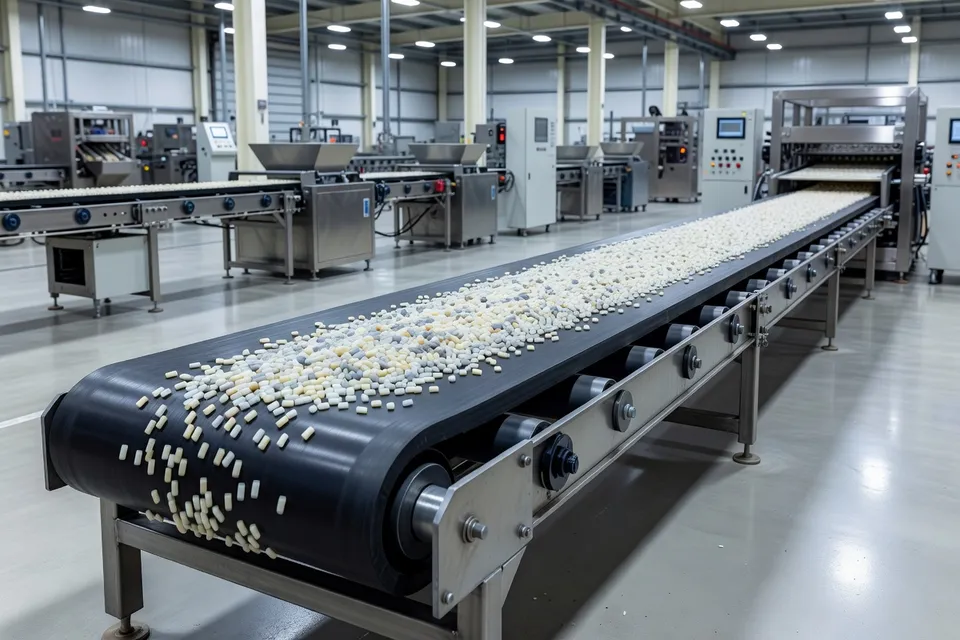
That is commercially significant for mines, logistics operators, cement plants, food processors, and industrial automation users that rely on continuous conveying systems. Belt replacement cycles, plant uptime requirements, and abrasion resistance standards keep demand relatively resilient even when wider manufacturing growth softens. At the same time, buyers are becoming more selective about total cost of ownership, not just purchase price.
Synthetic rubber retains its structural edge
Business Research Insights says the global rubber market is worth USD 68.93 billion in 2026 and is expected to reach USD 137.77 billion by 2035, with a CAGR of 8%. It also says synthetic rubber dominated in 2026 because of durability, chemical resistance, and industrial usage. That reinforces a broader industry pattern: where performance requirements are strict, synthetic grades tend to gain share, while natural rubber remains crucial where resilience and elasticity are central.
For supply chains, the commercial implication is clear. Producers with exposure to conveyor belts, industrial hoses, gaskets, and other engineered rubber goods will likely continue to see healthy underlying demand, but margin management will depend on procurement strategy, formulation discipline, and the ability to secure consistent feedstock. Asia-Pacific’s lead position also suggests that regional capacity, shipping costs, and trade policy will remain important competitive variables for 2026 and beyond.
What processors should watch next
The near-term question is not whether industrial rubber demand is growing, but whether the sector can preserve margins while raw material prices stay firm. ANRPC’s monthly reports show that natural rubber supply remains vulnerable to weather, seasonal wintering, and country-specific trade shifts. At the same time, market studies indicate that industrial rubber and conveyor belts continue to benefit from long-cycle industrial demand in Asia-Pacific.
That mix gives suppliers a constructive volume backdrop, but one that rewards operational efficiency. Companies that can manage inventory, compound flexibility, and regional sourcing are better positioned than those relying on spot purchases or narrow supplier bases. For belt producers in particular, steady growth is likely to be accompanied by tighter specifications, stronger buyer scrutiny, and a stronger premium on dependable delivery.
Editorial Insights
- How can industrial rubber processors protect margins when raw material markets stay tight and prices firm?
- Margin protection in a firm-cost environment rests on disciplined procurement and operational agility rather than chasing spot bargains. Processors are increasingly relying on multi-region sourcing, hedging or indexed contracts, and flexible formulations that can rebalance natural and synthetic inputs without compromising performance. Adding tighter inventory management and closer collaboration with end users on specification and price-adjustment mechanisms can turn cost volatility into a managed, rather than existential, risk.
- What does the growing reliance on conveyor and industrial belts imply for long-term asset and maintenance strategies?
- As belts consolidate their role as a core, relatively resilient demand segment, asset strategies are shifting from lowest purchase price to lifecycle optimisation. Plant operators are weighing abrasion resistance, energy efficiency, and uptime performance against replacement intervals and service support to reduce unplanned stoppages. This puts pressure on belt suppliers to document total cost of ownership, standardise performance data, and offer maintenance-friendly designs that fit into increasingly data-driven reliability programmes.
- How is the balance between natural and synthetic rubber evolving from a sustainability and risk-management perspective?
- Tight natural rubber balances are pushing supply chains to reconsider how far they can lean on substitution without eroding product resilience and elasticity. At the same time, scrutiny of land use, climate exposure, and carbon intensity is elevating interest in traceable natural rubber, lower-impact synthetic chemistries, and hybrid compounds. The emerging picture is less about choosing one material over the other and more about engineered blends that spread climate, price, and regulatory risk across a broader performance portfolio.
- What strategic implications does Asia-Pacific’s lead position have for global industrial rubber and belt supply chains?
- With production and demand increasingly concentrated in Asia-Pacific, global players face a structurally more regionalised market. This favours companies that align capacity with local growth, understand regional regulatory and logistics dynamics, and can arbitrage freight and tariff differentials. For buyers in other regions, it raises questions about supplier diversification, nearshoring key conversions, and designing supply networks that remain resilient if shipping costs, currency swings, or trade rules shift rapidly.
- How might electrification and industrial modernization reshape performance expectations for engineered rubber products?
- Electrified and automated systems tend to demand tighter tolerances, higher temperature and chemical resistance, and improved vibration and noise control from rubber components. This is pushing development toward more specialised compounds, advanced reinforcement technologies, and greater consistency in batch-to-batch performance. Suppliers that can translate system-level requirements into precise material specifications will be better placed to capture value in long-cycle projects where reliability and integration trump commodity pricing.
- What role can policy and standards play in stabilizing industrial rubber markets without stifling innovation?
- Policy levers are more effective when they target transparency and resilience rather than price control. Harmonised standards on safety, traceability, and environmental performance can reduce information asymmetries and lower compliance friction across borders, while leaving room for differentiated formulations and process innovation. Encouraging data-sharing on supply, promoting sustainable feedstock practices, and streamlining approval pathways for new materials can help the sector absorb shocks without freezing progress.
References
- 1.Persistence Market Research. (2026, July 19). Industrial rubber market size, share & analysis, 2033. Persistence Market Research.
- 2.Business Research Insights. (2026, September 1). Rubber market size, share, growth, and industry analysis by type and application, regional insights and forecast from 2026 to 2035. Business Research Insights.
- 3.Association of Natural Rubber Producing Countries. (2026, May 29). ANRPC releases Monthly NR Statistical Report, April 2026. ANRPC.
- 4.Association of Natural Rubber Producing Countries. ANRPC releases Monthly NR Statistical Report, February 2026. ANRPC.
- 5.Association of Natural Rubber Producing Countries. (2026, March 2). ANRPC releases Monthly NR Statistical Report, January 2026. ANRPC.