


From plastic bottles to bridge trusses: a new manufacturing architecture
What began as an MIT research project on sustainable housing has, by September 2026, matured into a commercial platform that recycles mixed plastic waste into structural composites without using water. Atlas Building Composites, spun out of the MIT HAUS (Home Architecture for Universal Sustainability) program, has engineered an AI-driven, robotic manufacturing cell that shreds single-use plastics, melts them, and fuses the melt with fiberglass before large-format 3D printing converts the composite into load-bearing components.
At MIT, researchers demonstrated this architecture by printing composite trusses for floors and other framing elements from recycled polyethylene terephthalate (rPET) mixed with glass fibers, showing that a waste stream dominated by discarded drinks bottles could become construction-grade material. The spinout now uses similar principles to turn low-grade, mixed plastics into trusses, foundations, decks, and other structural parts.
How Atlas’ waterless composite line works
Closed-loop, water-free conversion of plastic waste
Traditional mechanical recycling lines depend on washing systems and wastewater treatment – infrastructure that is expensive, permitting-intensive, and often unfeasible in water-stressed regions. Atlas’ process deliberately sidesteps this bottleneck. Single-use plastics, such as water bottles and other packaging, are shredded and melted directly, then compounded with American-made fiberglass into a composite that testing shows can perform stronger than wood in structural applications.
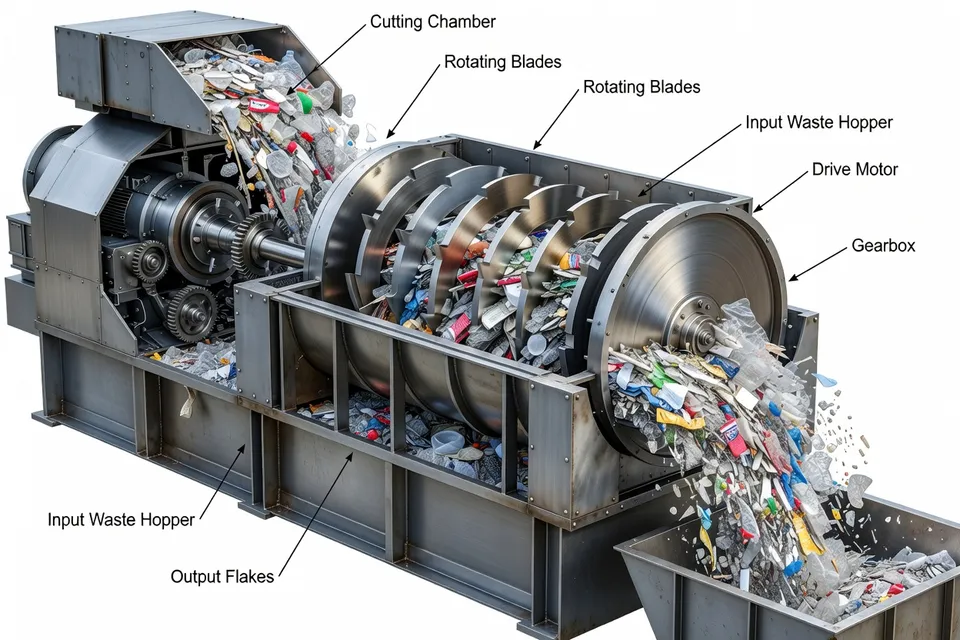
Critically, this recycling step is waterless. Atlas’ founders emphasize that eliminating water from the process is not just a sustainability gesture; it simplifies permitting and makes small manufacturing cells viable in locations where water access or treatment capacity would otherwise block new plants. For plastic processors and recyclers, that design choice opens up new geographies for composite production without the capital cost of wash lines.
Large-format 3D printing replaces molds and formwork
Once compounded, the plastic–fiberglass paste is fed into a large-format 3D printer that deposits material into engineered truss and framing geometries. Tests in MIT labs documented that a full-scale composite truss could be printed in under 13 minutes and carry loads exceeding about 4,000 pounds (around 1,814 kilograms), validating the structural performance of the material and the printing workflow.
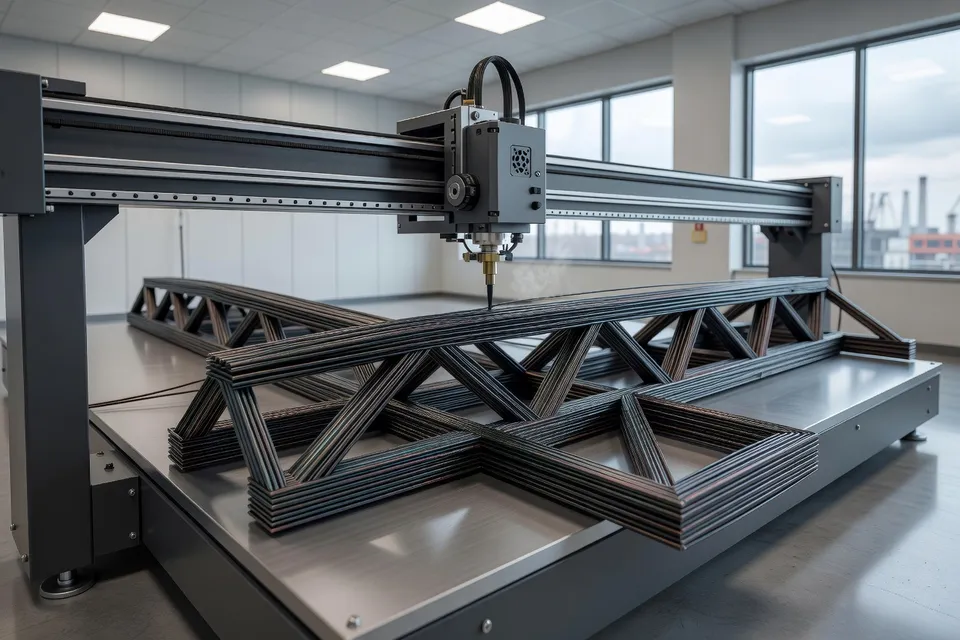
These printers are tuned for structural components rather than prototypes. Atlas reports output in the range of 60 to 80 pounds of parts per hour in MIT’s research setup, rising to approximately 150 to 200 pounds per hour in factory configurations. At that rate, a single modular cell can produce the framing package for a small home in roughly one day, directly from waste feedstock.
Micro-factories as a new production model
Distributed composite manufacturing near job sites
Instead of a single megafactory, Atlas is positioning its technology as modular micro-factories that sit near construction markets. Company materials describe a manufacturing loop of "Waste Plastic → Composite Materials → Robotic Manufacturing → Structural Building Components," with on-site cells designed to print foundations, trusses, and other framing elements close to where they will be installed.
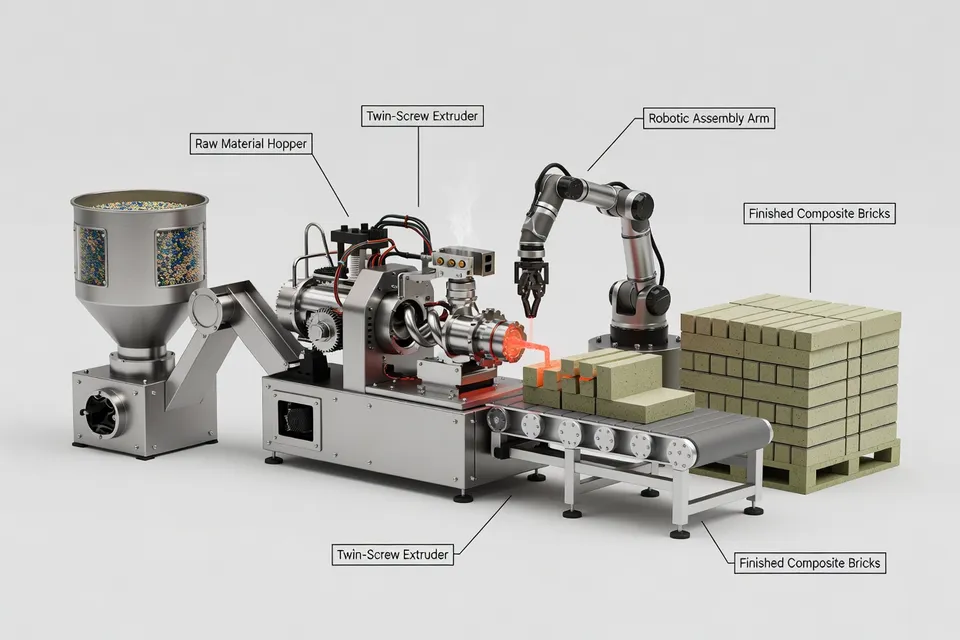
Atlas’ leadership outlines a vision of "home factories" capable of turning regional plastic waste streams into structural components for local housing. In practice, each factory cell today can deliver the structural framing for about one small home per day, and the firm’s founders talk about deploying thousands of such AI-enabled systems worldwide.
For builders, that model promises shorter lead times and fewer transportation constraints. Instead of shipping heavy concrete or timber components across continents, contractors could source composite frames that are printed a short drive away, with feedstock drawn from municipal or industrial plastic waste streams.
Early field deployments: barns, docks, and a 40-foot bridge
Atlas’ composites are already in use beyond the lab. Company and MIT reporting highlight installations supporting barns, sheds, decks, and docks, where corrosion resistance and moisture tolerance matter. The highest-profile project to date is a 40-foot bridge in a Massachusetts wetland, where Atlas supplied American-made recycled composite trusses to the U.S. Army Corps of Engineers. Assembly was completed in less than 24 hours, showcasing both the structural capacity of the trusses and the logistical advantages of prefabricated, lightweight components.

"Our mission is to convert waste plastic pollution into durable composites to build 1 billion homes." - A.J. Perez, chair and co-founder at Atlas Building Composites said
That mission statement points to a housing-first strategy. By focusing on foundations and framing systems, Atlas is targeting the parts of a house where performance, cost, and labor intensity intersect – and where incumbent materials like wood and concrete carry both carbon and supply-chain risks.
Automation, AI, and the broader composites trend
The Atlas platform sits squarely within wider automation trends in composites manufacturing. Industry sources describe the benefits of automated composite processes – including automated tape laying, fiber placement, and filament winding – as higher throughput, greater repeatability, shorter cycle times, and reduced labor cost compared with manual layup.
Atlas extends this mindset to recycling. Its cells combine robotics, AI-driven process control, and large-format additive manufacturing to create a closed-loop system: feedstock identification, shredding, compounding, and printing are coordinated to minimize touch labor. For plastics compounders used to twin-screw lines and downstream pelletizing, the Atlas architecture effectively merges compounding and part fabrication into one automated work cell, bypassing the pellet stage entirely.
What this means for plastics and rubber processors
New outlet for low-value, mixed waste streams
Many recyclers struggle to monetize mixed, contaminated, or low-grade plastics that are uneconomic to sort and reprocess into high-purity pellets. Atlas’ waterless composite manufacturing offers a different route: turning these streams directly into long-life structural products. Since the material is intended for decades of service in housing and infrastructure, it removes plastic from the short-loop packaging cycle and embeds it in assets that are rarely landfilled quickly.
For processors and municipalities, that could translate into new offtake agreements and tipping-fee models where the output is not flakes or pellets, but building components.
Operational implications for converters and builders
The platform changes several assumptions for converters and construction firms:
- No wash line: Plants do not need high-capacity washing and drying equipment, reducing capital requirements and simplifying permitting.
- On-demand geometry: Large-format 3D printing allows custom truss and foundation designs without new molds, which is attractive for small-batch or custom projects.
- Job-site efficiency: Lightweight, corrosion-resistant composite footings and frames can be moved and installed faster than many conventional alternatives, a point Atlas stresses in its description of foundations designed to replace traditional concrete solutions.
From a commercial perspective, this suggests a hybrid role for plastics firms: supplying feedstock, operating micro-factories under license, or integrating Atlas cells into existing compounding and fabrication operations. For brand owners in construction and infrastructure, it opens a path to verifiable waste diversion and embodied-carbon reductions without abandoning structural performance.
Next steps: scaling waterless composites without losing rigor
The technology has crossed an important threshold: it is already holding up barns, decks, and a 40-foot bridge, not just coupon samples in a test rig. Yet Atlas acknowledges that full-scale cost curves, environmental impact assessments, and long-term durability data will be decisive for widespread adoption. Testing and certification efforts are under way; a mid-2026 update notes grant funding to accelerate structural testing and code-compliance pathways for the company’s printable footings.
For now, the story is clear enough for the plastics and rubber community. Waterless composite manufacturing from plastic waste is no longer theoretical. It is an emerging process architecture—combining AI-guided automation, composite engineering, and distributed micro-factories—that invites processors, recyclers, and builders to treat plastic waste as structural inventory rather than a disposal burden.
Editorial Insights
- How could waterless composite manufacturing reshape the economics of low-value plastic waste for processors and municipalities?
- By eliminating wash lines and turning mixed, contaminated plastics directly into long-life structural products, waterless composite manufacturing converts a costly waste liability into a sellable asset with predictable demand in construction. This enables new offtake and tipping-fee models where revenue is tied to structural components rather than flakes or pellets, improving margins on hard-to-recycle streams while stabilizing supply for local building markets.
- What are the main technical risks processors should scrutinize when adopting AI-driven, waterless composite lines for structural components?
- Processors need to examine how mixed feedstock variability is managed by AI and process control, particularly in achieving consistent mechanical properties in structural parts. They should also probe long-term durability data, resin–fiber interface performance, and resistance to moisture, creep, and fatigue, alongside the robustness of automated quality assurance, to ensure the line meets structural codes without adding hidden rework or liability.
- In sustainability terms, how does embedding mixed plastic waste in structural composites differ from conventional recycling routes?
- Traditional mechanical recycling keeps plastics in short-lived packaging loops, where material often returns to waste streams within months. Embedding mixed plastics in structural composites ties them up in assets designed for decades of service, reducing leakage to landfill or the environment and shifting the discussion from recycled content percentages toward genuine waste removal and embodied-carbon performance in buildings and infrastructure.
- What regulatory and standards challenges could slow broader use of structural composites made from mixed plastic waste?
- Regulators and standards bodies will demand rigorous, repeatable data on load-bearing performance, fire behavior, weathering, and end-of-life options before approving new composite systems for primary structural use. Navigating building codes, infrastructure specifications, and third-party certification will require extensive testing and clear design guidelines, so early engagement with standards organizations is as critical as the underlying process innovation.
- How might modular micro-factories near job sites alter supply chains and competitive dynamics in the building materials sector?
- Distributed micro-factories shift value creation closer to the construction site, reducing dependence on centralized mills and long-haul logistics for heavy components. This favors regional waste collection networks and licensed operators over traditional materials suppliers, potentially fragmenting the market while rewarding firms that can integrate design, local feedstock sourcing, and automated production into a unified service offering.
- What ethical and societal questions arise when housing and infrastructure depend on composites made from waste plastic?
- Using waste plastic to build homes and bridges raises questions about transparency, trust, and long-term responsibility: occupants and communities need reassurance that performance and safety match or exceed traditional materials. It also challenges perceptions of waste, framing it as structural inventory rather than a burden, which could influence how societies prioritize reduction at the source versus clever re-use in essential assets.
References
- 1.Winn, Z. (2026, September 14). MIT spinout turns plastic waste into resilient building materials. MIT News.
- 2.Atlas Building Composites, INC. Atlas Building Composites, INC. – Building composites of the future. Atlas Building Composites, INC.
- 3.Global Sources. (2026, September 14). MIT spinout Atlas Building Composites turns plastic waste into construction materials. Global Sources.
- 4.Phys.org. (2026, September 4). AI-driven polymer discovery could replace years of trial and error with closed-loop testing. Phys.org.
- 5.Tech & Business. (2026, September 10). Anthropic researcher's AI extinction warning draws lab scrutiny. Tech & Business.
- 6.Tech & Business. (2026, August 28). MoonPay acquires Rhythm for onchain trading tools. Tech & Business.
- 7.The Daily News Now. (2026, September 14). Tech News Today | 2 min news | The Daily News Now! Apple Podcasts.
- 8.CompositesWorld. (2026, September 9). Automation in composites. CompositesWorld.
- 9.AMI Magazines. (2026). Compounding World: The global magazine for polymer compounders. AMI Magazines.
- 10.Adsale Plastics Network. (2026, September 2). KraussMaffei at Fakuma 2026: New ZSA UltraCycle side-entry solution boosts recycling performance. Adsale Plastics Network.