

September’s red screens point to a squeeze in 2026 margins
Equity markets are starting to price in tougher operating conditions for leading tire and rubber manufacturers, as a broad-based share price retreat in early September 2026 contrasts with largely positive first-half earnings.
Data compiled by the European Rubber Journal’s Rubber & Tire Industry in Numbers series show that from 3–4 September to 10–11 September 2026, major listed tire makers lost ground across the board. Bridgestone fell from Yen4,067 to Yen3,778, a 7.1% drop, while Goodyear declined from $6.21 to $5.75, down 7.4% over the same period. Hankook slipped 5.1% to KRW63,100, and Michelin eased 1.8% to €33.83.
Major tire maker stock price changes, September 2026
| Tire maker | Stock price change (%) |
|---|---|
| Bridgestone | -7.1 % |
| Goodyear | -7.4 % |
| Hankook | -5.1 % |
| Michelin | -1.8 % |
The weakness was mirrored in non-tire rubber stocks. Between 3–4 September and 10–11 September, Cooper-Standard fell from $25.75 to $24.75 (-3.9%), Datwyler from CHF131.00 to CHF127.60 (-3.0%), and Sanok Rubber from PLN22.60 to PLN21.00 (-7.1%), while Hexpol edged down 1.0%. Earlier in the month, the same ERJ dashboard showed Top Glove dropping 5.9% to MYR0.64 between 27–28 August and 3–4 September, even as some peers such as Semperit managed modest gains.

For executives, the coordinated move lower is less about a single shock than about investors reassessing the balance between robust revenue growth and rising input and operating costs.
Earnings still strong, but the quality of profit is under scrutiny
At face value, 2026 has been a solid year for many global tire and rubber manufacturers. ERJ’s latest financial scorecards show Hankook Tires reporting H1 2026 sales of KRW5,373 billion, up 10.6% year-on-year, with earnings rising 35.4% to KRW920.7 billion. ZC Rubber posted Yuan23.5 billion (€3 billion) in H1 2026 sales, up 7.4%, and earnings of Yuan2.4 billion, up 5.8%. The Semperit Group recorded €356 million in H1 2026 sales, a gain of 11.1%, and more than doubled earnings, which rose 116% to €66.6 million.
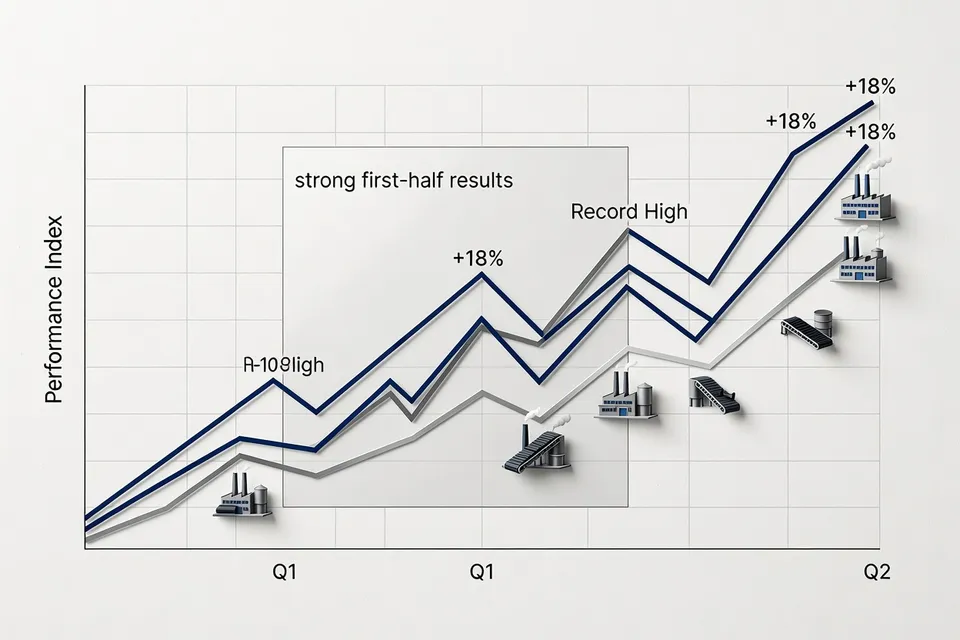
These figures suggest that volumes and pricing have so far supported a healthy sustained compound annual growth rate across key players. However, investors appear increasingly focused on whether current margins can be defended as the cost base shifts.
In its broader global survey of Top 50 rubber product manufacturers, ERJ noted that combined sales among non-tire producers fell in 2024, with European-based companies posting a 2.1% year-on-year decline. That backdrop of flattening revenue growth in mature markets, combined with strong 2026 earnings rebounds, raises a question: how much of the latest profit surge reflects cyclical price support and one-off items rather than durable, operational efficiency gains?
Natural rubber tightness helps sellers, but not every stock benefits
While exact price curves differ by source, the industry context is clear: natural rubber has entered a structurally tighter phase in the mid‑2020s, driven by slow replanting, competing land use and weather‑related supply constraints. Vietnam-focused reports highlight that since early May 2026, natural rubber prices have hovered around multi‑year highs, lifting export revenues and latex selling prices. Analysts there describe a “dual‑growth story” for producers, combining price‑driven uplift in core rubber operations with significant income from rubber tree liquidation and plantation land conversion.
In Vietnam, this mix is powering aggressive profit upgrades. One brokerage forecast that aggregate net profit for its rubber coverage universe could jump 92% year-on-year in 2026–2027, supported by elevated SVR10 prices around $2.5/kg and compensation for converting plantation land into industrial parks and expressway corridors. Companies such as Phuoc Hoa Rubber and Vietnam Rubber Group are singled out for sizable extraordinary gains tied to industrial-zone projects, where land conversion proceeds can outweigh latex margins.
For global investors, however, this narrative cuts both ways. On one hand, high natural rubber prices help defend selling prices for tires and technical rubber products. On the other, they create margin pressure for manufacturers that cannot fully pass through cost increases or do not enjoy land‑conversion windfalls.
Cost inflation and regional shifts weigh on sentiment
ERJ’s September business briefing underscores how cost inflation is filtering through the supply chain. Flexsys announced a global price increase of up to 20% for all grades and package types of insoluble sulphur, citing persistent cost escalation linked to geopolitical events in the Middle East. Tosoh Corp. flagged price hikes of Yen110/kg or more for certain chloroprene rubber grades and Yen60/kg or more for others, driven by rising labour, logistics and raw material expenses.
For tire makers and rubber product manufacturers, these upstream moves compress the room to manoeuvre. Many suppliers are already locked into annual contracts or face intense competition, limiting their ability to push through equivalent increases. The result is a growing wedge between headline revenue growth and underlying margin resilience, which equity markets are beginning to discount.
At the same time, capital is being deployed into new capacity that will shape regional competitive positioning. ERJ data show ZC Rubber signing a $500 million (€431 million) letter of intent for an integrated tire plant in Egypt’s Suez Canal Economic Zone on 3 September, while Aeolus Tire has launched a Yuan1.4 billion (€180 million) expansion of giant engineering tire capacity in China. These projects position Chinese groups for continued share gains in off‑the‑road and truck/bus segments, potentially intensifying price competition and adding another layer of margin pressure for incumbents in Europe and North America.
What this means for processors and brand owners
For downstream processors and converters, the current message from rubber stocks is caution rather than crisis. As long as natural rubber prices remain elevated and specialty chemical suppliers push through double‑digit increases, procurement teams should assume that input costs will stay structurally higher in 2026 than in the years immediately following the pandemic.
Brand owners sourcing tires and engineered rubber components are likely to see more selective price increases, especially in higher‑margin niches such as off-highway tires, sealing systems and vibration‑control parts. At the same time, the share‑price decline suggests that public‑market investors are no longer willing to reward volume growth alone; they are demanding clearer evidence of disciplined capital allocation and sustainable margin profiles.
In practical terms, this environment is reshaping strategic market opportunities. Suppliers with access to ancillary profit streams – notably land conversion income, as seen in Vietnam – will have greater flexibility to invest in capacity, technology upgrades and sustainability projects without eroding risk‑adjusted returns. Those reliant purely on manufacturing spreads will need to sharpen their cost management, differentiate through product performance, and explore closer collaboration with OEMs on long‑term pricing frameworks.
For now, the screens are sending a simple signal: the sector’s earnings story is still intact, but investors expect a tougher margin backdrop ahead. Executives who respond early – by aligning investment plans, hedging strategies and contract structures to this new reality – will be best placed to navigate the next phase of the rubber cycle.
Editorial Insights
- How should rubber and tire manufacturers rethink their margin strategy in an environment of structurally higher input costs?
- Manufacturers need to move away from a purely volume-driven model and build margin strategies around disciplined pricing, tighter cost control, and more selective exposure to segments where performance and reliability justify premiums. This includes revisiting contract structures, embedding cost pass-through mechanisms where possible, and prioritising investments that genuinely improve operating efficiency rather than simply adding capacity. The goal is to turn margin resilience into a core competency rather than a short-term response to inflation.
- What are the sustainability implications of relying on land conversion and asset liquidation to support rubber-sector profitability?
- Using land conversion and asset liquidation as a profit pillar can ease short‑term financial pressure but risks undermining long‑term sustainability commitments and local ecosystems. It may also lock businesses into irreversible land‑use decisions that conflict with future carbon, biodiversity, and community expectations. Companies that treat such gains as strategic windfalls rather than recurring income are more likely to maintain credibility when balancing financial performance with environmental and social obligations.
- How is investor behaviour reshaping strategic priorities for rubber and tire companies in the current cycle?
- Investors are signalling that top‑line growth alone no longer earns a valuation premium; they are looking for evidence that capital is being deployed into projects with clear returns and defensible margins. This pushes management teams to scrutinise expansion plans more tightly, favour higher‑value niches over commoditised volume, and build clearer narratives around cash generation and risk‑adjusted returns. The result is a more selective growth agenda, where capital discipline becomes as important as market share.
- What does the current margin backdrop mean for procurement strategies at downstream processors and brand owners?
- Procurement teams should assume that elevated raw material and specialty chemical costs are not a short‑term anomaly and design contracts accordingly. This may involve longer‑duration agreements with indexed pricing, diversification of supplier bases, and closer collaboration on forecasting to reduce volatility. Brand owners that treat procurement as a strategic function—integrated with product design, inventory policy, and pricing—will be better able to absorb cost shocks without eroding customer relationships.
- How might regional capacity expansions alter competitive dynamics in key rubber and tire segments?
- New capacity in emerging production hubs is likely to intensify competition in truck, bus, and off‑the‑road segments, putting further pressure on incumbents that rely on pricing power in mature markets. Over time, this can shift trade flows, compress margins for less differentiated products, and accelerate the need for existing players to focus on technology, service, and lifecycle performance as their main differentiation levers. Companies slow to reposition portfolios could find themselves competing primarily on price.
- What ethical questions does a tougher margin environment raise for companies across the rubber value chain?
- When margins tighten, there is a temptation to cut corners on safety, labour standards, and environmental controls to protect earnings, which raises clear ethical risks. A more responsible approach is to treat these areas as non‑negotiable and instead pursue transparency on cost pressures, fair pricing discussions with customers, and incremental efficiency improvements. Firms that maintain standards under stress often build trust that translates into stronger long‑term commercial relationships and reputational resilience.
References
- 1.European Rubber Journal. (2026, September 4). Rubber & tire industry in numbers. European Rubber Journal.
- 2.European Rubber Journal. (2026, September 11). Rubber & tire industry in numbers. European Rubber Journal.
- 3.European Rubber Journal. (2026, September 14). ERJ business briefing – 2026. European Rubber Journal.
- 4.Minh Thuy. (2026, September 15). Rising prices and land conversions set to drive rubber profits. VIR.
- 5.Central News Agency. (2026, September 15). [Title not available]. CNA.
- 6.Plasteurope.com. (2026, September 14). Regions & countries. Plasteurope.com.
- 7.Plasteurope.com. (2026, September 14). Plastics news from Europe. Plasteurope.com.
- 8.Plasteurope.com. European plastics news. Plasteurope.com.