


UK plant turns PVC waste into controlled regranulate stream
In 2021, a UK manufacturer of extruded and injection moulded PVC products installed a dedicated PVC regranulation and compounding line to bring in-house waste and post-consumer profiles back into its production without sacrificing product quality. The project, engineered by Bausano with local partner Intelicare, now sits against a 2026 backdrop of weak European PVC demand and erratic global pricing, pushing more processors to treat internal scrap as a managed raw material stream rather than a disposal problem.
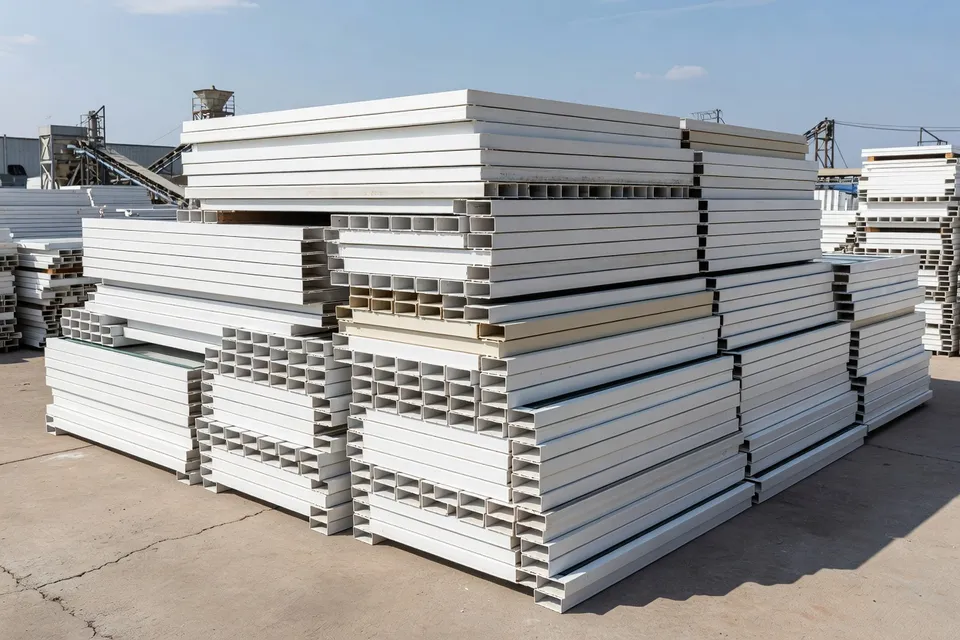
The UK case centres on rigid and flexible PVC waste, including window frames that would otherwise have gone to landfill, being granulated and compounded into ready-to-use pellets for the plant’s own extrusion and moulding lines. Rather than shipping mixed scrap to a third party, the processor treats regranulation as a core operation, with dedicated equipment sized for its actual volume and product mix.
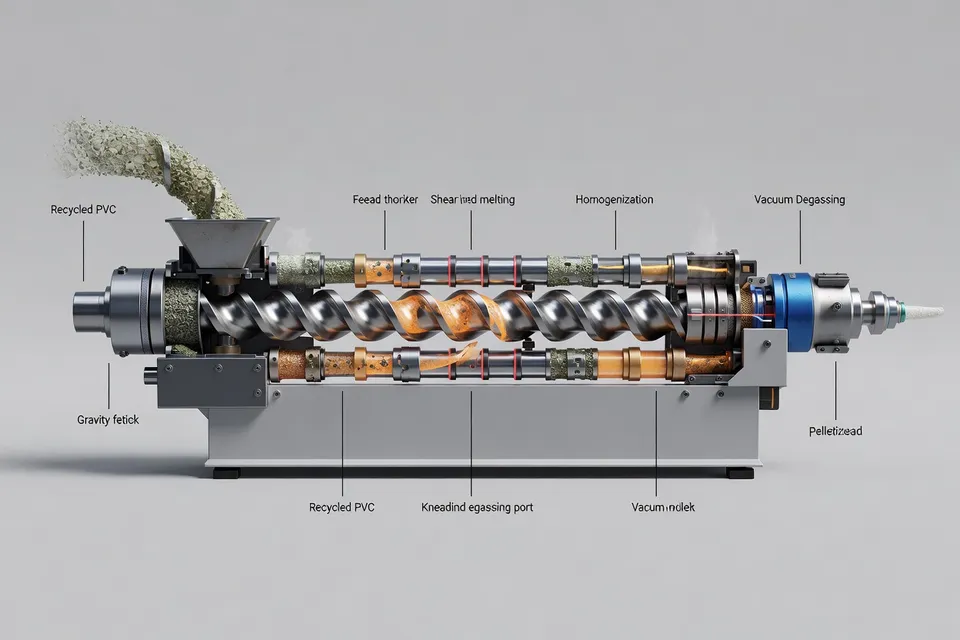
Inside the MD130 twin-screw compounding line
The line is built around a Bausano MD130 twin-screw extruder designed specifically for PVC compounding and regranulation. The extruder is part of an integrated system that includes:
- Digital Extruder Control 4.0 for line management
- Bausano’s Orquestra Industry 4.0 platform to supervise the entire extrusion line
- A die-face cutter
- Screen changer
- RG4 pellet cooling system
- Big bag loading with automatic changeover
For a PVC plant manager, the notable point is that this is not a bolt-on grinder feeding a generic extruder. It is a 1000 kg/h compounding line engineered to run recycled PVC at defined throughput, with instrumentation and software tied to material quality.
Multi-drive system: energy and mechanical implications
The MD130 uses Bausano’s patented multi-drive system, which splits torque across multiple motors to reduce stress on the gearbox and transmission components. In practice, that means:
- Lower mechanical load on each shaft
- Reduced risk of catastrophic gearbox failures
- A claimed 30% reduction in overall energy consumption versus conventional drives
For a processor trying to justify regranulation, this matters twice. First, PVC regrind is rarely as predictable as virgin resin; torque spikes are common when contamination or density shifts show up in the barrel. A multi-drive system gives some margin before those spikes translate into mechanical damage. Second, PVC prices in Europe have been under downward pressure, while energy and feedstock costs swing independently. Cutting extruder power consumption by 30% does not change the resin price, but it does harden the business case for running recycled feedstock during periods of thin margins.
Turning scrap into a controllable raw material
The UK processor’s line is configured to take segregated PVC waste, including cut-offs and end-of-life profiles, through granulation and compounding into pellets that can be reintroduced directly into existing product formulations. Bausano presents this as a way to lower virgin usage and meet internal sustainability targets, but the operational logic is straightforward:
- Scrap is classified and fed as a defined blend, not as a mixed, uncontrolled stream.
- Twin-screw compounding gives the shear and mixing needed to homogenise recycled PVC and additives.
- Pellet cooling and big bag loading turn a variable waste stream into a physically stable, trackable inventory.
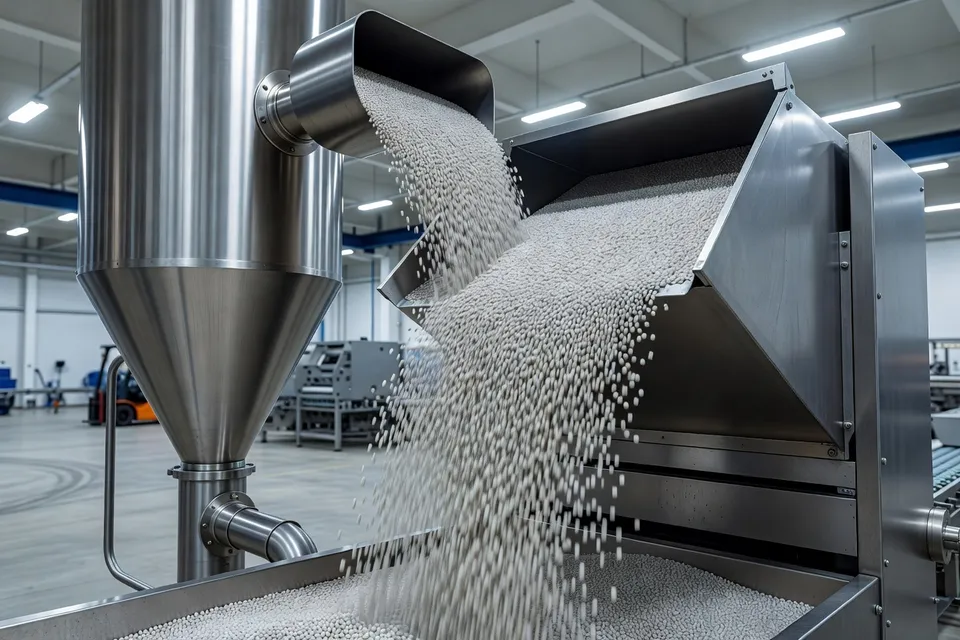
European recyclate markets in 2026 are described as supply-heavy, with price discounts and demand below normal levels. In that context, a plant-level regranulation line gives a PVC processor a choice: buy cheap recyclate from outside, or produce its own grades tuned to its exact extrusion conditions and colour targets.
Lessons from UK waste reduction practice
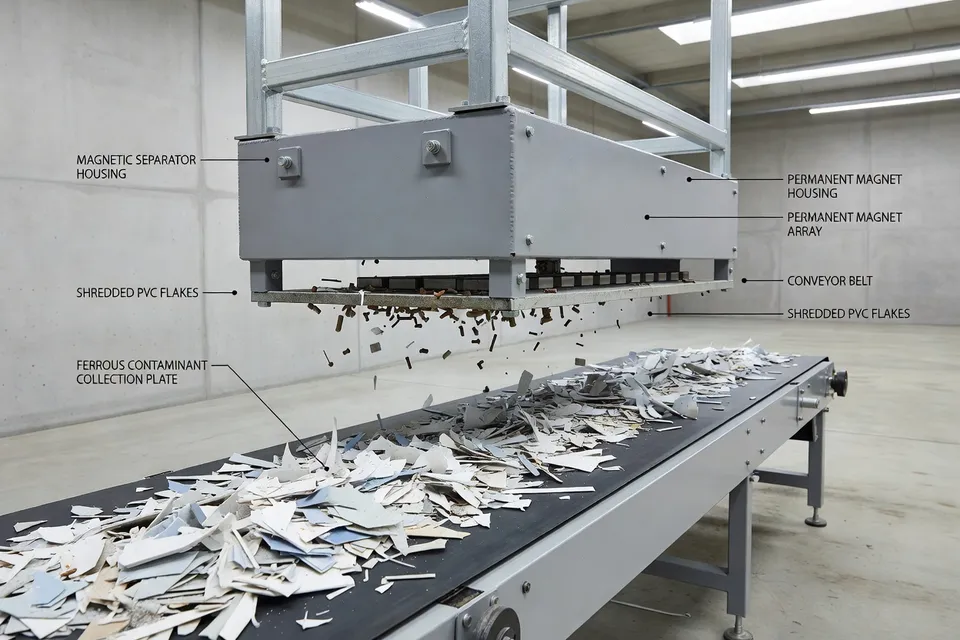
The UK is not short of examples where tight process control around PVC scrap delivers measurable gains. EcoVyn, for instance, cut waste from 60 tonnes to 4 tonnes after installing drawer filter magnets to capture ferrous contamination before pulverising PVC waste. Controlled tests showed 99.9% removal of ferrous metals, which directly reduced rejected material and protected downstream pulverisers and extruders.
"Since the installation of the magnetic separators, EcoVyn has reduced their waste by 94%." - Bunting Magnetics, application report for EcoVyn
For processors looking at a regranulation line, this kind of upstream housekeeping is not optional. A twin-screw extruder with a sophisticated drive and screen changer will still struggle if scrap carries metal or heavy mineral contamination. The UK case study line runs with a screen changer and pellet cooling, but its performance depends on the same kind of front-end sorting and cleaning EcoVyn put in place.
Market conditions: why 2026 favours in-house regranulation
PVC markets in 2026 show a mixed picture:
- In Europe, PVC demand recovery has fallen short, and supply remains heavy.
- Asia has seen sharp price swings driven by futures limits, property sector policies and higher upstream costs, not by strong downstream demand.
- US-origin PVC has, in earlier periods, fallen to multi-year lows in export markets, underscoring how quickly global benchmarks can shift.
For a plant depending solely on virgin purchases, this volatility complicates budgeting and margin management. An in-house regranulation and compounding line cushions the impact in several ways:
- Internal scrap becomes a partial hedge against feedstock price spikes.
- The plant can adjust recycled content by grade, increasing it where mechanical performance allows.
- Recycled PVC from known sources avoids some of the quality variability of spot-market recyclate.
Processors still need to track price signals and contract trends, but once a line like the MD130 setup is installed, they have a dial to turn on virgin versus recycled content, instead of treating scrap as a fixed loss.
Practical takeaways for PVC processors
Several plant-level lessons stand out from the UK regranulation and compounding experience and wider market context:
- Size the line to your real scrap volume. The UK case went to a 1000 kg/h line because it had steady PVC extrusion and moulding volumes to feed it. Smaller processors may need less capacity but the same focus on integrated control.
- Treat contamination first. EcoVyn’s magnet installation shows that basic metal removal can eliminate tens of tonnes of waste and protect regranulation equipment.
- Use twin-screw compounding for recycled PVC. The rheology and additive demands of recycled PVC are better handled on twin-screw lines designed for this job than on general-purpose extruders.
- Link regranulation to market intelligence. With European recyclate prices under pressure and Asia moving on cost-driven swings, the value of in-house recycled PVC shifts month to month. Processors with their own compounding lines can respond by adjusting recycled content, grades and customer messaging.
The UK case study shows that plant-level PVC regranulation and compounding is no longer a side project. With the right twin-screw line, front-end cleaning, and live monitoring of market trends, processors can turn PVC waste into a controlled, strategic raw material stream that supports both margin and circularity goals.
Editorial Insights
- How does treating PVC scrap as a managed raw material stream change the economics of a processing plant?
- When scrap is classified, compounded and pelletised to defined specifications, it shifts from being a disposal cost to a controllable input that can partially hedge against resin price volatility and tight margins. It reduces dependence on spot purchases, stabilises material planning and allows plants to flex recycled content by grade without compromising product performance. Over time, this integration can make capacity utilisation and cost per tonne more predictable than relying solely on virgin feedstock.
- Why is front-end sorting and contamination control critical for successful PVC regranulation and compounding?
- Metal and mineral contamination in PVC scrap quickly translates into equipment damage, off-spec pellets and higher reject rates if it is not removed before granulation. Robust upstream measures such as segregation, magnet installation and basic cleaning protect twin-screw extruders and screen changers, while also improving the consistency of melt quality. In practice, investing in front-end housekeeping often delivers faster payback than any downstream optimisation because it cuts avoidable waste at the source.
- What makes twin-screw technology particularly suited to running recycled PVC compared with general-purpose extrusion lines?
- Recycled PVC typically carries more variability in viscosity, fillers and residual additives than virgin grades, and twin-screw compounding offers the controlled shear, mixing and dosing accuracy needed to homogenise these inputs. Purpose-built lines can stabilise throughput, maintain dimensional tolerances and support direct reintroduction of recyclate into existing formulations. This capability turns a challenging, inconsistent waste stream into a repeatable pellet grade that can be dialled in by recipe rather than managed by trial and error.
- How does plant-level PVC regranulation support longer-term circularity and reputational goals?
- Integrating regranulation into core operations demonstrates a tangible commitment to closing material loops, not just relying on external recyclate markets or offset claims. By systematically reclaiming cut-offs and end-of-life profiles, processors reduce landfill volumes and create traceable, in-house recycled grades that can be communicated transparently to customers. Over time, this combination of operational discipline and measurable recycled content can become a differentiator in sectors where product stewardship and lifecycle responsibility are under closer scrutiny.
- In volatile PVC markets, how can processors use in-house regranulation to adjust their commercial strategy month to month?
- With an internal compounding line, processors can respond to price and demand swings by varying recycled content, tailoring grades to specific customers and using more recyclate where mechanical requirements are less demanding. This flexibility allows them to protect margins in weak demand phases, offer cost-competitive products when recyclate is discounted, and shift back toward higher virgin ratios when quality or contractual constraints require it. Essentially, regranulation turns scrap management into a tactical lever in sales and procurement planning.
- What role can energy-efficient drive systems play in strengthening the case for recycled PVC at plant level?
- Regranulation adds processing steps, so its viability is closely tied to the energy profile of the compounding line. Drive concepts that spread torque, minimise mechanical stress and cut power consumption help offset the extra kilowatt-hours required to turn scrap into pellets, especially when resin prices are soft but electricity costs are rising. By lowering the operating cost per tonne, energy-efficient systems make recycled PVC more competitive internally and reduce the risk that sustainability ambitions clash with financial realities.
References
- 1.PlastikMedia. (2021, October 20). UK case study: PVC regranulation & compounding. PlastikMedia.
- 2.Echemi. (2026, September 8). Business Society September 2, 2026 PVC market view. Echemi.
- 3.Echemi. (2026, September 16). Business Society's PVC trend analysis on September 16. Echemi.
- 4.CommoPlast. (2026, September 4). China PVC surged on futures limit and property reforms, but downstream resistance and freight snarls unmask synthetic rally. CommoPlast.
- 5.Plasteurope.com. (2026, September 16). Regions & countries. Plasteurope.com.
- 6.Plasteurope.com. (2026, September 15). European plastics news. Plasteurope.com.
- 7.Polymerupdate. Polymerupdate: Polymer market intelligence platform. Polymerupdate.
- 8.ChemOrbis. Plastics news. ChemOrbis.