

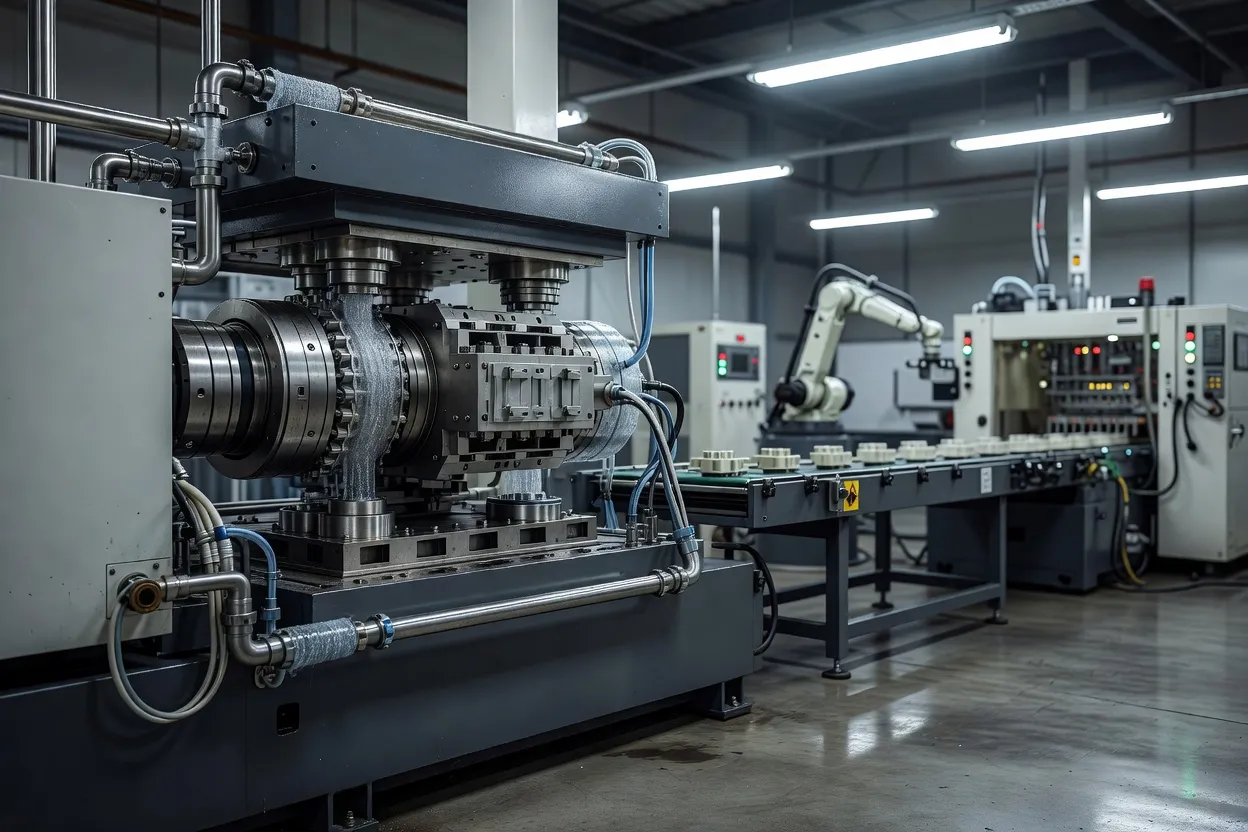
Cooling control is becoming a capacity lever
Plastic molders are treating cooling circuits as a production variable, not just a utility line, because monitored flow, pressure, and temperature can expose problems before they become scrap or downtime. Grundfos Direct Sensors and the Mouldflo system are built around that idea, with digital monitoring of every circuit and individual flow settings to improve heat transfer, cycle time, consistency, and energy use.
In Grundfos’ case material, the Mouldflo system records flow and temperature for each circuit, while manifold inlet and outlet pressure sensors help validate the setup and identify pressure loss through the mold. The same source says operators can monitor flow, temperature, and pressure, receive alarms when values move outside limits, and use the recorded data to spot blocked channels and maintenance needs before quality is affected.
That matters because cooling is often where throughput is quietly lost. The Grundfos material says setting flow and temperatures individually for each channel can support the shortest possible cycle time and lower energy use, while also improving product consistency. For processors, that translates into more usable machine hours without a capital move to a larger press line.
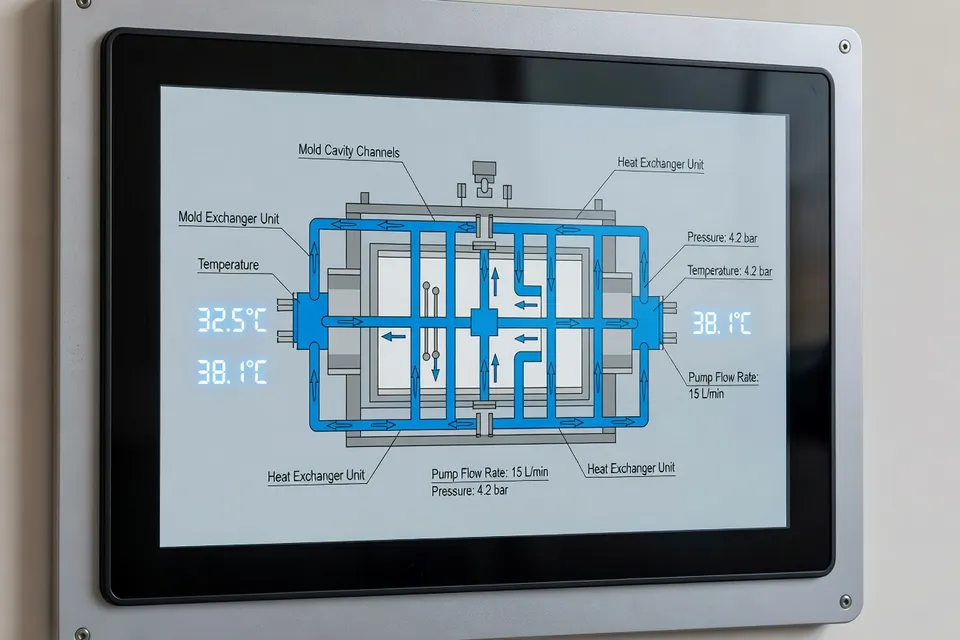
What the monitoring systems actually measure
The systems described in the sources do not just show a temperature number on a screen. They track flow, pressure, and temperature in real time, and some versions use the data to flag thermal drift, pressure loss, or blocked waterways. Mouldflo says its platform provides real-time flow, temperature, and pressure data from inside the mold channels and uses automated alarms and audit logging to make the process visible.
The Kistler reference reinforces the same operating logic from a different angle: measuring pressure and temperature directly in the mold gives users more transparent process control and supports more efficient setup, faster startup, and part-by-part documentation. That is important for shops trying to shorten launch time on a new tool or transfer work from one plant to another.
Reshoring shifts the pressure toward stability
AdvanTech Plastics (AdvanTech Plastics, LLC, a Woodstock, Illinois injection molder that publishes reshoring case studies for plastic injection molding) shows why this control discipline has commercial value. Its case study on reshoring says a customer moved production back from an overseas supplier because lead times, inventory risk, and quality concern had become unacceptable. A related AdvanTech post says the company worked with a U.S. mold shop that also operated in China to inspect the tools, perform sampling, and make repairs before production resumed in Illinois.
The commercial consequence was substantial. AdvanTech says lead times fell from 18 months to four weeks, with scheduled monthly releases afterward, and urgent inventory could be overnighted within 24 to 48 hours. For a molder or brand owner, that changes not only service levels but also the amount of safety stock needed to cover supply disruption.
AdvanTech also says a recent transfer involving seven molds moved from China to Illinois delivered better quality, faster lead times, reduced production risk, and clearer communication after the tools were cleaned and sampled. The company’s reshoring guidance ties those gains to better oversight, fewer supply chain surprises, and simpler compliance with U.S. standards.
Scheduling becomes the other half of the equation
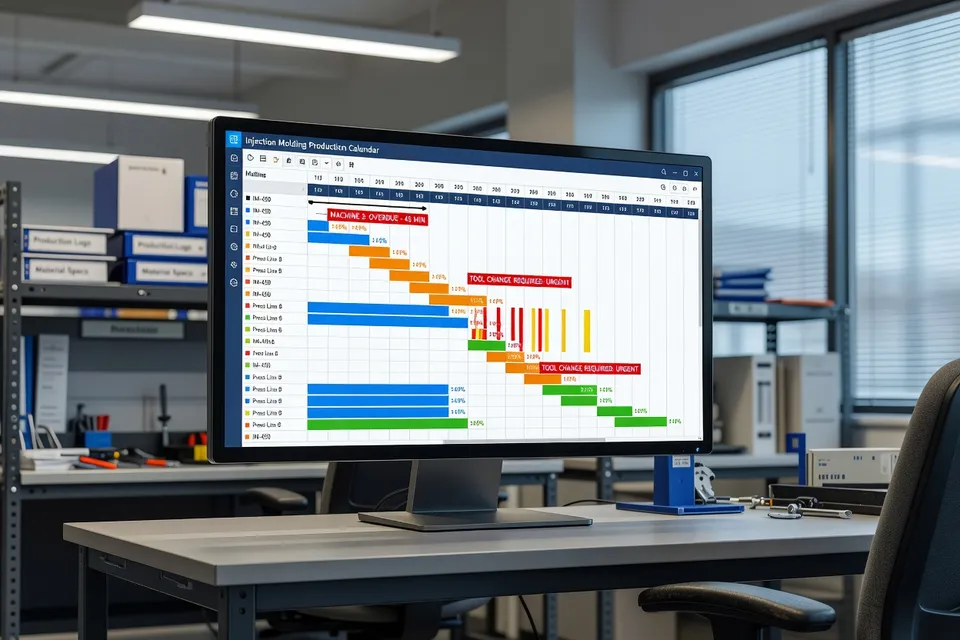
The AIMS Press study on injection molding production scheduling points to the same need from the planning side. The paper presents a mixed-integer programming formulation for injection-molding production scheduling in kitchen-appliance manufacturing and says the model integrates shared molds, sequence-dependent setups, operational disruptions, inventory, subcontracting, and grouped customer demand. The authors describe it as the first unified formulation of that type in their study.
That is relevant to processors trying to squeeze more output from existing assets. If cooling control can tighten the actual cycle, scheduling can decide whether the machine spends that saved time making the right jobs in the right order. The study’s focus on shared molds and sequence-dependent setups shows that capacity is not only a machine issue; it is also a changeover and allocation problem.
Why the combination matters on the floor
For processors, the practical takeaway is that capacity gains now depend on two linked disciplines: thermal control at the mold and disciplined scheduling at the plant level. Cooling systems from Grundfos and Mouldflo are aimed at detecting deviations, validating flow, and preserving stable conditions so molders can run closer to the validated window. The scheduling work from AIMS Press shows how those hours can be assigned more intelligently once they are available.
The operational value is straightforward. Better cooling visibility can reduce blocked-channel surprises, cut the time lost to troubleshooting, and improve consistency at the tool. Better scheduling can reduce setup friction, absorb disruptions, and protect inventory against last-minute changes. Together, they give processors a way to expand injection capacity without first expanding floor space.
That is the direction the cited sources point to: more data from the mold, more discipline in the plan, and fewer hidden losses between the press and the shipping dock.
Editorial Insights
- How does treating cooling as a controllable production variable change the way molders think about capacity and investment?
- When cooling circuits are monitored and individually controlled rather than treated as a fixed utility, they become a lever for cycle time and stability instead of a constraint. That allows processors to unlock more usable hours from existing presses, delaying or avoiding capital expenditure on new machines while tightening quality windows. In practice, it shifts investment decisions toward smarter sensing, data, and maintenance practices instead of purely mechanical upsizing.
- What are the sustainability implications of tighter cooling control and smarter scheduling in injection molding plants?
- More precise cooling reduces over‑flow and over‑chilling, cutting both energy waste and unnecessary scrap. When those gains are combined with scheduling that minimizes idle time, emergency changeovers, and excess inventory, plants can meet demand with fewer machine hours and less material overhead. The net effect is a quieter reduction in the carbon and resource footprint per shipped part, achieved through operational discipline rather than headline‑grabbing technology swaps.
- Why does better process visibility at the mold level matter for reshoring and shorter supply chains?
- Reshoring depends on matching or improving the reliability and cost of long‑distance supply, and that hinges on predictable cycles and clean transfers between tools and plants. Real‑time cooling and pressure data make molds more portable by documenting their validated windows and exposing issues before they disrupt local production. That transparency supports tighter lead times, lower safety stock, and more credible commitments to regional customers without relying on buffer inventory overseas.
- How does advanced production scheduling complement data‑driven cooling control in avoiding hidden capacity losses?
- Cooling data can shorten and stabilize the technical cycle, but those gains are diluted if the press spends its saved time in inefficient sequences or extended changeovers. Scheduling models that account for shared molds, sequence‑dependent setups, and grouped demand help assign those recovered minutes to the right jobs in the right order. The combination transforms capacity from a purely mechanical ceiling into a managed resource that spans the mold, the press, and the order book.
- What ethical and long‑term considerations arise when plants rely heavily on monitoring and algorithms to run closer to process limits?
- Running nearer to the validated processing window raises questions about how much risk is being shifted from equipment to people and customers. If alarms and scheduling models become central to daily decisions, plants need clear accountability for data quality, maintenance, and override rules to avoid normalizing near‑misses. Long‑term resilience depends on using these tools to build robust processes and skills, not simply to push productivity until the next unexpected failure.
- How might greater transparency from mold‑level data and smarter scheduling affect customer expectations and relationships?
- When processors can document conditions in the mold and show how capacity is allocated, they are better positioned to offer credible lead times and respond to urgent orders. That visibility tends to reset customer expectations toward more frequent, smaller releases instead of bulk orders driven by fear of disruption. Over time, the relationship shifts from reactive fire‑fighting to collaborative planning, with process data becoming part of the commercial conversation rather than an internal black box.
References
- 1.Grundfos. (2024, January 25). Grundfos Direct Sensors and Mouldflo manifolds improve the efficiency of plastic injection molding machines. Grundfos.
- 2.PR Newswire. (2026, September 3). CLF ships Taiwan's first 5000-ton injection molding machine, its largest in 60 years, to a top-tier US logistics supplier. The Storm Media.
- 3.Suzhou Lizhu Machinery Co., Ltd. Injection molding industry news. Suzhou Lizhu Machinery.
- 4.AdvanTech Plastics, LLC. (2026, August 28). Case study: Reshoring plastic injection molding to reduce lead times, inventory risk and quality concern. AdvanTech Plastics.
- 5.Wang, Y. Optimization model for injection molding production planning with unbalanced dual ownership. AIMS Press.
- 6.Spark Mould. (2025, May 12). Plastic injection mold solutions & engineering portfolio. Spark Mould.
- 7.Spark Mould. (2025, May 12). Collection of case studies on plastic pipe fitting molds. Spark Mould.
- 8.Springer. Plasticity modelling for deformation-induced anisotropy in sheet metals: From experiments to finite element implementation. Springer.