

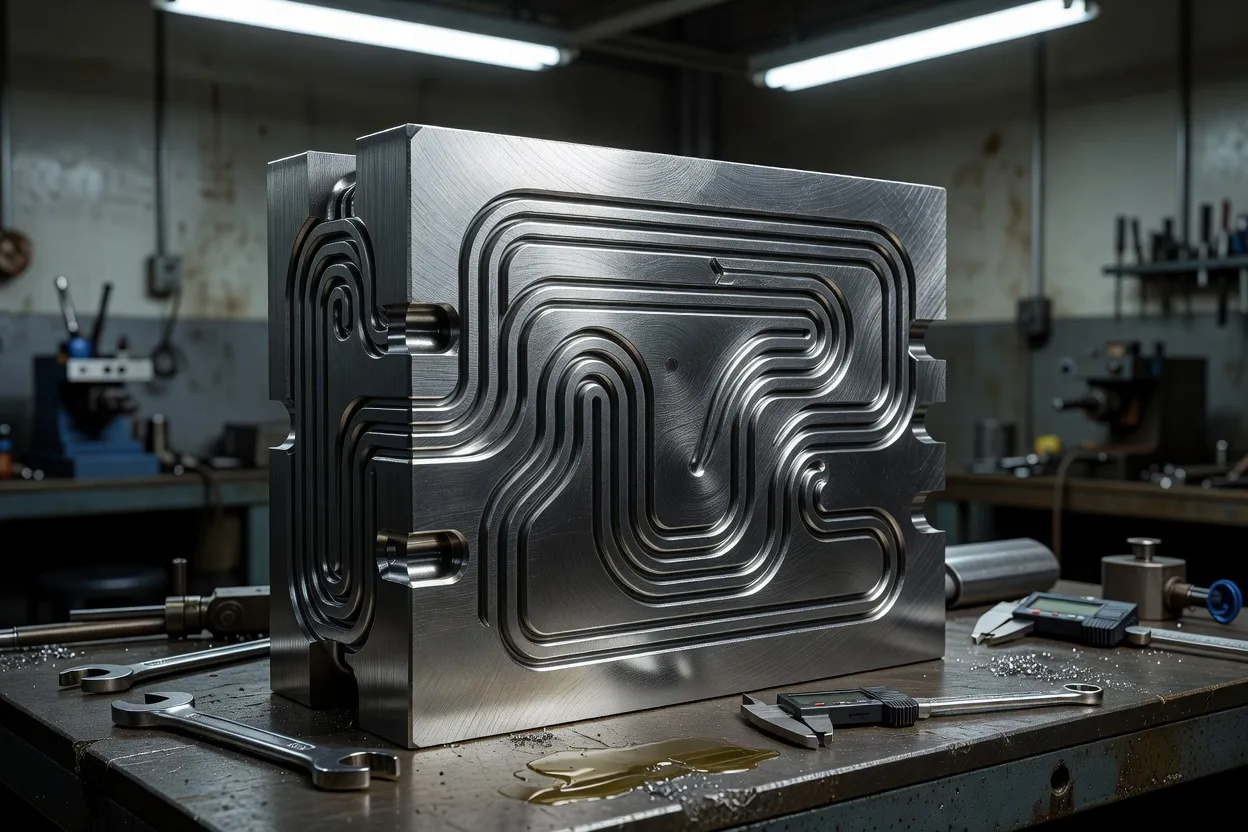
K-Rain’s production mold gained roughly 10 seconds per cycle after engineers installed metal-additive conformal-cooling inserts, reducing the cycle from 54 seconds to about 44 seconds. The reported improvement was 18% to 20%; a servo-motor upgrade supplied about two seconds of the gain, while faster and more uniform cooling supplied most of the balance.
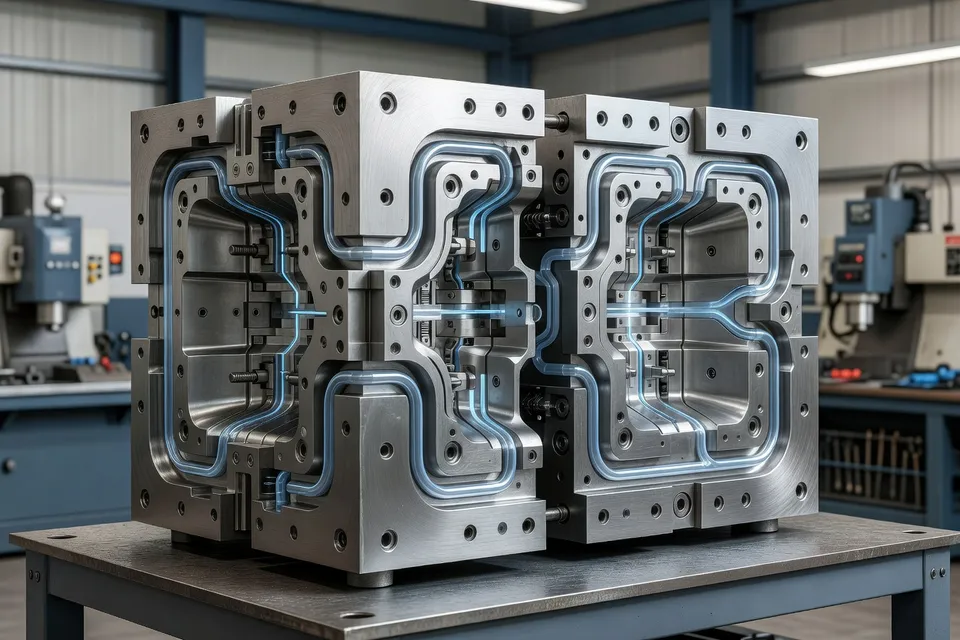
That result puts the capacity question in the mold, not only in the molding machine. The relevant change was the path through which heat left the part. A conformal channel follows the cavity or core profile and can approach hot areas that conventional straight-drilled passages leave remote. In the K-Rain case, the inserts were built, installed and run in the existing production tool before the cycle comparison was reported.
EVCO’s case study provides the clearest before-and-after measurement in the packet. Its engineers examined a mold in which the insert arrangement produced substantial temperature variation across the tool. They replaced that arrangement with a conformally cooled insert whose channels followed the part contour through the cavity, core and slides.
Cooling time became the first capacity lever
The EVCO redesign reduced cooling time from 20 seconds to five seconds, a 75% reduction. The complete cycle fell from 40 seconds to 16 seconds, a 40% reduction. Those figures share the same part and mold case, so they can be read together as a process change rather than as a general productivity claim.
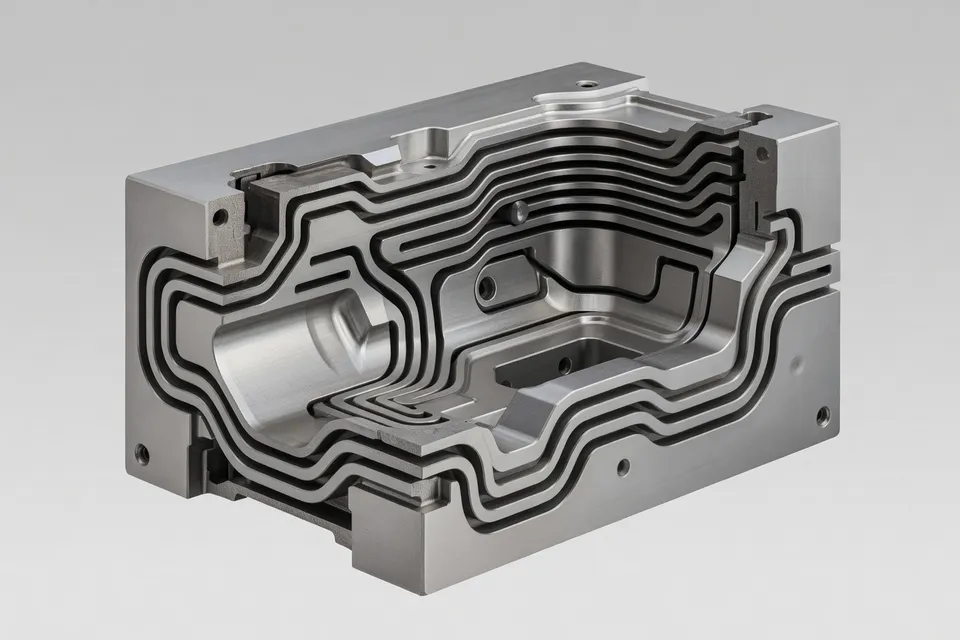
The geometry mattered because the part included a tight internal area and a complex layout. EVCO distributed the channels around the cavity, core and slides instead of relying on a single accessible route. The stated purpose was to keep coolant flow and mold temperature more even across those mold elements.
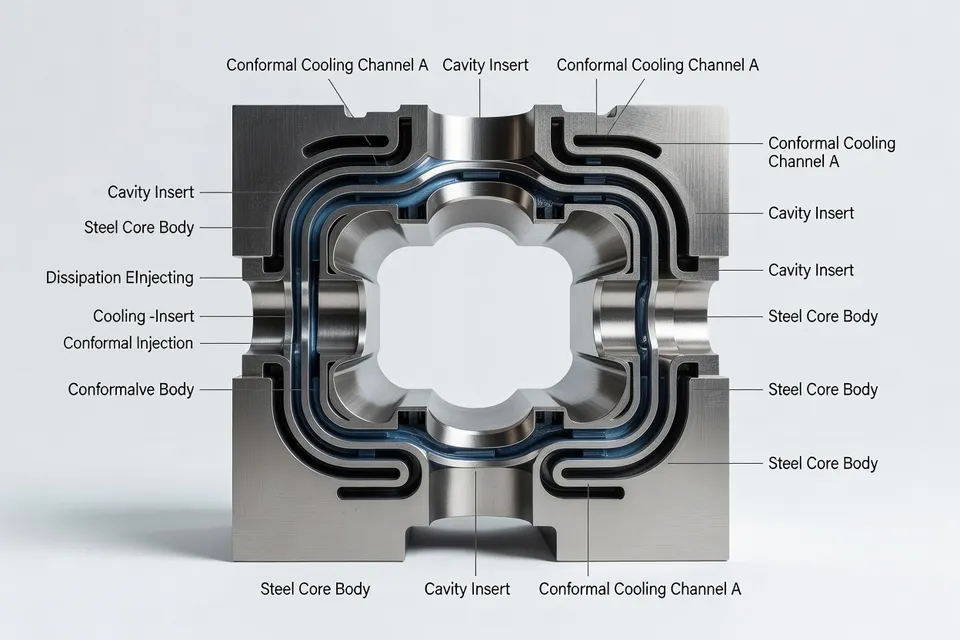
The part-quality measurements moved with the cycle result. EVCO reported minimized sink on the top surface of the sensor housing and final-part stability of 16.43 Cpk. The case study also reported that the initial conformal-cooling investment was recovered within eight months.
The figures should not be transferred directly to every mold. K-Rain’s reported cycle began at 54 seconds and ended near 44 seconds, while EVCO’s case moved from 40 seconds to 16 seconds. The tools, parts, process settings and measurement conditions are different. The comparable point is narrower: both cases assigned the gain primarily to improved heat removal, not to a faster injection stroke alone.
Deep cores still need a different route
Conformal channels are not the only way to reach trapped heat. A separate MoldMaking Technology report describes jet cooling for deep core pins in die-casting tooling and notes its relevance to plastic injection molds. The method uses gun-drilled passages, inserted jet coolers, and pulsed air and water delivered after filling. Thermal analysis sets cooling duration for individual areas, with the system described as capable of cooling up to 32 or more core pins.
The reported examples show why the failure location must be identified before selecting the tool change:
-
Cooling time fell from 84 seconds to 57 seconds when jet cooling was first applied to two cores; extending the system to 11 cores reduced cooling time to 22 seconds and cut total cycle time by 40%.
-
Four jet coolers in the central core reduced a park release valve’s total cycle from 101 seconds to 80 seconds, a 20% reduction, for a part shipped at 220,000 pieces per year.
-
Another central-core application reduced the cycle from 33 seconds to 17 seconds, nearly halving the cycle.
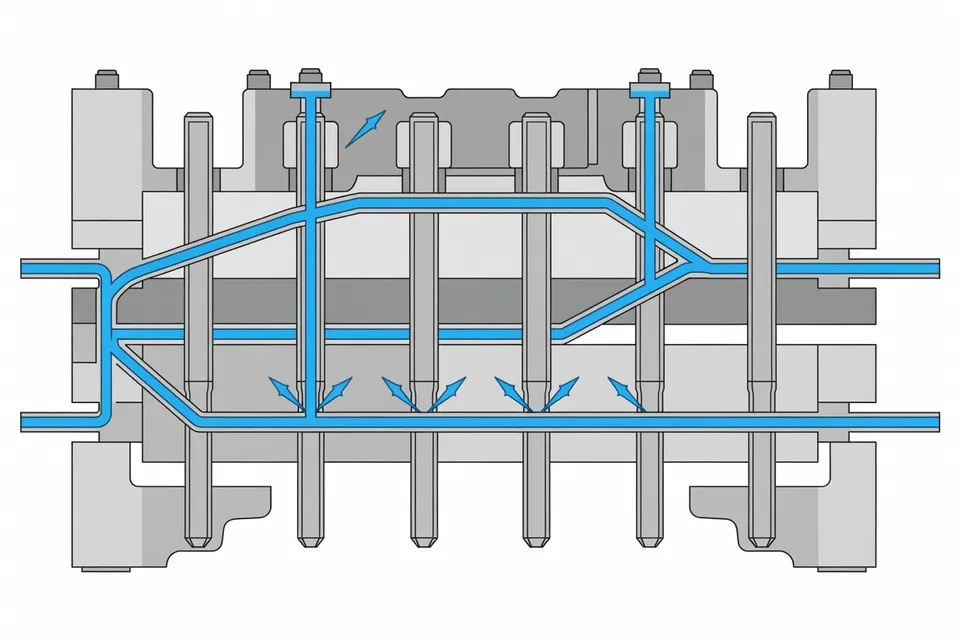
Those examples use a pulsed-fluid system rather than an additively built conformal insert. They support the same plant question—where does the part remain hot after filling?—but they do not establish that jet cooling and metal-additive inserts are interchangeable. A processor would still need to check core-pin access, sealing, pressure, maintenance and the temperature response of the actual polymer and mold.
Simulation can identify the hot spot, not release the part
The packet also includes an injection-molding plastics white paper and technical and academic material related to mold cooling and simulation. These sources are useful for the design stage, but the available source information does not supply a common production baseline, a shared part, or a finished QA release that would rank their methods against the K-Rain and EVCO cases.
That distinction matters on the floor. A thermal model can locate a predicted hot area or compare channel layouts before steel is made. It does not, by itself, prove that sink, warp, cycle time or dimensional variation has moved on the press. The release gate remains the measured part: cycle records from the same machine and mold, cavity or part temperature where relevant, dimensional results, visual defects, and the QA limit that determines whether production can continue.
The research and academic listings also point to ongoing work rather than a closed-loop plant result. Their presence supports testing cooling geometry and process behavior, but the packet does not provide enough detail to attach a numerical production claim to them. The same restraint applies to the ANTEC-R event listing and the prototyping-mold article: they can identify technical subjects or development activity, but the supplied material does not establish a comparable commercial cycle reduction.
The next check is a matched production run
For a processor evaluating conformal cooling, the practical comparison is a paired run on the same part and machine. Record the old and new cooling times separately from injection, pack and mold-open intervals. Hold resin, shot size, mold temperature set points and operator procedure constant where the tool permits. Then check sink, warp, dimensions and capability before assigning the saved seconds to capacity.
K-Rain’s result shows why the contributors should be separated: about two seconds came from the servo upgrade, while most of the reported 10-second reduction came from cooling. EVCO’s result adds the quality check, with minimized sink and a reported 16.43 Cpk. A plant that cannot connect the cycle change to a stable part and an accepted QA result has a trial result, not yet a finished capacity release.
The next checkable event is the processor’s matched trial lot: the conformal insert must run through the planned production window, and QA must release the measured parts against the existing specification before the saved cycle becomes scheduled capacity.
Editorial Insights
- How do you decide whether conformal cooling is the right mold change for a cycle-time problem?
- Start by measuring where the part stays hot after fill and pack, then separate cooling time from injection, pack, mold-open and handling time. Conformal channels make sense when a cavity, core or slide leaves hot areas remote from straight-drilled passages; they do not fix a machine-speed or filling limitation. The usual mistake is to redesign the insert before proving that cooling is the constraint, then credit the insert for seconds gained by a separate servo or setting change.
- What must be held constant before assigning saved seconds to production capacity?
- Run the old and modified tool on the same machine with the same resin, shot size, mold-temperature setpoints and operator procedure wherever possible. Log injection, pack, cooling and mold-open intervals separately, then compare sink, warp, dimensions and capability on released parts. If a servo upgrade, mold setting change or operator adjustment is included in the trial, the capacity claim is mixed; the cooling insert may be useful, but its contribution is not isolated.
- Can a thermal simulation release a conformally cooled mold for production?
- No. Use the model to locate predicted hot spots and compare channel layouts before making steel, but require a matched press trial before releasing the cycle. The file should include cycle records, relevant cavity or part temperatures, dimensional checks, visual defects and the QA limit for acceptance. A common failure is treating a clean thermal map as proof of lower sink or warp; the part can still miss dimensions when flow, packing, coolant balance or ejection differs from the model.
- When is jet cooling a better route than an additively manufactured conformal insert?
- Inspect the failure location first. Jet cooling can suit deep core pins or trapped central areas where access for a conformal insert is impractical, using gun-drilled passages, inserted jet coolers and pulsed air and water. Verify core-pin access, sealing, pressure, maintenance and the polymer’s temperature response before selecting it. Do not treat the two methods as interchangeable: a system that reaches several deep cores may solve a localized hot spot while offering no benefit on a cavity surface that remains unevenly cooled.
- What quality evidence is needed before a shorter cooling time becomes scheduled capacity?
- Require a trial lot that runs through the planned production window, with QA releasing parts against the existing specification. Check sink, warp, dimensions and capability rather than relying on cycle time alone. The friction is that a faster cycle can expose thermal drift as the mold reaches steady state, so an initial pass at startup is not enough to support a permanent setpoint or capacity plan.
- How should the financial case for a conformal insert be checked?
- File the insert cost, installation work, trial time, expected released seconds per cycle and the production volume that will actually use them; then test payback against the accepted part rate, not the theoretical machine rate. A reported payback within months is not transferable without the same cycle constraint, annual demand and quality result. Extra capacity is easy to overstate when the downstream operation, mold maintenance or customer schedule remains the bottleneck.
References
- 1.MoldMaking Technology. (2026, September 10). How metal AM cut mold cycle time by 20%. MoldMaking Technology.
- 2.EVCO Plastics. (2026, June 19). Case study: Conformal cooling transforms molding process. EVCO Plastics.
- 3.MoldMaking Technology. (2026, September 7). Deep-cavity cooling made easy. MoldMaking Technology.
- 4.Swapcard. ANTEC® 2026 event planning. Swapcard.
- 5.IOSR Journals. G2301017278. IOSR Journals.
- 6.University of Massachusetts Lowell. Ph.D. dissertation proposal defense. University of Massachusetts Lowell.
- 7.SOLIDWORKS. Plastics mold injection white paper. SOLIDWORKS.
- 8.MoldMaking Technology. 3D printing accelerates R&D process for prototyping molds. MoldMaking Technology.