

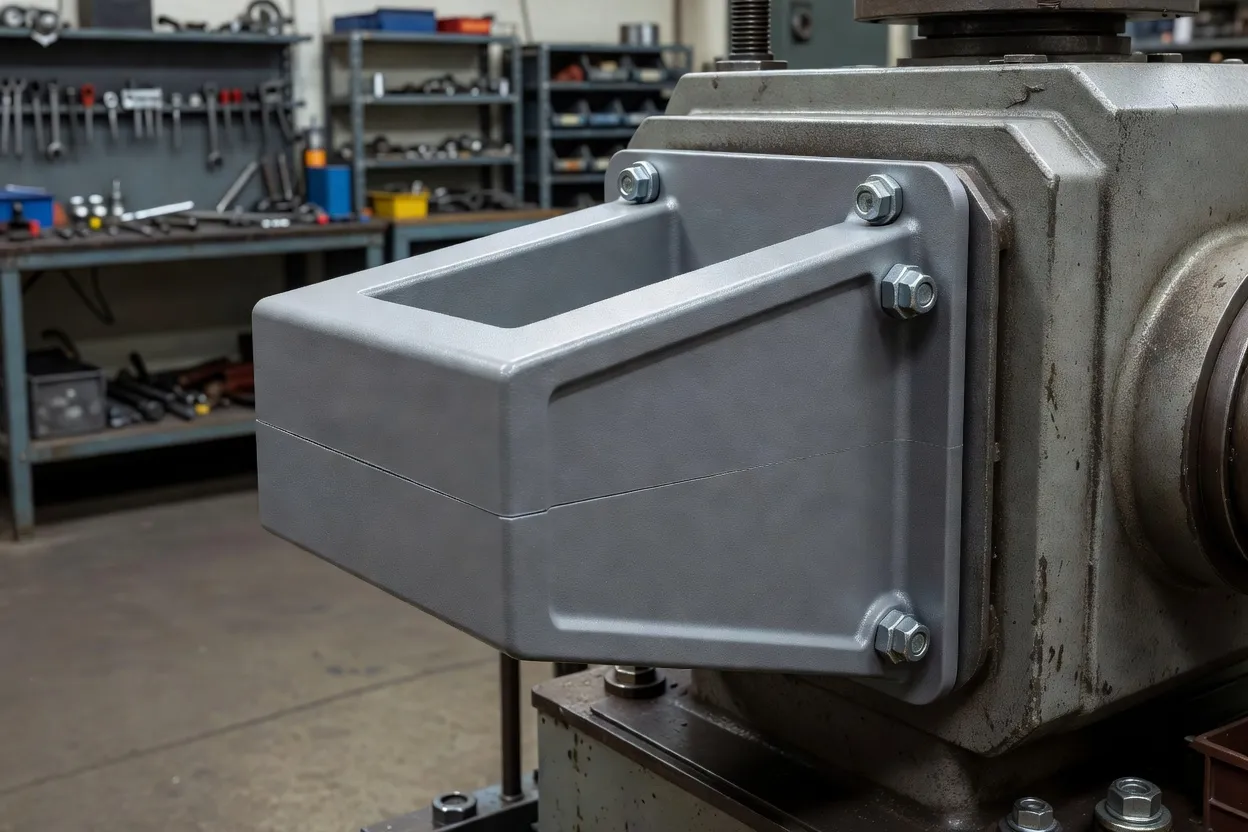
Regrind does not fail at the grinder alone. It fails when a processor treats irregular chips, fines, strings, wet resin, and mixed heat history as if they were uniform virgin pellets. The first check on the next shift is simple: inspect the stream before it reaches the hopper, then hold it if the material is dirty, visibly dusty, mixed, or outside the approved resin route.
The control problem is not whether scrap can be reused. Thermoplastic scrap can be reclaimed and blended with virgin resin, or used by itself. The control problem is whether the recovered material still has a defined identity and a process condition the machine can handle. That requires a lot record, a contamination check, a particle-size check, and a moisture check where the polymer is moisture-sensitive.
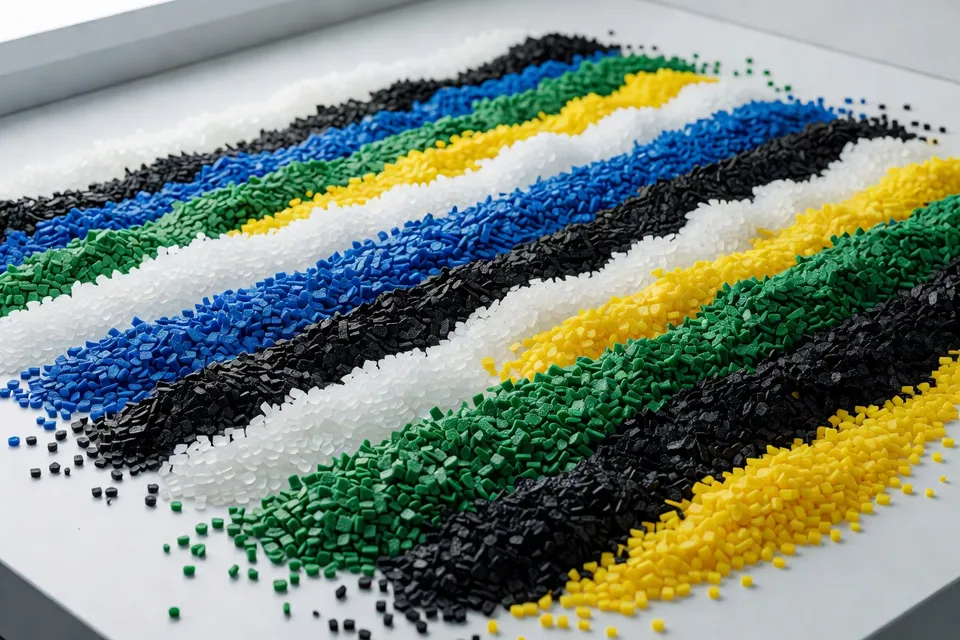
The regrind stream
ShortName (full official name, one-sentence identifier from the URLs or number-free context) describes regrind as material recovered from excess material and rejected parts. That material carries the earlier molding history into the next shot. Thermal and mechanical stress can change physical, chemical, and flow properties. The grinding step adds another source of stress. The result may still look acceptable in a gaylord while its flow or toughness has moved.
The commonly used blending target is 20% to 25% regrind or less in virgin resin. That is a practice range, not a universal approval limit. The correct limit belongs to the polymer, part, mold, and customer specification. A processor should ask the resin supplier how many molding passes the material can tolerate before a property falls by more than 10%, and which property moves first. If that answer is not documented for the grade in use, the regrind ratio is not fully controlled.
The first pass also does not reset the history. A later blend still contains material from earlier passes. A 20% addition on the current run does not mean only 20% of the feed has ever seen the process. That is the hidden weakness in a simple ratio sheet.
For the commonly cited regrind blend range, the check looks like this:
| Blend condition | Regrind content |
|---|---|
| Common molding target | 20% to 25% or less |
| Possible production practice | 100% virgin to 100% regrind |
The range shows why a percentage alone cannot release a load. The same nominal percentage can behave differently after repeated passes, drying errors, excessive melt temperature, or contamination.
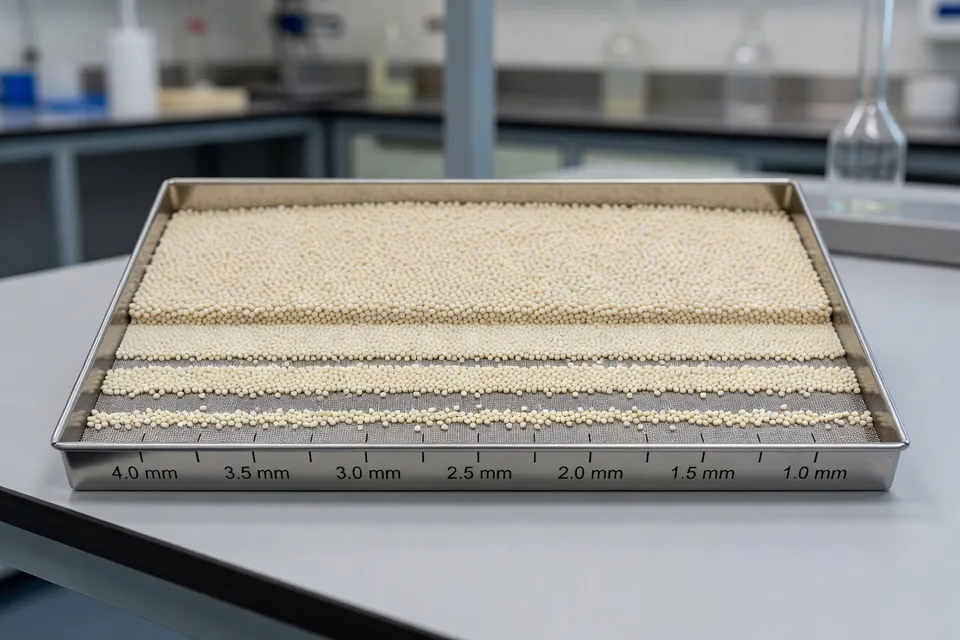
The grinder and separator
Cleanliness starts before conveying. Regrind should be collected in clean containers and moved to a separate grinding area. The grinder must match the scrap volume. Knife condition, cutting angle, and screen selection affect the size distribution. A worn blade or damaged screen can turn a usable stream into a mixture of chips, dust, and long strings.
Uniformity matters because screws are built to convey a defined feed form. Irregular chips and flakes do not behave like pellets. Fines can bridge, settle, overload filters, or move unevenly through the feed throat. In blow molding, fines can clog dryers and screen packs and can show up as streaks, specks, or starbursts in the parison or finished part. In injection molding, the same feed instability can appear as a cosmetic defect, an inconsistent shot, or a mechanical result that fails later testing.
A fine separator above the feed hopper is a practical control where the stream generates dust or strings. A deduster can remove small particles before they enter the machine. That device does not repair degraded polymer or separate incompatible resin. It only controls the material it can physically remove.
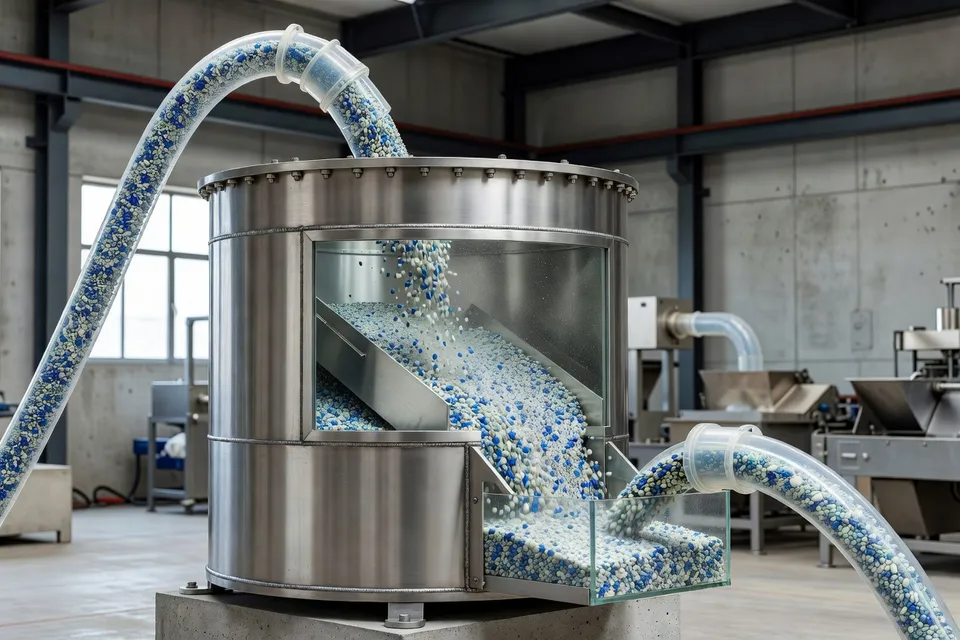
Stop the feed when the screen is loaded, the separator is bypassed, the grinder produces excessive dust, or the regrind contains visible foreign plastic. Do not solve a contamination problem with a higher virgin percentage. Repelletizing with melt filtration may remove nonplastic contamination, but it still requires a defined grade and a check that the filtration process has not changed the material beyond the approved use.
Heat history and moisture
Heat history is cumulative. Repeated processing and grinding can reduce the usable property window. Higher-than-recommended processing temperature accelerates degradation. A part can pass a visual inspection and still carry lower toughness, altered flow, or reduced chain length.
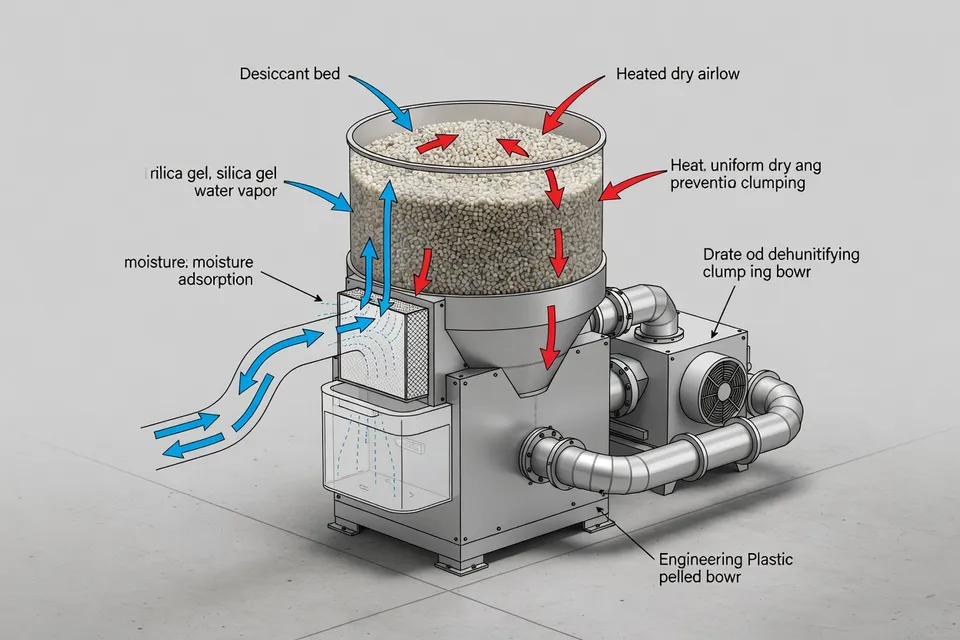
Moisture creates a separate failure path. Nylon, polycarbonate, PBT, and PET require proper drying before initial processing. If moisture remains, hydrolysis can lower polymer chain length and degrade the resin in the barrel. Blending that degraded material into virgin resin at 25% can change part performance and function. The stop condition is not a cloudy hopper or an obvious hiss. The stop condition is failure to verify the drying condition required for the specific grade.
A moisture-sensitive load needs a documented route from dryer to machine. Check exposure time, conveying-gas quality, receiver venting, and any repeated circulation. Do not transfer a drying rule from one polymer to another. Polyolefin regrind and hygroscopic engineering resin do not share the same moisture risk, and the sources do not support one universal dryer setting.
The conveying line
The conveying system must be checked as a system: pickup point, gas velocity, bends, line temperature, distance, receiver, filter, and discharge. Regrind and virgin pellets can have different bulk density, particle shape, fines content, moisture sensitivity, and static behavior. A line that runs cleanly with uniform virgin pellets can generate fines or segregation when the feed changes.
Record transfer rate, pressure or vacuum profile, cycle time, residual material, fines generation, streamer generation, receiver discharge, and destination stability when qualifying a blend. Challenge the conditions operators usually discover only after a defect: empty source, blocked line, high filter load, and failed discharge. The test is not complete if it covers only a full hopper under normal flow.
Retained pellets also matter. Valves, hoses, receivers, filters, and low points can hold the previous color or resin grade. Before a material or color change, define the cleanout method and the acceptable residue. A purge that leaves an unmeasured pocket is not a validated changeover.
The QA release
The quality system needs more than a regrind percentage on the batch ticket. The release record should identify the source parts, resin grade, color or additive package, grinder condition, screen condition, particle-size result, contamination result, moisture status where applicable, and the approved destination machine or mold.
A processor can use 100% regrind in some applications, but that choice removes neither contamination nor degradation risk. It changes the control strategy. Keeping virgin resin out of the regrind stream may reduce cross-contamination, while a separate route can make the recovered material easier to identify. The application still needs a property check and a customer-approved specification.
Do not release a mixed load because the color looks close. Do not release a dusty load because the part passed one visual sample. Do not release a wet load because the hopper temperature appears normal. Hold it when identity, dryness, particle form, or accumulated history cannot be shown.
The next check this shift is at the hopper: pull a representative sample, look for fines and strings, verify the resin identity against the traveler, check the approved moisture condition, and record whether the stream is clean enough for the intended press and mold.
Editorial Insights
- What must be checked before regrind enters the hopper?
- Pull a representative sample and verify resin identity, visible contamination, particle form, and the approved moisture condition for that grade. Hold the stream if it is dusty, stringy, mixed, or outside the assigned resin route. The usual failure is checking only the gaylord or top layer, then feeding a load whose fines, oversize pieces, or foreign plastic destabilize the shot.
- Is a 20% to 25% regrind blend automatically safe?
- No. Treat 20% to 25% as a common starting practice, not as an approval limit. Set the allowable ratio from the polymer, part, mold, customer specification, and documented pass-history data, including which property declines first. A ratio sheet can look stable while cumulative heat history, drying errors, or a drifting feeder rate has already moved the material outside the usable window.
- What grinder controls protect feed consistency?
- Check knife condition, cutting clearance, screen selection, and the resulting size distribution, then remove fines and strings before conveying. The grinder must produce a stream the screw and feed throat can handle consistently; a separator cannot repair degraded polymer or incompatible resin. The common miss is treating a worn blade as a cosmetic maintenance issue until dust, bridging, shot variation, or screen loading appears at the press.
- When does moisture control become a release requirement rather than a dryer setting?
- For moisture-sensitive grades, refuse release until the material-specific drying condition and route to the machine are documented. Verify exposure time, conveying-gas quality, receiver venting, and any recirculation rather than relying on hopper temperature or appearance. Regrind can carry a larger moisture risk than intact pellets, and the failure mode is hydrolysis in the barrel: the load looks acceptable while chain length and part performance have already declined.
- How should a regrind blend be qualified through the conveying system?
- Run the actual blend through the pickup point, bends, line, receiver, filter, and discharge while recording transfer rate, pressure or vacuum, cycle time, fines, streamers, residual material, and destination stability. Challenge an empty source, a blocked line, a high filter load, and a failed discharge; a full hopper under normal flow proves little. The line may handle virgin pellets cleanly yet segregate or abrade irregular regrind, leaving a different material at the machine than the batch ticket describes.
- What information belongs on the regrind release record?
- File the source parts, resin grade, color or additive package, grinder and screen condition, particle-size result, contamination check, moisture status where applicable, and approved machine or mold destination. Add the permitted blend ratio and accumulated processing history when those limits are part of the grade approval. Do not release a mixed or dusty load because one visual sample passed; the hidden weakness is an incomplete identity trail that makes the next defect impossible to assign or contain.
References
- 1.Plastics Technology. (2026, October 8). Smart handling of regrind can improve your bottom line. Plastics Technology.
- 2.UL Prospector. (2025, November 3). Regrind: Making the most of your resin. UL Prospector.
- 3.Powder & Bulk Videos. (2026, October 8). Plastic pellet & resin handling. Powder & Bulk Videos.
- 4.Molds-Dies.com. Molds-Dies.com. Molds-Dies.com.
- 5.Charming MB. 6 steps to build an effective plastic manufacturing quality system. Charming MB.
- 6.X. X. X.
- 7.Scribd. Case study: Regrind. Scribd.
- 8.Novatec. Injection molding defects. Novatec.