

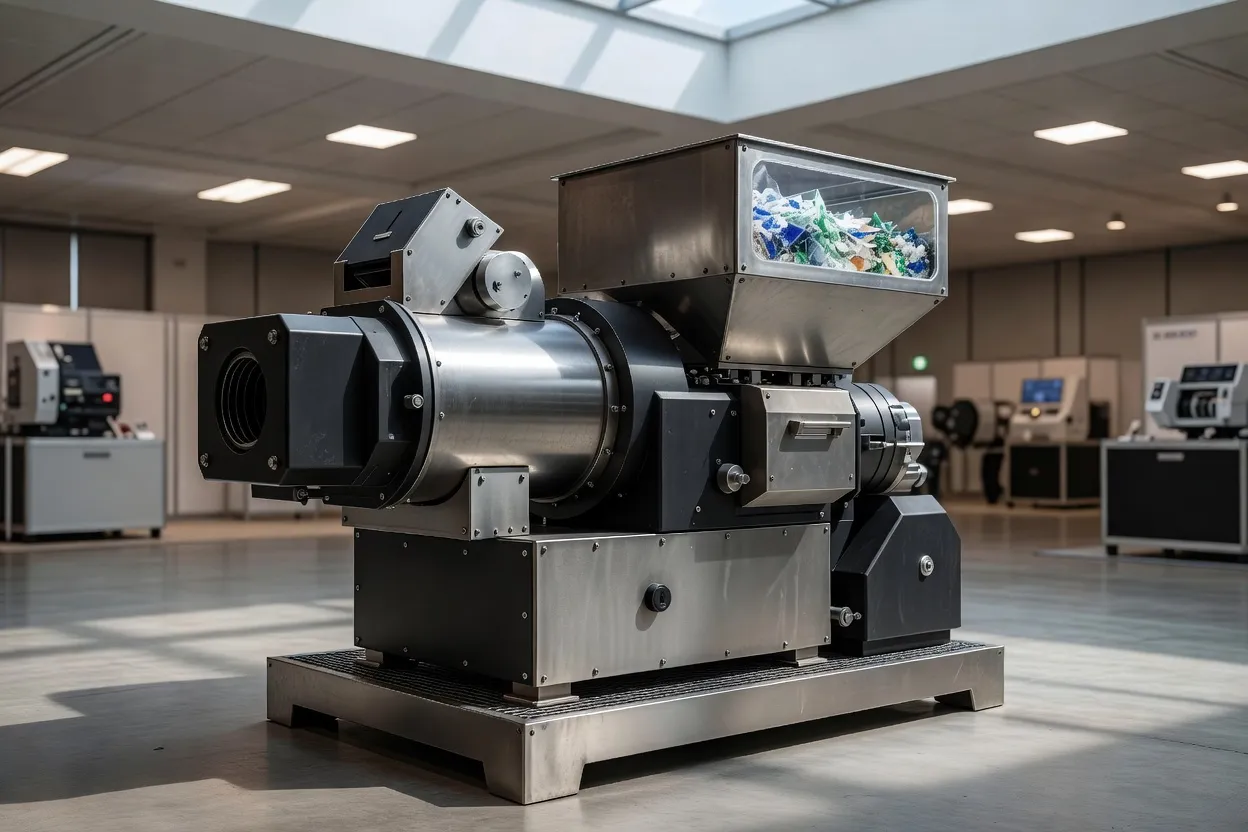
KraussMaffei Extrusion is taking aim at one of recycling's least glamorous bottlenecks: getting lightweight, low-bulk-density feedstock into a stable extrusion process. The company's ZSA UltraCycle side-feed system, presented for Fakuma 2026, is designed to process that material directly without a separate pre-compaction step. The claimed benefit is not a new polymer or a higher recycled-content percentage. It is a shorter line.
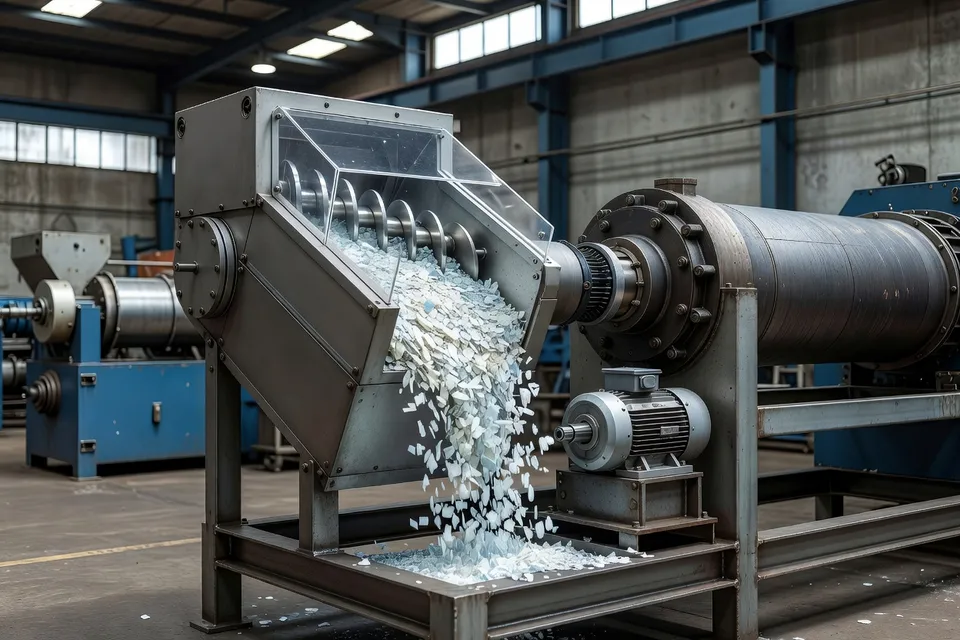
That distinction matters. Removing pre-compaction can reduce equipment count, energy demand, and investment cost, but the result still depends on whether the side feeder can meter an inconsistent feed into the extruder without starving, surging, or bridging. KraussMaffei describes the system as suitable for lightweight materials with low bulk density. The available announcement does not provide a throughput, power comparison, material-specific trial window, or finished-product baseline. A processor should therefore treat the UltraCycle as a line-integration proposition, not as a demonstrated universal route for difficult recyclate.
The ZSA UltraCycle feed point
The process change is straightforward to describe: low-density material enters through a side-feed arrangement and bypasses pre-compaction. In a conventional recycling line, that upstream step can make fluffy film, fiber-like fractions, or other irregular feedstocks more manageable before melting. It also adds a machine, a drive, maintenance points, and an energy load. UltraCycle's value rests on making the extruder accept the material in its original loose condition.
The control question is feed consistency. Bulk density changes alter the volume required to deliver the same mass flow. Moisture, particle shape, labels, fines, and residual air can change the behavior again. If the feeder maintains mass flow while the extruder maintains pressure, the shorter route has a credible plant advantage. If it only moves the compaction problem into the feed throat, the claimed savings will not survive commissioning.
No public figure in the announcement establishes the limit. There is no stated maximum proportion of low-density input, no reported melt-pressure trace, and no disclosed comparison with a pre-compacted baseline. Those are the measurements a technical lead would need before approving a retrofit.
The MAAG pump as a recycled-PVC control step
MAAG Group (a supplier of polymer-processing and quality-control systems) is presenting a different answer to recycled-feed variability. Its extrex⁶ EC gear pump is designed specifically for continuous conveying of rigid PVC. The pump uses a gap-free design without dead spaces, intended to prevent PVC from sticking and stagnating inside the pump, where thermal exposure can promote degradation.
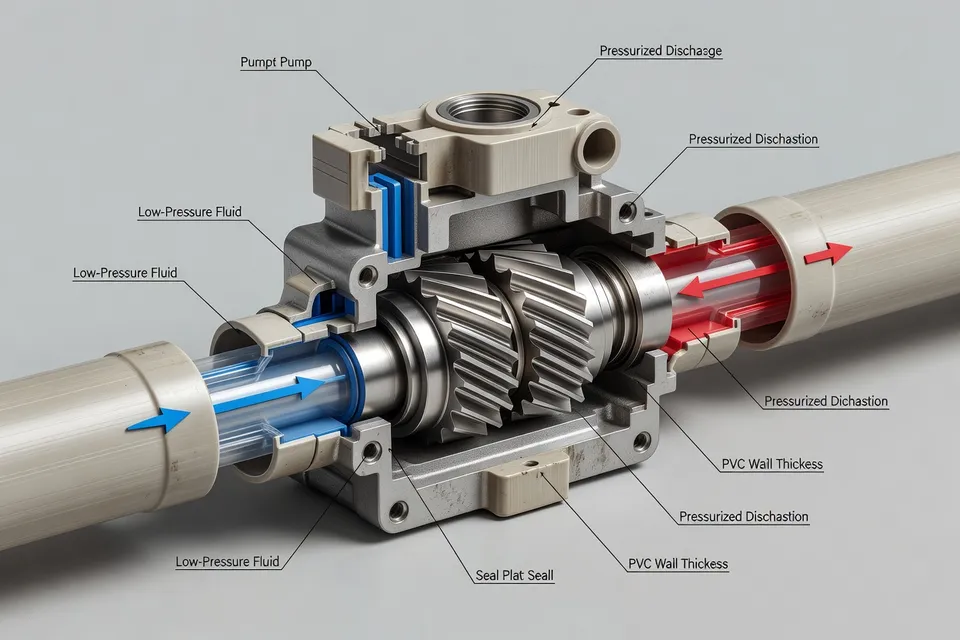
The strongest evidence in this packet comes from MAAG's development work with REHAU. Testing at REHAU's technical center ran from 2022 through 2024, followed by a production-profile prototype test in early 2025. MAAG says the pump was then installed for production at a REHAU plant in Spain. With cost-effective recycled PVC, the company reports reduced die-pressure fluctuations, improved profile quality, and an extruder-load reduction of up to 20%.
Those results are more useful than a booth claim because they identify a material, a development period, a production-profile test, and a plant installation. They still remain a supplier-reported result rather than an independently audited production study. The claim also belongs to rigid PVC profile extrusion at REHAU; it should not be transferred automatically to polyethylene film, polypropylene regrind, or mixed-polymer streams.
MAAG's public material gives two different energy figures for the extrex⁶ EC in its 2026 communications. One product announcement says that, at constant throughput, extruder energy savings can reach up to 50%, while the REHAU case describes an extruder-load reduction of up to 20%. These are not interchangeable metrics. One is presented as an application-dependent energy claim; the other is tied to the reported recycled-PVC production experience.
| Reported basis | Period or status | Figure |
|---|---|---|
| REHAU recycled-PVC production-profile experience | Early 2025 / production use after testing | Up to 20% lower extruder load |
| MAAG extrex⁶ EC application-dependent constant-throughput claim | Fakuma 2026 presentation | Up to 50% extruder energy saving |
The gap between those figures is exactly why qualification needs a defined baseline. A plant should record motor load, melt temperature, die pressure, throughput, profile dimensions, surface defects, and maintenance intervals on the same PVC formulation before accepting the larger claim.
Pelletizing and inspection after the melt
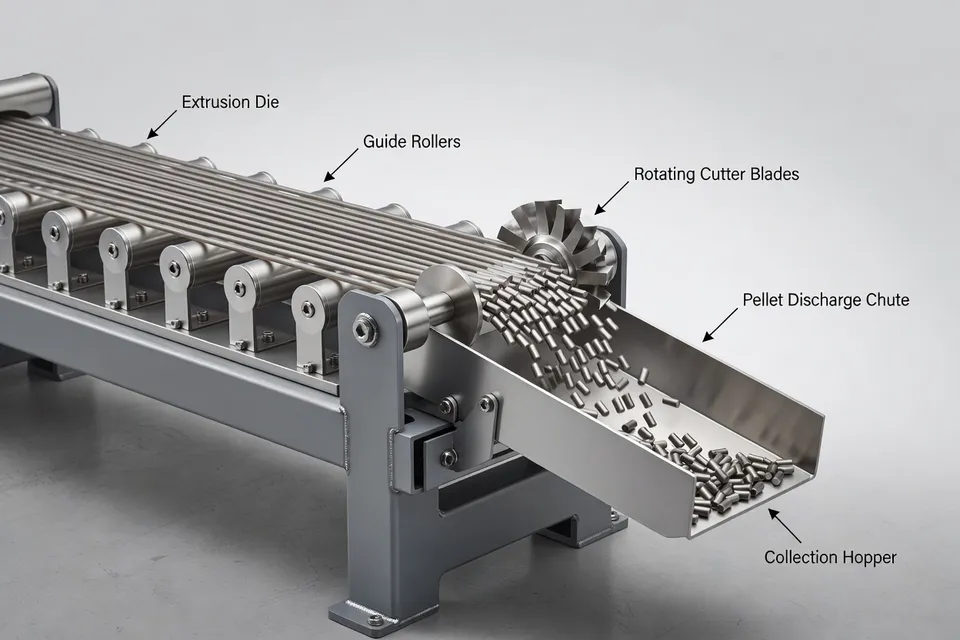
The downstream equipment completes the machinery logic. MAAG is showing the PRIMO 60 E strand pelletizer for compounds, masterbatch, specialty polymers, frequent product changes, and smaller batches. Fast cleaning, accessibility, and short tool-change times address a different recycling constraint: not whether material can enter the line, but whether the line can change grades without losing excessive time or contaminating the next batch.
MAAG is also presenting SIKORA's PURITY CONCEPT V offline inspection system. It examines pellets, flakes, and test plates, using an optical camera to detect black or colored specks and discoloration from 50 micrometers. The company states that analysis takes less than a minute and produces a test certificate and HSV color map. That is a useful quality gate, but it is not a substitute for continuous process control. Random inspection can identify a failed or suspect sample; it does not by itself prove that every kilogram between samples meets a customer specification.
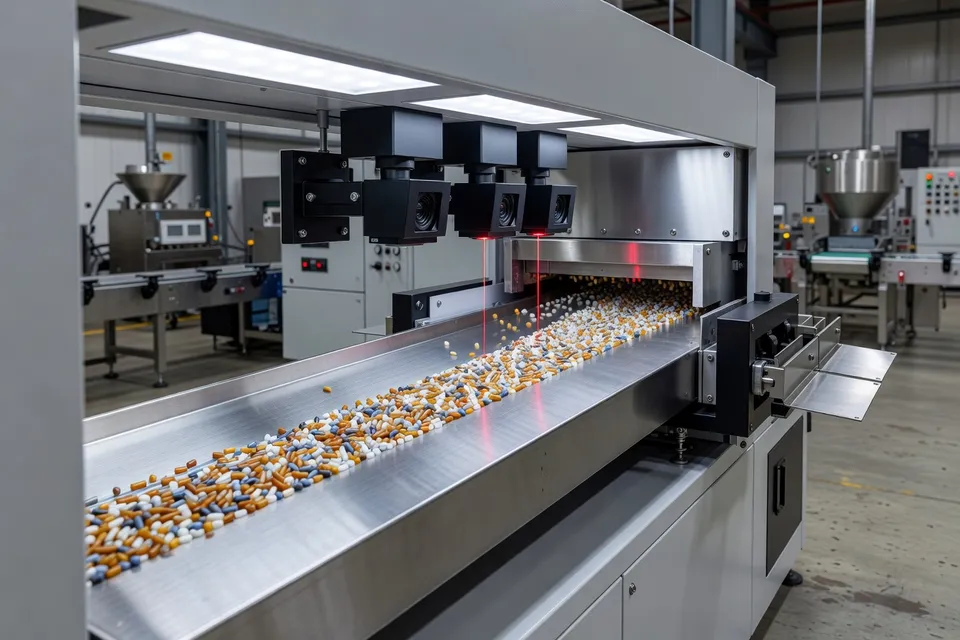
The equipment therefore addresses three separate failure points: low-density feeding, unstable conveying of sensitive recycled PVC, and contamination or color variation in the finished pellet. Combining them may shorten a line or improve stability, but the machines do not erase feedstock variation. Each step still needs its own acceptance test.
The next qualification gate
For KraussMaffei, the next meaningful trial is a controlled comparison between direct side feeding and the existing pre-compaction route using the same low-density material. The record should include mass throughput, feeder stability, motor power, melt pressure, screen-change frequency, and product quality. Without that comparison, “fewer process steps” remains a credible design objective rather than a measured plant result.
For MAAG and REHAU, the harder question is repeatability across recycled-PVC batches. The reported Spanish installation and earlier testing establish a serious development path, but not a universal operating envelope. QA should ask for the formulation range, contamination level, throughput, pressure variation, and duration behind the reported 20% load reduction.
The machinery advance is real where the process step is clear: direct feeding removes pre-compaction, a dead-space-free pump limits PVC residence problems, and optical inspection catches defects down to 50 micrometers. The claims become decision-grade only when each machine is tied to a measured baseline, a defined feedstock, and a production run long enough to expose drift.
Editorial Insights
- What must be measured before removing a pre-compactor from a low-density recycling line?
- Run the same feedstock through the existing pre-compaction route and the direct side-feed route, then record mass throughput, feeder stability, motor power, melt pressure, screen changes, and product quality. Do not approve the shorter line from equipment count alone. Fluffy flakes, fibers, fines, moisture, labels, and trapped air can change bulk density enough to cause bridging or surging; a feeder that appears stable during a short trial may still starve the extruder during a longer production run.
- Can a direct side feeder be treated as a universal solution for difficult recyclate?
- No. Treat it as a feed-system proposition for defined low-bulk-density materials, not as proof that every loose recyclate can be processed without preparation. Qualification must establish the usable material range, gravimetric accuracy, maximum stable feed rate, pressure behavior, and finished-product limits. The usual failure is moving the compaction problem into the feed throat: the line loses output or pressure stability even though the separate pre-compactor has disappeared.
- What evidence is needed before accepting a recycled-PVC gear-pump load-saving claim?
- Ask for the PVC formulation, recycled-content range, contamination level, throughput, die-pressure trace, motor-load baseline, and duration of the production run. Compare like for like: extruder load, energy, profile dimensions, surface defects, and maintenance intervals must be measured on the same line and formulation. A result from rigid PVC profile extrusion should not be transferred to polyethylene film, polypropylene regrind, or mixed-polymer streams. Confusing an application-specific energy claim with a reported extruder-load reduction is an easy way to overstate the payback.
- What does a gap-free pump actually control in recycled PVC processing?
- Use it to control residence-related degradation and pressure variation, not to correct every problem in recycled PVC. A pump with no dead spaces can reduce material sticking and stagnation, while constant conveying can smooth die pressure and lower extruder load. It cannot remove unstable formulation, excessive contamination, poor temperature control, or inadequate stabilization. If discoloration or profile defects remain, check the feedstock and thermal history before assigning the problem to pump design.
- How should offline pellet inspection be used in a release procedure?
- Define the sample location, sample size, inspection frequency, defect classes, acceptance limits, and the person authorized to release or quarantine the lot. Optical inspection can identify black specks and color deviations in pellets or flakes, including defects around 50 micrometers, and can produce useful test documentation. It remains a sample check, not continuous proof of every kilogram. If sampling is too sparse, a contamination event between two clean samples can still reach the customer.
- Does combining direct feeding, pumping, pelletizing, and inspection remove the need for separate acceptance tests?
- No. Each machine addresses a different failure point: feed stability, recycled-PVC conveying, batch-change losses, or pellet contamination. Qualify each step against its own baseline, then test the complete line for interactions such as changed residence time, pressure response, contamination carryover, and sampling bias. A shorter process can still create a longer troubleshooting exercise if ownership of feeder setpoints, pump conditions, cleaning, and lot release is left undefined.
References
- 1.KraussMaffei Extrusion. (2026, August 31). Mehr Recycling, weniger Prozessschritte: KraussMaffei Extrusion präsentiert neue ZSA UltraCycle auf der Fakuma. KraussMaffei.
- 2.MAAG Group. (2026, October 15). 30th Fakuma: MAAG wins first place in the Innovation Award for revolutionary PVC pump. MAAG Group.
- 3.Plastech.pl. (2026, October 15). Maag Group to present polymer processing systems at Fakuma. Plastech.pl.
- 4.Oerlikon HRSflow. Oerlikon HRSflow at Fakuma 2026. Oerlikon HRSflow.
- 5.plasticker. Fakuma 2026. plasticker.
- 6.Energycle. Plastics recycling equipment. Energycle.
- 7.Torontech. Explained: Plastic recycling equipment. Torontech.
- 8.Plastics Engineering. Equipment. Plastics Engineering.