

Continental Tires saved more than 400 GWh across its worldwide plants between 2020 and 2025, but the company's own breakdown points to vulcanization—not a generic factory lighting project—as the main place to check heat demand. Nokian Tyres took the harder route at its Oradea, Romania, plant: electric boilers generate the steam used to cure tires, and the site operates without fossil energy. The two examples point to the same plant question: reduce the heat entering the curing cycle first, then change how that heat is made.
The evidence is not a single closed-loop comparison of identical tire sizes, cure times, and production rates. Continental reports an accumulated program result. Nokian reports an operating energy architecture and zero direct emissions, not a curing-energy reduction against a fossil baseline. A process engineer should therefore treat the savings figure as a documented fleet outcome and the electric-boiler design as a verified supply choice—not as proof that every vulcanizer will use fewer kilowatt-hours per tire.
Continental's curing heat
Continental Tires (Continental's tire business, which operates manufacturing plants worldwide) says its plants saved more than 400 GWh of energy from 2020 through 2025. The work combined equipment insulation, piping and building insulation, steam-system optimization, more efficient regenerative thermal oxidation systems, cooling and storage improvements, and heat pumps.
The company identifies vulcanization and building heating as the largest opportunities to reduce heat demand. That distinction matters on the floor. A plant can buy renewable electricity and still carry an oversized steam load, leaking distribution lines, poorly insulated valves, or a curing cycle that spends energy maintaining temperature after the tire has already reached the required state.
Continental also reports that greenhouse-gas intensity from tire production fell by more than 10% in 2025 from the previous year and by around 70% from its 2019 baseline. Those are intensity and emissions results, not a published cure-press energy audit. They show movement at the production-system level, but they do not identify the energy reduction per tire, per press, or per cure recipe.
The comparable figures are both Continental fleet-level results, but they measure different things.
| Measure | Result | Period or baseline |
|---|---|---|
| Energy saved across tire plants | More than 400 GWh | 2020–2025 |
| Greenhouse-gas intensity reduction | More than 10% | 2025 versus 2024 |
| Greenhouse-gas intensity reduction | Around 70% | 2025 versus 2019 |
The table does not turn those figures into a press-level benchmark. The energy total shows the scale of the program; the intensity figures show that emissions per metric ton moved, while the missing measurement is the curing line's own energy per finished tire.
Since early 2026, Continental says none of its tire production sites worldwide has used coal or heavy fuel oil to generate steam. Its remaining mix includes biomass, biogas, renewable electricity, liquefied petroleum gas, and natural gas. Electric boilers and electric curing are being considered or deployed for key processes, including an electric boiler at Lousado in Portugal that can use on-site solar power and renewable grid electricity.
That change removes coal and heavy fuel oil from the steam source, but it does not by itself prove lower total heat demand. QA and production engineering still need the cure temperature, pressure, cycle time, tire specification, and steam or electricity consumption tied to the same production lot.
Nokian's electric boiler route
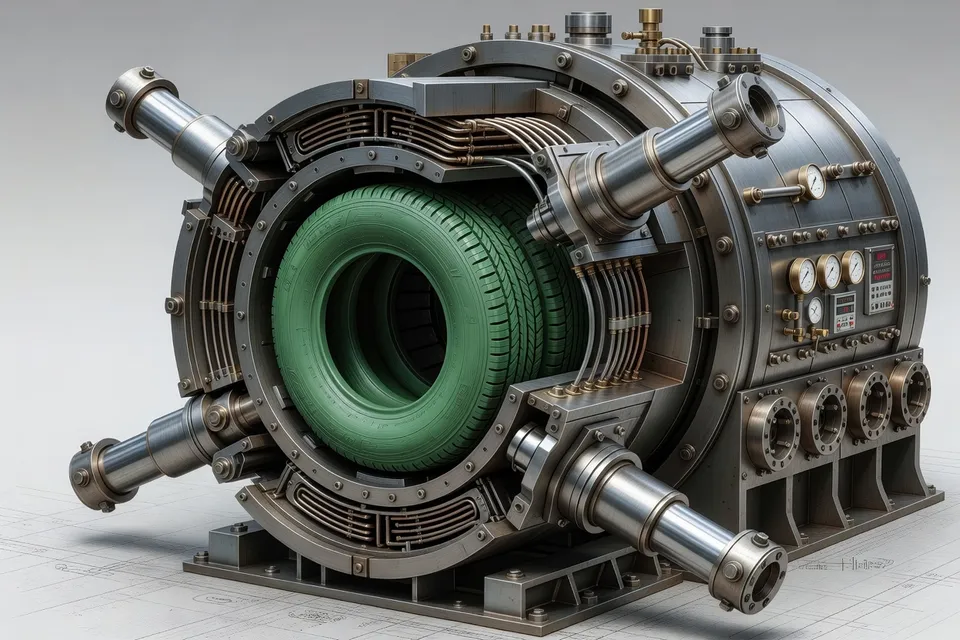
Nokian Tyres (a tire manufacturer operating factories in Finland, the United States, and Romania) opened its Oradea passenger-car tire factory in 2024. The company says the plant has operated with zero direct Scope 1 emissions, uses 100% renewable energy for Scope 2, and began tire deliveries in 2025. Steam for curing is generated by electric boilers powered by zero-carbon electricity rather than coal or gas.
This is a clear equipment and energy-source decision. It is not a disclosed comparison showing that Oradea consumes fewer kilowatt-hours per tire than an equivalent gas-fired or coal-fired plant. The factory's design also includes heat recovery, water recirculation, energy-efficient lighting, and on-site solar generation. Those features can reduce purchased energy or emissions, but the public operating description does not isolate the contribution of the curing system.
Nokian reports that 80.5% of the energy used in its tire factories came from renewable sources in 2025. It also reports a 2025 Scope 1 and 2 emissions intensity of 127 kilograms of carbon dioxide equivalent per ton of tires produced for its Finnish and U.S. factories. That figure is not a Romanian curing benchmark and should not be used as one. The geography and factory set differ from Oradea's zero-direct-emissions claim.
For a plant manager, the useful separation is straightforward. Oradea demonstrates that an electric boiler can supply curing steam in a full-scale tire factory under a zero-fossil-energy model. Continental demonstrates that a multi-year efficiency program can accumulate a large energy saving across plants. Neither page supplies the same-line baseline needed to rank one cure system against another.
Steam transfer remains the line check
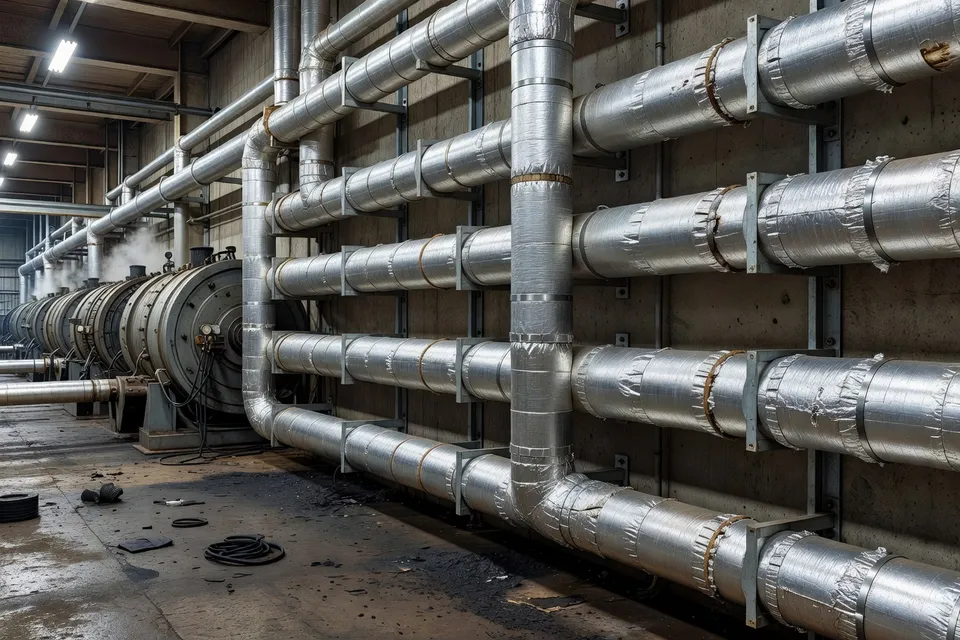
Kurita (a water and process-treatment technology provider) identifies vulcanization as one of the most steam-intensive operations in tire manufacturing. Its described mechanism is dropwise condensation: improve condensation heat transfer so the steam already supplied to the curing system transfers heat more effectively through the bladder and mold system.
The proposed intervention is aimed at existing curing assets. Kurita says the technology can reduce steam consumption and associated steam-generation energy without replacing the curing equipment or installing major heat-recovery equipment. Those are product and mechanism claims, not a reported plant trial with a named tire size, production rate, baseline steam meter, or accepted QA result in the available page material.
That gap sets the measurement requirement. A trial should log steam mass or boiler energy for the same press, mold, tire construction, cure recipe, and output rate before and after the intervention. Temperature and pressure alone will not establish savings. The line also needs confirmation that cure state, adhesion, hardness, uniformity, and dimensional results remain inside the existing release limits. If the steam meter falls but cure quality shifts, QA should refuse the claimed saving.
What the numbers still do not prove
The 400-GWh Continental result is strong as a company-wide program figure because it carries a five-year period and a named operating group. It remains weak as a transferable vulcanization benchmark because the company does not publish the share attributable to curing, the denominator by ton or tire, or the baseline for each plant.
Nokian's Oradea operation is strong as a dated plant configuration: electric boilers supply cure steam, the plant began deliveries in 2025, and the company reports zero direct Scope 1 emissions. It is not a measured energy-efficiency comparison. Renewable electricity changes the emissions profile of the steam; it does not automatically reduce the steam required by the mold.
The next approval should therefore be narrow. Record the existing cure line's steam or electrical energy per accepted tire, run the proposed change on a defined trial lot, and compare the result with the same product and recipe. Keep the change only if energy falls without a QA refusal, a longer cycle, or a loss of output. That is the measurement still missing between a plausible heat-transfer mechanism and a transferable plant result.
Editorial Insights
- What must be measured before claiming that a curing change saves energy?
- Refuse a fleet number as a press benchmark. Meter steam mass or boiler energy for the same press, mold, tire construction, cure recipe, and accepted output before and after the change, then retain cycle time, pressure, temperature, and QA results with the trial record. A lower steam reading is not a saving if the press runs longer, rejects increase, or output falls; the comparison must use energy per accepted tire, not energy per cycle alone.
- Does an electric boiler automatically reduce the energy required by vulcanization?
- No. Ask first whether the boiler is replacing the steam source or whether the cure line itself has been made less heat-intensive. An electric boiler can remove combustion emissions at the site and may simplify integration with renewable electricity, but it does not prove that the mold needs fewer kilowatt-hours per tire. Oversized steam demand, leaks, poor insulation, and a recipe that holds temperature after cure remains complete can survive the fuel switch.
- How should a plant approve a steam-transfer treatment on an existing vulcanizer?
- Run it as a controlled production trial, not as a boiler-room demonstration. Lock the tire specification, mold, press, recipe, production rate, and baseline meter readings; then verify steam use, cycle duration, cure state, hardness, adhesion, uniformity, and dimensions against existing release limits. The usual failure mode is to accept a lower steam reading while a slower heat transfer or altered condensation pattern quietly shifts cure quality. QA must sign the result before procurement treats the treatment as a recurring saving.
- Which distribution losses should maintenance check before requesting new curing equipment?
- Inspect insulation on steam lines, valves, flanges, and condensate equipment, then check pressure drop, leaks, trap condition, and water removal at the press. Heat-transfer work inside the vulcanizer cannot compensate for a distribution line that arrives cold or wet. A common miss is to compare boiler output with press demand while ignoring steam lost between them, making the new boiler or treatment appear necessary when the line defect is the real load.
- What approval sequence keeps an energy-saving cure change from damaging output?
- File the baseline, define the trial lot, and name one owner for the cure recipe and one approver for product release before changing setpoints or steam treatment. Production engineering should confirm that the trial does not extend cycle time; maintenance should verify the steam and condensate path; QA should release the resulting tires; and purchasing should use the measured energy per accepted tire in its value case. Do not scale from a successful no-load or short run: the failure usually appears when mixed sizes, shift changes, or normal press utilization expose an unstable temperature or pressure profile.
References
- 1.Executive Chairman, Giti Tire. (2026, October 16). Why engineering value first is key to product and system excellence in the mobility sector. World Economic Forum.
- 2.Continental Tires. (2026, October 6). Operations. Continental Tires.
- 3.Thermal Energy International. (2026, October 3). Tire and rubber manufacturing. Thermal Energy International.
- 4.European Rubber Journal. Sustainability news tracker 2026. European Rubber Journal.
- 5.Nokian Tyres. Emissions and energy. Nokian Tyres.
- 6.Analytica Sector. Energy-efficient tire production: Where plants gain the most savings. Analytica Sector.
- 7.MfgCalcs. Rubber, tires, foam, and elastomer manufacturing benchmarks and KPIs. MfgCalcs.
- 8.Kurita Europe. Steam efficiency in tire manufacturing. Kurita Europe.
- 9.Tyre Trends. The tyre giant that doesn’t want a dark factory. Tyre Trends.