

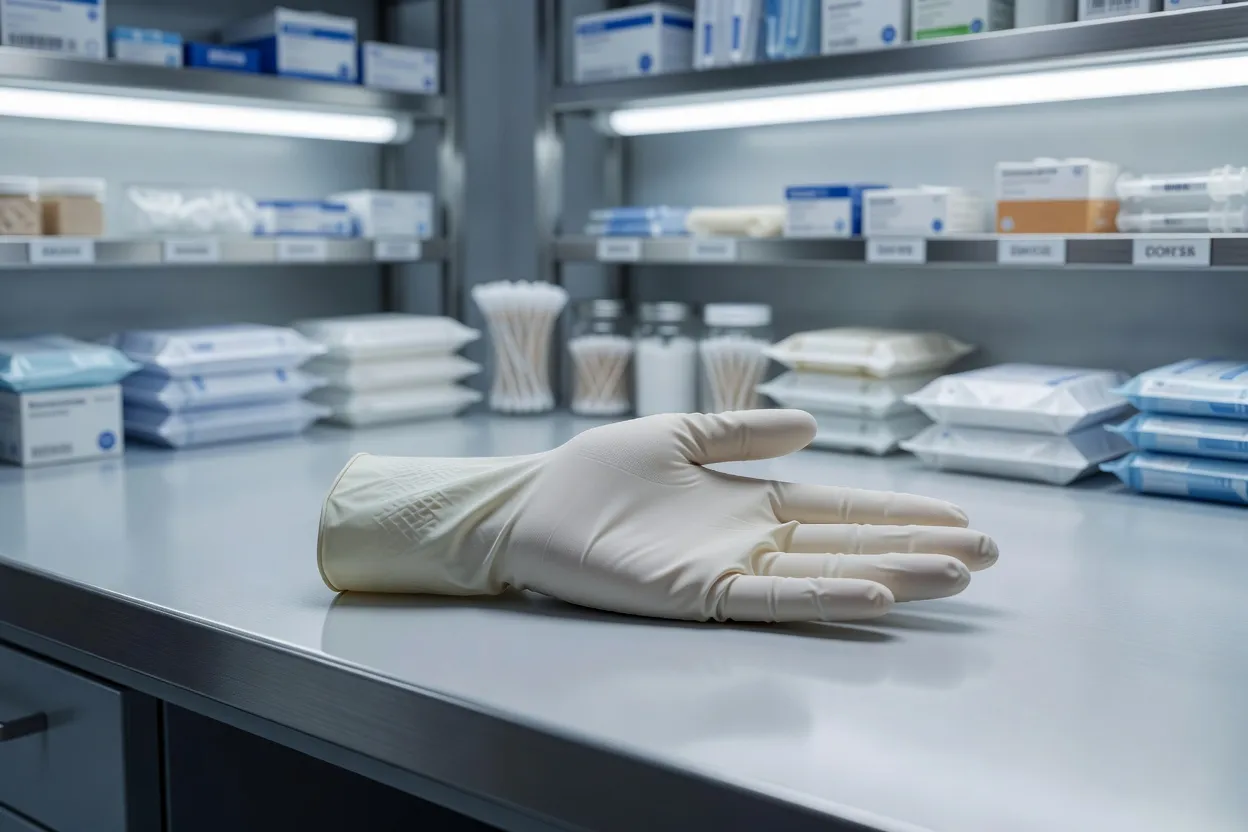
Cranfield University and Meditech have developed a deposition-based route for making rubber gloves that replaces repeated dipping baths with digitally controlled elastomer placement. The 3D-PEP, or 3D Printer for Elastomeric Products, sprays natural-rubber latex onto a former and heats the glove from inside and outside during deposition so the material can vulcanize into its final shape.
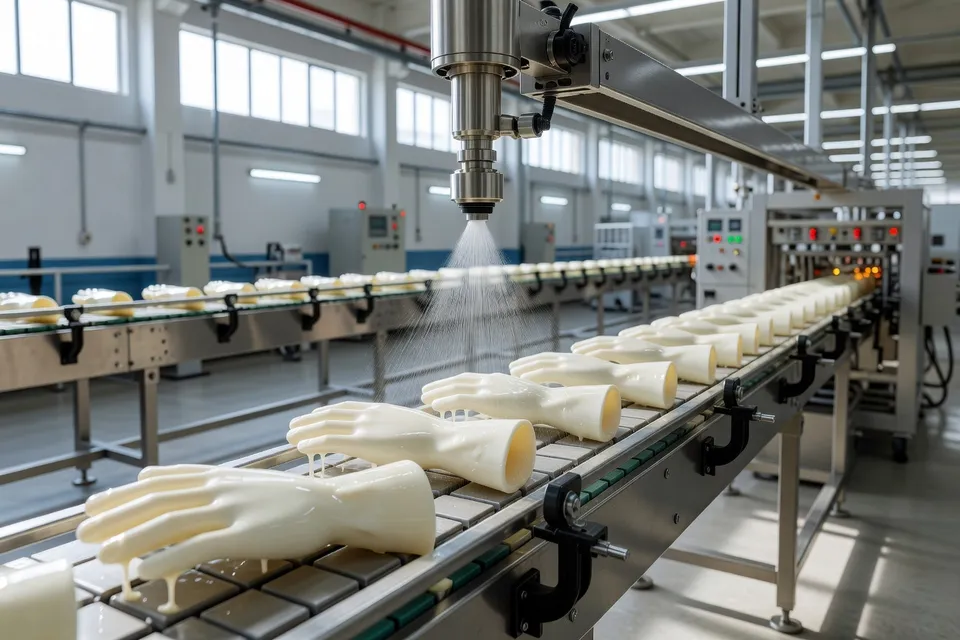
That process step is the story. The machine is not simply printing a solid thermoplastic and hoping it behaves like rubber later. It is placing a latex formulation and managing cure on the former. For a processor, that changes the production question from how many identical formers can run through a long bath sequence to how accurately a smaller lot can be deposited, heated, and released without losing film integrity.
The reported result is a demonstrated glove-making method, not a commercial production rate. The project compares a printed glove with a commercial surgical glove and presents the method as more adaptable to batch size and geometry. The available report does not establish line speed, latex throughput, glove cost, tear strength, elongation, barrier performance, or validated medical compliance. Those are the gates a purchasing or quality team would still require before replacing a dipped product.
The deposition step
Conventional glove production uses formers that pass through multiple baths, with drying between stages. That sequence commits the plant to equipment, floor space, bath control, and a production volume large enough to justify the line. The Cranfield–Meditech approach instead sprays the rubber onto the form, while internal and external heating supports vulcanization during the build.
The benefit is not “3D printing” as a label. It is the combination of localized material placement and concurrent cure. A digital path could alter wall distribution, glove shape, or lot size without making a new dipping line. It also creates a route to hand-specific products: the project describes scanning a user's hand and producing a personalized glove.
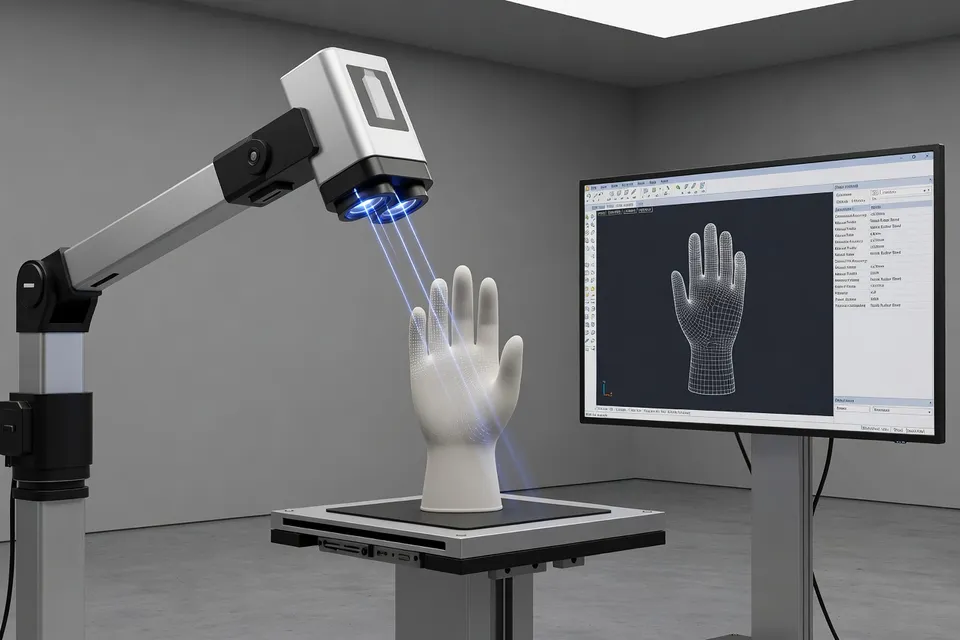
That flexibility comes with a tighter process-control burden. A dipping line creates a continuous film through immersion, withdrawal, drainage, and drying. Deposition must control spray delivery, overlap, substrate temperature, cure history, and the bond between successive passes. Any claim of smaller custom batches therefore depends on repeatable thickness and cure, not only on the ability to change a digital file.
What the comparison establishes
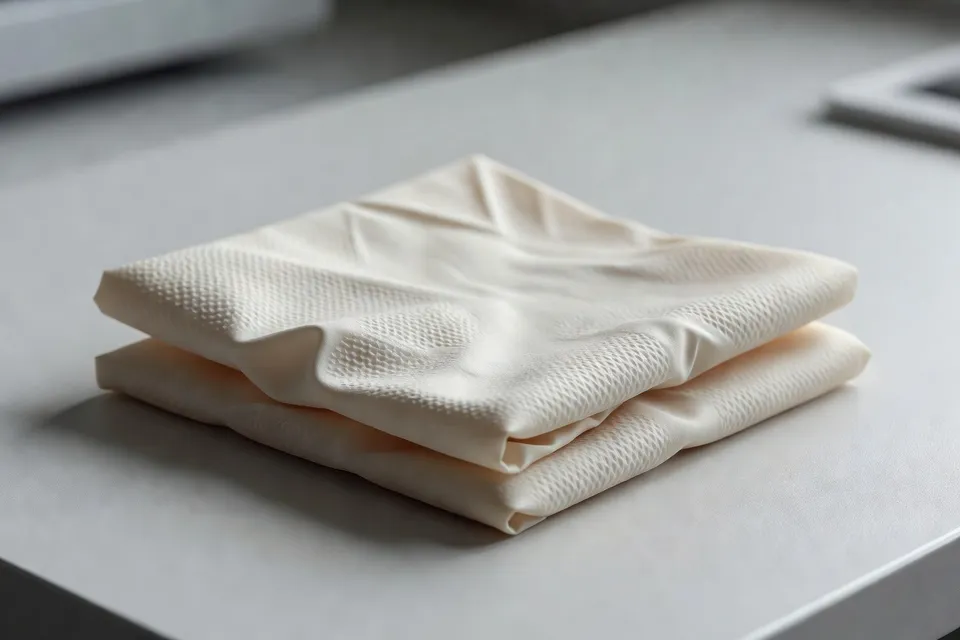
The published comparison shows that a 3D-printed glove can be made and examined alongside a commercial surgical glove. It does not provide a common mechanical or barrier dataset that would let QA rank the printed film against the reference product. The film surface images show a comparison of finish, but a visual comparison is not a specification.
The distinction matters because glove performance is a coupled materials problem. Natural-rubber latex must form a continuous film, achieve the required vulcanization state, and survive stretching, handling, and contact with the intended environment. A rougher surface, local thickness variation, under-cure, or excess cure could each become a failure mode even if the glove looks intact after printing.
The project team also presents natural rubber as a sustainability advantage over synthetic alternatives and says the material could degrade in about one year. That is a material claim whose usefulness depends on disposal conditions and the actual formulation. It should not be converted into a plant-level carbon or end-of-life result: the report does not provide a measured life-cycle comparison, degradation protocol, or waste balance against dipped gloves.
The figures that still need to move
The reported comparison contains two objects—a printed glove and a commercial surgical glove—but no shared numerical performance series. The evidence therefore supports a process demonstration rather than a validated product-equivalence claim.
| Compared object | Reported evidence | Decision still open |
|---|---|---|
| 3D-printed glove | Produced with 3D-PEP deposition and in-process heating | Thickness, cure, barrier, and mechanical qualification |
| Commercial surgical glove | Used as visual and product comparison | Matched test conditions and acceptance limits |
The printed glove proves that the route can form the product. It does not yet prove that the route can hold the same specification across a custom batch.
The next qualification gate
The practical next trial should run matched printed and dipped gloves from the same defined latex formulation, with thickness mapped across the palm, fingers, cuff, and high-strain zones. The study should record spray rate, pass overlap, former temperature, internal and external heating profiles, and cure time for every lot. Those process variables are the bridge between a customizable digital path and a repeatable rubber article.
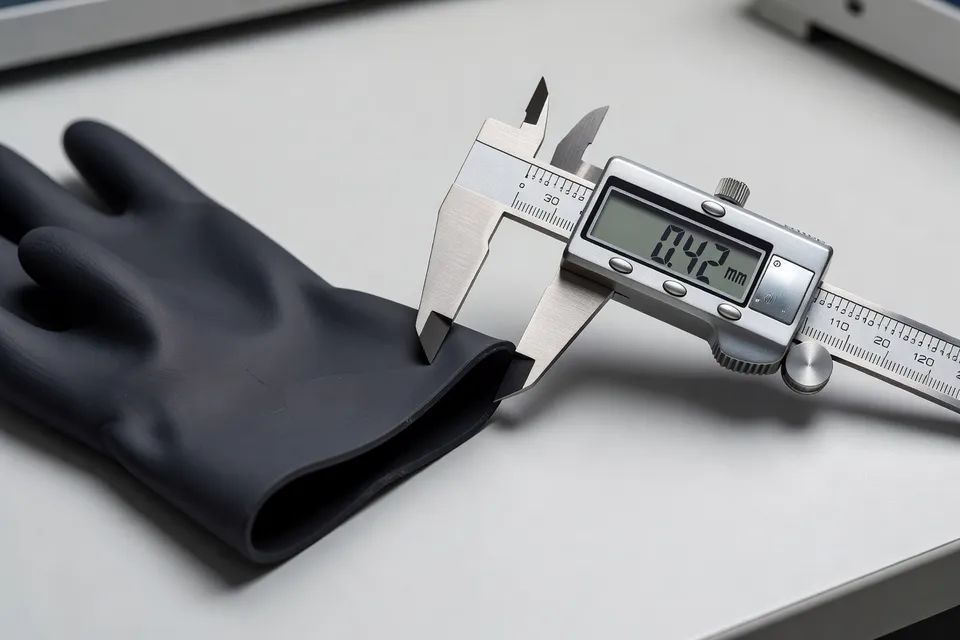
QA would then need paired barrier, tensile, elongation, tear, aging, and pinhole results under the target glove standard. The comparison must include a batch-size window, because the value proposition is not merely making one unusual glove; it is making smaller lots without allowing variation to consume the benefit.
The route has a credible mechanism for custom production: deposit latex where required, shape the part digitally, and vulcanize it during manufacture. That is enough to justify a controlled pilot. It is not enough to call the printed glove a commercial substitute for dipped surgical gloves. The next gate is a documented repeatability trial tied to thickness, cure, and barrier limits. Until those measurements close, digital deposition is a promising batch-control method—not a finished rubber-glove qualification.
Editorial Insights
- What must be controlled before a digitally deposited latex glove can be called repeatable?
- Record spray rate, pass overlap, former temperature, internal and external heating profiles, and cure time for each lot. Then map thickness across the palm, fingers, cuff, and high-strain zones rather than accepting an average value. The usual failure is a file that repeats perfectly while local overlap or temperature drift creates thin spots, under-cured regions, or excess cure. Digital path control is only useful when those settings have named owners and a defined operating window.
- Can the deposition route replace a dipped surgical glove after one successful print?
- No. A successful print proves that the glove can be formed, not that it meets the required product specification. Run matched printed and dipped gloves from the same defined latex formulation, then compare barrier performance, tensile strength, elongation, tear, aging, and pinhole results under the target standard. Visual similarity is not qualification; the common mistake is allowing a clean surface image to substitute for a shared numerical dataset.
- When do smaller custom batches create a real economic advantage rather than just a different production method?
- Start by defining the batch-size window the process must serve and compare total cost against the fixed equipment, floor space, bath control, drying, and changeover burden of dipping. The benefit is credible only if smaller lots can be made without excessive scrap, rework, or inspection time. Freight or line-size savings alone do not establish value; a custom batch that requires repeated tuning and destructive testing can consume the margin the digital route was meant to create.
- What additional checks are needed before a scanned hand shape can become a production glove?
- Freeze the approved digital geometry, define dimensional tolerances, and verify that the altered path still delivers continuous film, consistent thickness, and adequate cure in every high-strain area. The scan does not replace former validation or final dimensional and performance checks. A personalized geometry can introduce sharper transitions or difficult spray angles, so the first custom article should be treated as a controlled qualification build rather than released because the file matches the user’s hand.
- How should the natural-rubber degradation claim be used in a purchasing or sustainability decision?
- File it as a material and disposal hypothesis, not as a verified environmental result. Confirm the actual formulation, disposal conditions, degradation test method, and waste balance before assigning carbon or end-of-life value. Natural rubber may offer a useful alternative to some synthetic materials, but the claim becomes misleading when a reported degradation time is treated as proof of lower life-cycle impact without measured comparison.
References
- 1.Health Medicine. 3D enables custom rubber gloves. Health Medicine.
- 2.3DPrint.com. (2026, October 21). 3D printing news briefs: October 17, 2026: Affordable housing, bone implants, rubber gloves, & more. 3DPrint.com.
- 3.atpress.ne.jp. (2026, October 21). 3Dプリンティング用エラストマー市場―2026年~2032年の世界市場予測. atpress.ne.jp.
- 4.AZoM. Materials news. AZoM.
- 5.Rubber World. Michelin and the University of Poitiers to inaugurate i-TireLab this November. Rubber World.
- 6.European Rubber Journal. Rubber and tire industry in numbers. European Rubber Journal.
- 7.European Rubber Journal. SaarGummi starts automotive seals production at new India facility. European Rubber Journal.
- 8.Plastech. Technologies. Plastech.