

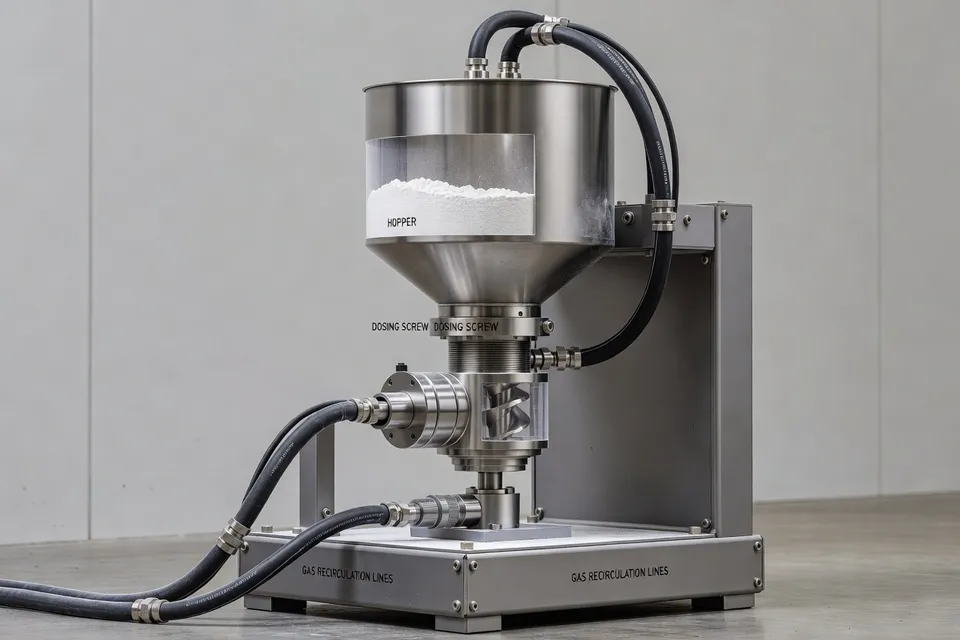
AM Solutions has introduced a powder-management system and a direct-feeding system for polymer additive manufacturing, targeting the handoff between processed selective laser sintering powder and the printer. The equipment addresses a production constraint that is less visible than print speed: maintaining a controlled, repeatable feed of usable powder into the machine.
The move matters because polymer additive manufacturing is separating into two industrial requirements. Powder-bed users need material preparation, replenishment and reuse to operate as one workflow. Pellet- and filament-based users need formulations that retain engineering performance while remaining processable through the selected deposition system. Neither requirement is solved by a broader catalogue alone.
The powder handoff
AM Solutions' systems automate replenishment with processed SLS powder. The stated function closes the gap between powder preparation and printer supply, rather than changing the polymer itself. That distinction limits what can be claimed. The announcement establishes a feed-control intervention; it does not establish a measured improvement in uptime, powder utilization, part quality or production cost.
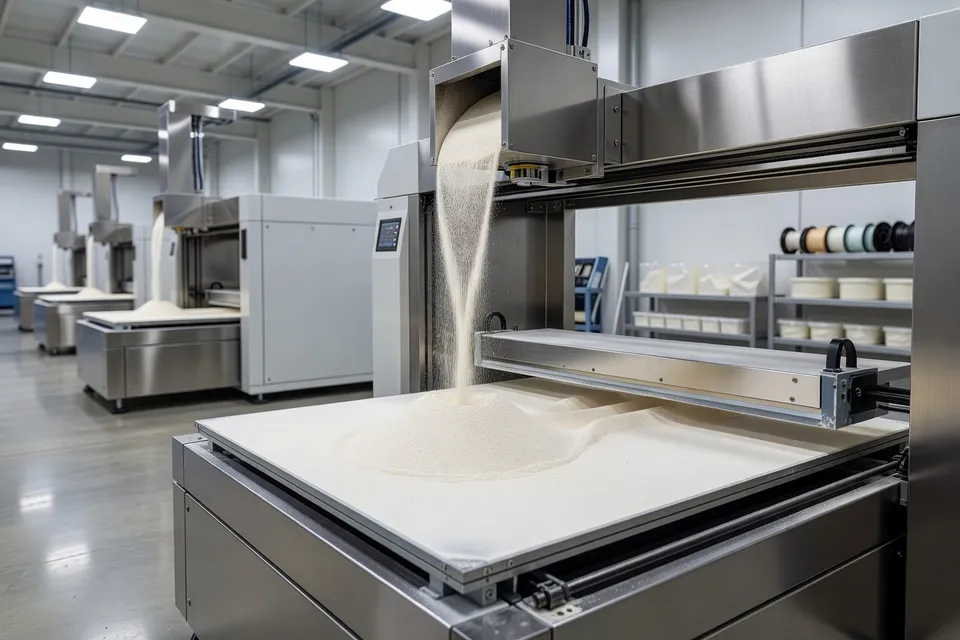
For a processor, the commercial question is therefore operational. A controlled feed may reduce manual handling and make the material path more repeatable, but qualification still depends on the powder definition, the printer, the refresh practice and the part specification. A system that moves powder reliably does not by itself prove that the powder remains within a usable processing window.
The missing production evidence is clear: no throughput result, utilization rate, defect rate or plant comparison is identified in the available account. Buyers should treat the system as automation infrastructure until those measurements are published. The value is plausible; the production result remains unclosed.
The material development track
Xenia Materials (composite-materials developer) has formed a partnership with Italy's National Research Council, specifically its Institute for Polymers, Composites and Biomaterials, to develop future composite materials. The programme covers injection-moulding materials as its primary field and includes pellet- and filament-based 3D printing.
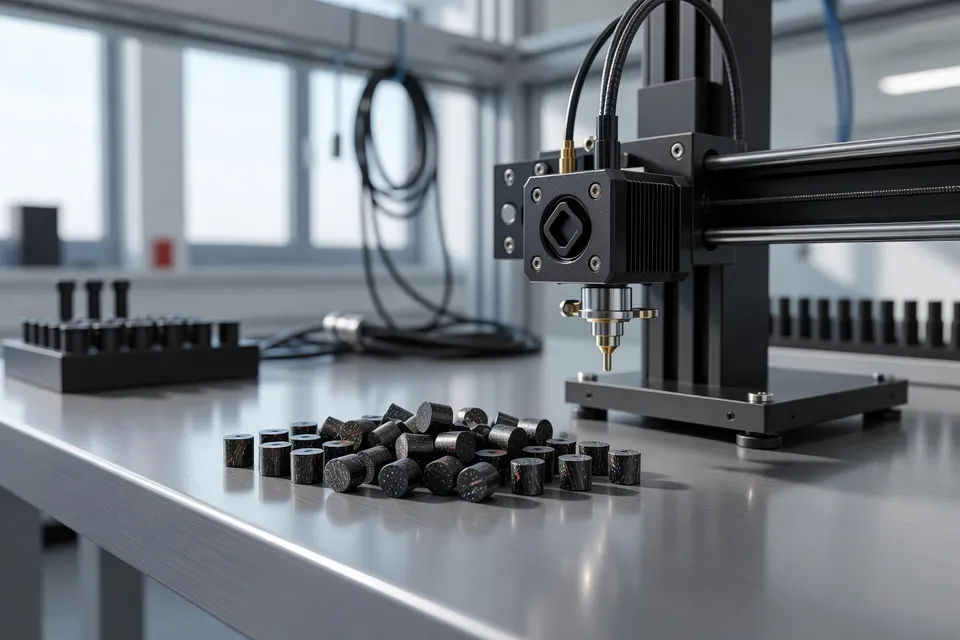
The partnership combines Xenia's more than 30 years of experience in reinforced composites with CNR's research capabilities. Its target properties include lightweighting, high performance, self-healing behaviour, energy absorption, electromagnetic-interference shielding and electrical conductivity. Carbon fibres, nanofillers and graphene are identified as reinforcement routes.
Those targets are technically relevant but commercially unfinished. A material that provides conductivity or EMI shielding still has to meet feeding, melt-flow, layer-bonding and dimensional requirements in the intended printing process. A fibre-reinforced formulation may improve stiffness while increasing wear, clogging risk or anisotropy. The partnership creates a development route; it does not yet provide a qualified grade, capacity figure or field result.
The distinction is especially important for pellet printing. Pellet feedstock can support higher material throughput than filament, but the feed system must accept a consistent particle size and formulation. Thermal history, moisture and reinforcement dispersion can all affect extrusion stability. The announced work points toward integrated material design, yet the available description gives no processing window or production baseline against which to judge it.
Specialization without a volume claim
TCT Shenzhen 2026 showed the same shift from general-purpose capability toward application-specific materials. Polymaker displayed reinforced polymers including Fiberon PA612-CF15 and ASA-CF08, alongside printed examples. The event coverage also identified elastomers and silicone as part of a wider move toward materials matched to product function.
That evidence supports a change in emphasis, not a market ranking. The exhibition demonstrated that suppliers are offering reinforced and flexible polymers for specific requirements, but it did not establish comparative regional volumes, installed capacity or share. It would be wrong to turn a show-floor display into proof of adoption.
| Polymer material direction | Product or grade example | Application requirement identified |
|---|---|---|
| Reinforced polymer | PA612-CF15 | Structural performance and lightweighting |
| Reinforced polymer | ASA-CF08 | Functional printed components |
| Advanced composite development | Carbon fibre, nanofillers and graphene | Conductivity, EMI shielding and mechanical performance |
The table separates displayed or proposed material directions from proven production outcomes. The examples show where suppliers are placing technical attention; they do not show which grade leads the market.
Feed control is the nearer industrial test
Among the developments, feed control is the more immediate production issue. AM Solutions' equipment is aimed at a defined process step and a defined material stream: prepared SLS powder entering a polymer printer. That makes it easier to verify than a multi-property materials programme. The relevant tests are also concrete: replenishment consistency, operator intervention, powder traceability, printer availability and part acceptance.
Xenia and CNR face a longer qualification path. Their programme may produce materials with properties that conventional grades do not offer, but each function must survive the selected printing route and the buyer's approval system. A smart composite that cannot maintain stable deposition or repeatable part properties will remain a laboratory formulation.
TCT Shenzhen reinforces the same commercial filter. Exhibitors increasingly linked materials to particular products, including reinforced polymers, flexible footwear materials and elastomeric structures. The event's central message was practical application, but the next step is cost-effective and reliable production. Product demonstrations establish direction; they do not establish demand.
The defensible 2026 conclusion is narrow. Polymer additive manufacturing is moving toward tighter control of both the material formulation and the material path. AM Solutions has supplied a concrete automation response for SLS powder handling. Xenia and CNR have supplied a development platform for higher-function pellet and filament materials. The assumption that would change the assessment is measured plant evidence: a dated comparison showing that controlled feeding improves yield or utilization, or a qualified composite grade demonstrating repeatable performance in production.
The next useful data point is therefore not another broad materials announcement. It is the first reported operating result from the powder-management system or the first qualified pellet or filament grade from the Xenia-CNR programme.
Editorial Insights
- Which metrics need checking before crediting a powder-feed system with higher output?
- Log replenishment consistency, operator interventions, printer uptime, powder traceability and first-pass yield both before and after the change. Hold powder grade, refresh rate, printer parameters and part spec constant throughout. Better transfer alone does not prove higher utilization; powder may reach the machine steadily while its processing window or part acceptance stays unproven.
- Does controlled powder feeding fix inconsistent SLS powder quality?
- No. Confirm particle-size distribution, moisture content, refresh practice, traceability and the printer’s allowed powder state first. The feeder can steady the material path but cannot revive degraded powder or fix a bad blend. Cutting manual handling and then blaming the feeder for less scrap confuses material quality with transfer consistency.
- What steps must a reinforced pellet or filament formulation pass before approval?
- Begin with a fixed formulation and feedstock spec, then set moisture limits, particle or filament size, thermal history, filler dispersion and a stable processing window on the target printer. Next qualify layer adhesion, dimensional stability and final properties against the customer spec. Skip the lab-to-production leap; fibres or nanofillers often raise stiffness or conductivity yet add wear, clogging or anisotropy.
- Which parameters require control when running pellet feedstock for higher polymer-printing throughput?
- Maintain particle-size consistency, moisture level, formulation uniformity and thermal exposure, then confirm steady conveying and extrusion across the full run length. Higher pellet throughput only helps if deposition stays uniform and parts meet both dimensional and mechanical specs. Short trials often look fine until segregation or moisture pickup triggers surging later.
- How should claims for conductivity, EMI shielding or self-healing materials be evaluated?
- Demand more than a single property test. Check the claimed function alongside melt flow, feeding stability, layer bonding, dimensional control and the actual part spec on the chosen process. A conductive or self-healing grade is worthless in production if it fails those checks over repeated cycles. Reporting a lab specimen value without print-direction effects or thermal history is the usual overclaim.
References
- 1.TCT Magazine. (2026, October 19). AM Solutions introduces Powder Management System & Direct Feeding System to support polymer additive manufacturing. TCT Magazine.
- 2.TCT Magazine. Xenia Materials partnership with National Research Council of Italy to develop materials for polymer 3D printing technologies. TCT Magazine.
- 3.Fanglei, X. (2026, October 19). Seven trends reveal what’s next for 3D printing at TCT Shenzhen 2026. 3DPrint.com.
- 4.Advanced Carbons Council. (2026, October 18). Polymers. Advanced Carbons Council.
- 5.MDPI. Polymers, volume 18, issue 19. MDPI.
- 6.Plastics Technology. Plastics Technology.
- 7.Data Resources, Inc. Global resins for 3D printing. Data Resources, Inc.
- 8.Plastics Machinery & Manufacturing. Plastics Machinery & Manufacturing.