

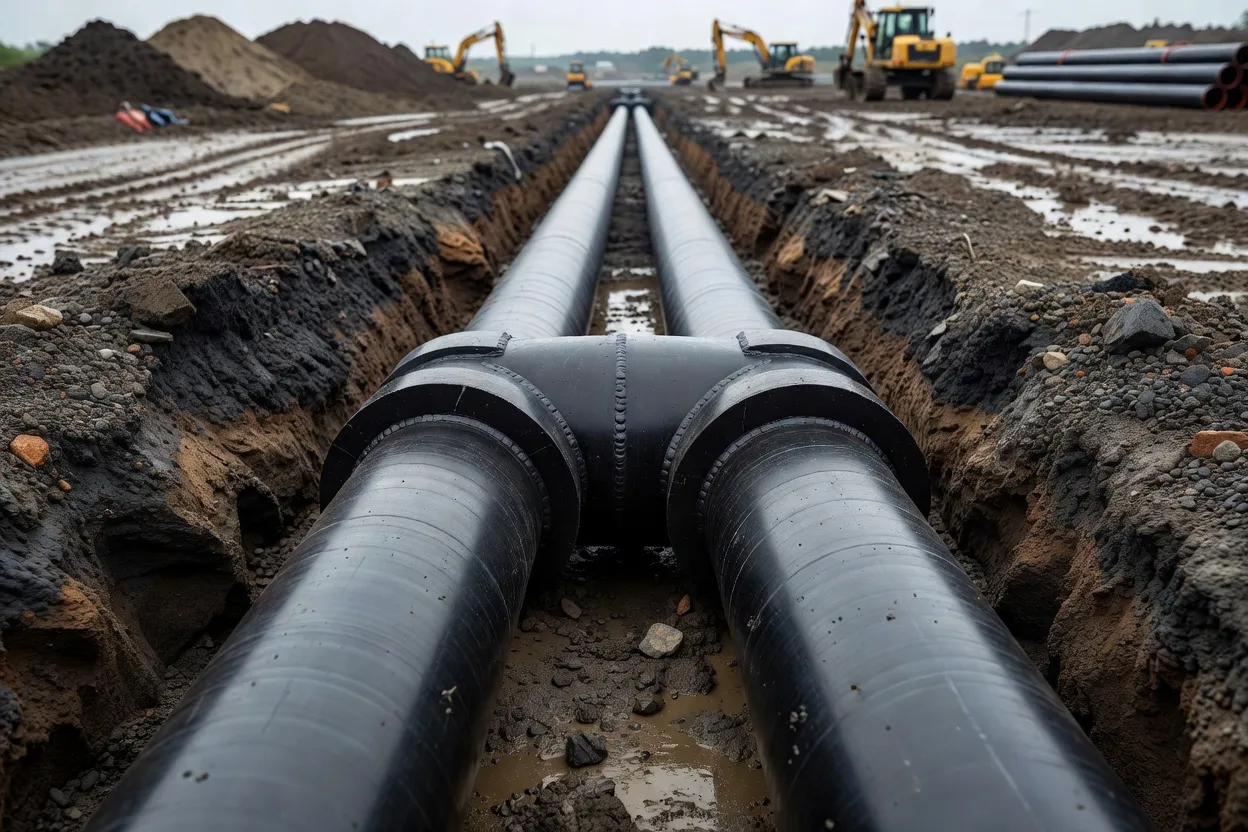
Formosa Plastics Corporation USA has declared force majeure on selected polyethylene grades effective October 29 after an unplanned shutdown of a production unit at its Point Comfort, Texas, complex. The notice establishes a contractual supply constraint. It does not establish the size of the shortfall, the affected grades, or the duration of the outage.

That distinction matters to every converter buying US PE. Formosa has not identified the failed unit, stated how much capacity is offline, or given a restart window. The Point Comfort complex is estimated to have combined PE capacity of 1.8 million to 1.9 million tonnes per year, but that site total cannot be used as the lost volume. QA and purchasing teams should not treat the full complex capacity as unavailable until Formosa identifies the unit and grades covered by the force majeure.
The immediate question is allocation, not the headline number. A force majeure lets a producer limit contractual performance when an event outside its control prevents delivery. It does not by itself prove that every PE grade is short, that spot buyers are refused, or that North American supply has entered a generalized deficit.
The Point Comfort unit
Formosa Plastics USA (Formosa Plastics Corporation USA, the producer operating the Texas complex) has not named the production unit behind the October 29 declaration. That leaves three operational cells unresolved: whether the outage affects LDPE, HDPE, LLDPE, or more than one family; whether inventories can cover scheduled shipments; and whether export cargoes will be reduced before domestic allocations.
The complex's estimated annual PE capacity provides scale, but not an outage calculation. The published estimate divides the site into approximately 625,000 tonnes per year of LDPE, 800,000 tonnes of HDPE, and 465,000 tonnes of LLDPE. Those figures describe installed capacity, not current production and not the tonnage withheld under the declaration.
| Point Comfort PE capacity estimate | Tonnes per year |
|---|---|
| LDPE | 625,000 |
| HDPE | 800,000 |
| LLDPE | 465,000 |
The figures show why buyers need a grade-specific notice. A converter running an LLDPE film line cannot substitute an HDPE estimate, and a site total cannot support a resin approval. Until Formosa names the affected grade and allocation method, the defensible purchasing action is to confirm order status, committed quantity, and alternate supply rather than assume a plant-wide stoppage.
The October price case
The force majeure arrived after a 5-cent-per-pound September PE increase had taken hold, while Dow and NOVA announced additional 7-cent-per-pound increases for October. ResinSmart said domestic demand remained soft, inventories were growing, availability was healthy, and spot ethylene was steady at 23 cents per pound when it assessed the October increase. That backdrop makes the Formosa event material, but it does not retroactively validate every October nomination.
ResinSmart executive Michael Workman said buyers should test whether an increase reflects actual cost or tighter supply. That is the correct order of operations now. A producer declaration can tighten a named grade; it cannot prove that unrelated grades have lost availability or that the entire October price move rests on this outage.
North American resin production data also argues against using one plant notice as a complete regional balance sheet. The American Chemistry Council reported 9.1 billion pounds of major plastic resins produced in August 2026, up 1.7% from July but down 0.7% from August 2025. Sales and captive use also reached 9.1 billion pounds, up 1.7% from July and 3.8% from a year earlier.
| US major plastic resins | August 2026 |
|---|---|
| Production | 9.1 billion lb |
| Sales and captive use | 9.1 billion lb |
| Production versus July | +1.7% |
| Sales and captive use versus July | +1.7% |
Those ACC figures cover major plastic resins rather than the Point Comfort grades specifically, so they cannot measure the Formosa shortfall. They do, however, prevent a broader claim that the force majeure alone demonstrates a US-wide PE shortage. Buyers need the affected grade, the committed allocation, and the next shipment date before accepting a supply or price conclusion.
The export route
Point Comfort sits within a US Gulf Coast production system that serves domestic processors and export customers. A prolonged outage could reduce availability for film, injection molding, and packaging converters in North America while also removing cargoes that would otherwise move to Latin America, Europe, or Asia. That is a route risk, not proof that those regions have already lost supply.
The allocation decision will determine the practical effect. If Formosa protects contract customers and cuts spot or export volumes, traders may find replacement cargoes before domestic converters see a missed truck. If the shutdown reaches a grade with limited substitution, processors may face qualification work, longer lead times, or a refusal to change resin without a trial. Neither outcome can be selected from the force majeure declaration alone.
Shell's account of the 2021 Texas winter storm remains a useful operating warning: regional PE disruptions can halt production, and plants may need time to inspect equipment and restart after unscheduled downtime. But that earlier event does not supply a restart forecast for Formosa in October 2026. The new outage needs its own unit status and mechanical timeline.
What buyers can verify
Purchasing teams should ask Formosa or their distributor four direct questions: which grade is under force majeure, what quantity is allocated, which orders retain confirmed ship dates, and when the next status review will occur. A substitute grade should enter production only after the converter confirms processing, performance, and customer approval.

Dow has pointed to declining inventories, constrained production, and higher feedstock costs as support for cumulative October and November increases totaling 12 cents per pound. Its executives also cited a 5-day and 400-million-pound decline in PE inventories in September. Those figures describe the conditions Dow used for its pricing outlook; they do not quantify Formosa's outage and should not be combined with the Point Comfort capacity estimate as though they were one balance sheet.
The cleanest judgment is therefore narrow. Formosa's declaration is a real supply-control event for selected PE grades, but the market cannot yet price the full Point Comfort complex as offline. Until the producer identifies the unit, grades, allocation volume, and restart plan, buyers should defend confirmed tons and challenge unsupported claims of a system-wide shortage. No restart window is on the notice.
Editorial Insights
- What should a buyer verify before treating the force majeure as a shortage of a specific PE grade?
- Ask for the affected grade code, allocated quantity, confirmed shipment dates, and next status-review date. Do not convert the site’s combined capacity into a lost-volume estimate; the notice does not identify the failed unit or production family. The common mistake is to assume that a plant-wide announcement means every LDPE, HDPE, and LLDPE order is exposed, then pay for cover that the supplier never actually withdrew.
- Can the October PE increase be justified solely by the Formosa shutdown?
- No. Separate the producer’s contractual allocation action from the evidence used to support a market-wide price move. Check the named grade, available inventory, replacement offers, feedstock basis, and your confirmed tons before accepting a nomination. A force majeure can tighten one grade without proving that unrelated PE grades are short, and buyers often let a credible plant notice validate an increase that the notice itself does not quantify.
- When is a substitute PE grade ready to enter production?
- Refuse a direct substitution until processing data, finished-part performance, and customer approval are documented. Compare melt-flow behavior, density, additive package, molding or film settings, and product specifications, then run a controlled trial under the converter’s change-control procedure. Matching one headline property is not approval: a second source can meet melt flow and still change sealing, optics, impact, warpage, or scrap.
- How should purchasing and QA divide responsibility while the affected unit remains unidentified?
- Purchasing owns the order ledger, allocated tons, confirmed ship dates, and supplier follow-up; QA owns grade identity, CoA review, substitution approval, and trial records. File the supplier notice with each affected lot and keep the approved resin specification visible to production. The failure mode is letting purchasing release an alternate material because it is available while QA learns about the change only after a line has produced nonconforming parts.
- What does the shutdown imply for export availability and replacement cargoes?
- Treat export reduction as a route risk, not as proof that overseas markets have already lost supply. Track whether the producer protects contracted domestic volumes, cuts spot orders, or removes export cargoes, and compare those changes with grade-specific offers from other sources. More export pressure can tighten replacement options, but a trader’s concern about the last port is not a shipment confirmation for a converter’s next truck.
References
- 1.Polymerupdate. Polymerupdate news article. Polymerupdate.
- 2.Polymerupdate. Plant news listing. Polymerupdate.
- 3.Shell Polymers. (2026, October 6). What the winter storm in Texas taught us about risk mitigation in polyethylene supply chains. Shell Polymers.
- 4.ResinSmart. (2026, October 23). ResinSmart says buyers must look beyond October resin price increases. PRWeb.
- 5.PlasInsight. North American October 2026 resin prices split by feedstock. PlasInsight.
- 6.Plastics News. Polyethylene prices rebound: PE, PET resin outlook 2027. Plastics News.
- 7.Resource Recycling. Dow bullish on PE pricing into 2027. Resource Recycling.
- 8.American Chemistry Council. ACC releases August 2026 resin production and sales statistics. American Chemistry Council.
