

EWI (EWI, an engineering organization developing manufacturing technologies) has reported a proof-of-concept result for a different way to reduce polymer flow resistance: put the ultrasonic source in the rotating screw rather than adding vibration through the die or barrel. The reported result was approximately 16% greater average penetration into small features, with no formulation change.
That is a useful result, but it is not yet a production-rate claim. EWI's disclosure describes a patented platform, U.S. Patent No. 12,668,011, and identifies finite element analysis as the design route for a tuned screw operating near 20 kHz. The measured movement is feature penetration. The publication does not establish a sustained throughput increase, a cycle-time reduction, a melt-temperature reduction, or a mechanical-property baseline.
For a processor, that distinction matters. A material that reaches a narrow cavity or nozzle passage more effectively may support finer geometry or reduce the need to raise barrel temperature. It does not automatically prove that the screw can run faster, that the polymer sees less thermal history, or that the molded or printed part meets its existing specification.
The screw is the process change
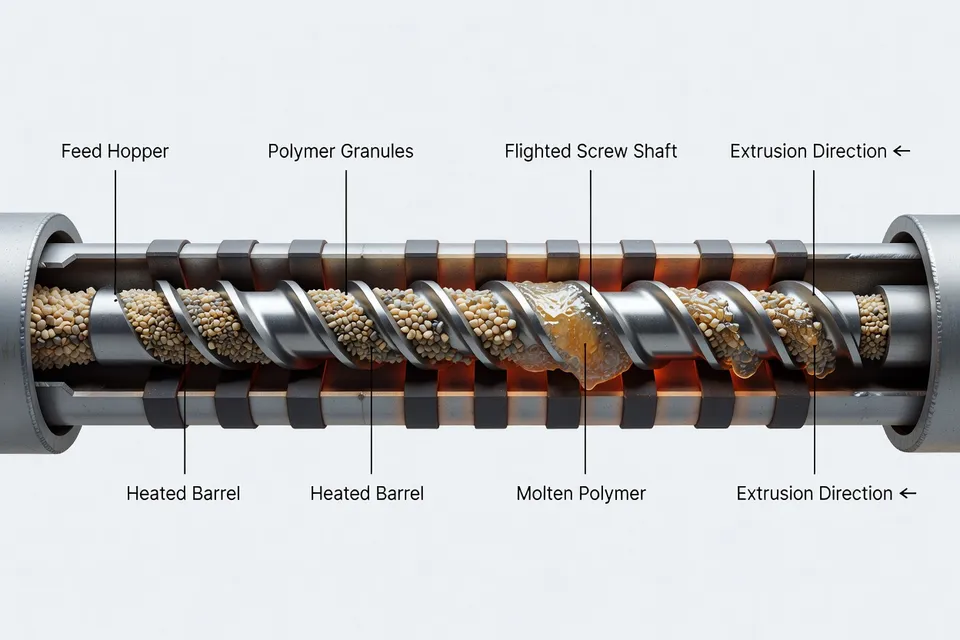
Conventional approaches can introduce ultrasonic energy through a die or barrel. EWI's approach transfers the energy directly through a tuned, rotating extrusion screw. The claimed advantage is not simply “ultrasound” as an additive process step; it is the location and mechanical integration of that step.
Flow resistance rises when a molten polymer must pass through a small opening or when the material has high viscosity. Increasing temperature can lower resistance, but it can also alter degradation risk, crystallization behavior, dimensional stability, and the usable processing window. Slowing the line preserves residence time control but gives up productivity. The screw-integrated concept targets the resistance locally, while leaving the polymer formulation unchanged in the reported test.
EWI says finite element analysis guided the screw design and that the platform is intended to operate near 20 kHz. That design work is a necessary engineering step because a rotating screw must transmit vibration while surviving torque, thermal cycling, polymer pressure, and abrasive or filled compounds. The available result shows that the mechanism can improve penetration in a controlled test. It does not show how the assembly behaves over a production campaign.
The distinction between a patent demonstration and a qualified extrusion process should remain sharp. A technical lead would still need screw-life data, acoustic calibration under load, temperature mapping, residence-time measurements, and a comparison against the same formulation processed through the same geometry without ultrasonic assistance.
The only reported movement is feature penetration
The reported test changed the filling result, not the formulation. The figure below is therefore a process-effect measure rather than a market or capacity comparison.
| Test condition | Polymer formulation | Average penetration into small features |
|---|---|---|
| Ultrasonic assistance | Unchanged | Approximately 16% increase |
| Formulation change | None reported | Not applicable |
The 16% figure supports a narrow judgment: ultrasonic assistance improved the measured penetration outcome in EWI's proof-of-concept work. It does not provide a baseline value in millimeters, a feature geometry, a pressure profile, a polymer grade, or a production duration. Without those cells, a processor cannot convert the percentage into a die-design rule or a guaranteed line-speed gain.
That missing baseline is not a minor reporting gap. A 16% improvement in a highly restrictive passage could be significant, while the same percentage in a generously filled feature might have little effect on part acceptance. The result needs to be tied to the feature size, melt temperature, screw speed, pressure, and acceptance criterion before it can guide a process window.
Where the claim could matter first
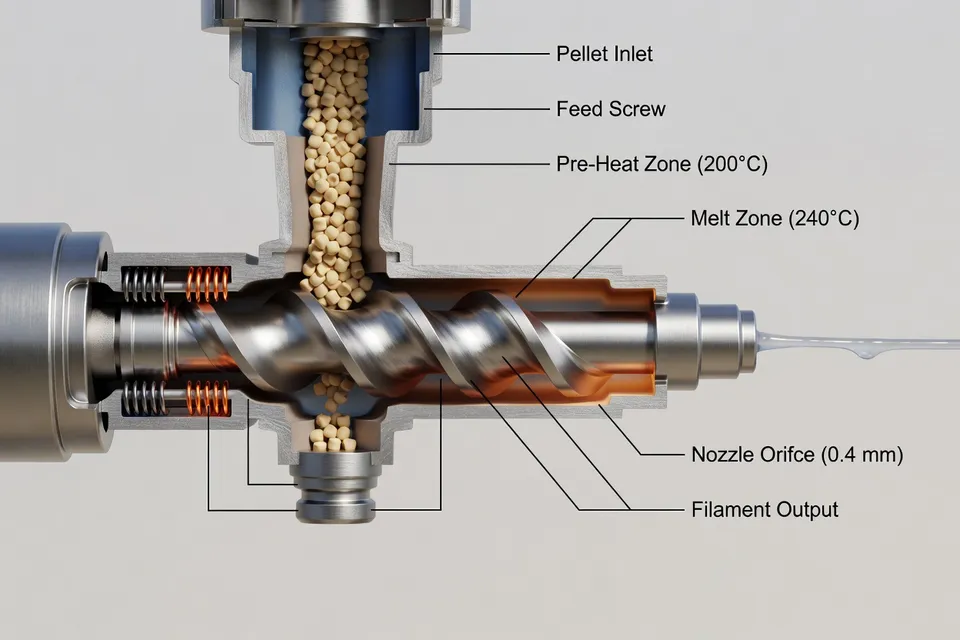
EWI identifies injection molding, conventional extrusion, high-viscosity or highly filled polymers, and pellet-fed additive manufacturing as potential applications. Fused granulate fabrication is a logical early target because pellet-fed systems often trade deposition rate against the ability to push a viscous melt through a nozzle while preserving bead definition.
The process question for large-format additive manufacturing is not just whether more material exits the nozzle. The deposited bead must retain positional accuracy, fuse with the previous layer, and avoid defects caused by unstable pressure or excessive thermal exposure. Ultrasonic assistance could be valuable if it improves passage through the nozzle without requiring a broad temperature increase. That remains a hypothesis until bead width, layer bonding, surface quality, and output rate are measured together.
Injection molding presents a similar qualification gate. Better penetration into small features may help with thin walls or fine surface detail, but cavity pressure, filling time, weld-line strength, shrinkage, and warpage must be compared against an untreated process. A pressure trace that improves filling but increases flash would not be a process win.
Highly filled compounds add another constraint. Fillers can increase viscosity and wear, and they may change how vibration couples into the melt. The published proof of concept does not establish performance with glass fiber, carbon fiber, mineral filler, or abrasive pigment systems. Those materials should be treated as separate trials, not assumed beneficiaries of the same mechanism.
The next gate is durability and a full baseline
The optimistic part of this development is specific: a tuned ultrasonic field delivered through the screw was associated with approximately 16% greater average penetration into small features without reformulating the polymer. That is enough to justify a controlled pilot, not enough to release a commercial process specification.
The next trial should hold grade, moisture, temperature profile, screw speed, back pressure, die or nozzle geometry, and output constant while comparing ultrasonic and non-ultrasonic runs. The test should record pressure, melt temperature, residence time, penetration or fill dimensions, output rate, and part properties. A longer campaign must then show whether the transducer-screw assembly maintains amplitude and alignment under load.
Until those measurements exist, the defensible claim is improved flow access in a proof-of-concept feature test. The unproven claim is faster, cooler, longer-running extrusion. EWI has supplied a mechanism and a measured directional result; the next qualification gate is a production-relevant baseline that shows whether the 16% penetration improvement survives real polymer, real pressure, and real run time.
Editorial Insights
- What must be measured before treating ultrasonic assistance as a production-rate improvement?
- Hold the polymer grade, moisture, temperature profile, screw speed, back pressure, and die or nozzle geometry constant, then compare output rate with and without ultrasonic energy. Record pressure, melt temperature, residence time, feature fill, and part acceptance together. A higher penetration result alone does not show that the line can run faster; unstable pressure or a longer thermal history can erase the apparent gain. The usual mistake is converting a controlled feature result into a throughput promise before the untreated baseline is measured on the same equipment.
- Which documents and measurements are needed to turn the penetration result into a usable process window?
- Ask for the feature geometry, baseline penetration dimension, melt temperature, screw speed, pressure profile, and acceptance criterion, then file those values with the run record. The percentage improvement has no fixed process meaning without its starting point: a restrictive passage and a generously filled feature will not respond the same way. Add acoustic amplitude and calibration data under load so the measured effect can be tied to a known machine condition. Without those records, the result is a demonstration, not a die-design rule.
- Can the same ultrasonic screw be approved for glass-filled or other abrasive compounds after testing an unfilled polymer?
- No. Run filled compounds as separate trials and inspect screw wear, amplitude stability, pressure behavior, and material properties. Fibers, minerals, and abrasive pigments can raise viscosity, change vibration coupling, and accelerate wear on the rotating assembly. Matching the unfilled polymer’s penetration result does not establish performance in a filled grade. The failure mode is straightforward: the process appears effective in the first material, then loses amplitude or damages the screw during a longer campaign.
- What should an additive-manufacturing trial verify besides higher flow through the nozzle?
- Measure bead width, positional accuracy, layer bonding, surface quality, pressure stability, and output rate in the same trial. The nozzle may pass more material while depositing an oversized bead or creating inconsistent fusion between layers. Keep the thermal profile fixed initially; otherwise a temperature change can be mistaken for an ultrasonic benefit. Pellet-fed printing is a plausible early application, but it still needs a dimensional and mechanical baseline before a production setting is released.
- What durability evidence is required before a tuned ultrasonic screw can support a production campaign?
- Require a sustained run that tracks transducer amplitude, acoustic calibration, screw alignment, torque, melt temperature, pressure, and feature or part quality from start to finish. The assembly must survive torque, thermal cycling, polymer pressure, and any abrasive load without drifting away from its tuned condition. A short proof-of-concept run cannot reveal fatigue, coupling loss, or wear that appears after repeated heating and loading. If amplitude falls while penetration remains intermittently acceptable, the process may produce hidden variation rather than a stable operating window.